 |
In Ojibwa culture, identity, or ‘who you are’, is the basis of living and communicating. From a historical or colonial perspective, one that labels Natives as ‘savage’ or ‘primitive’, is not how Natives identify themselves. Because the term ‘identity’ can be problematic, it is important to realize that representation is an integral aspect to identity. There have been many eurocentric views that have ignored true Native Canadian culture, in which Natives have not been allowed to represent themselves. Instead, Natives have been represented by ‘us’, or western academics who have believed that ‘other’ cultures need to be represented – need to be understood in ways of which speak to western culture. “The human being is in the middle of an environment, and he relates himself to it” (Dokis, lecture). From a lecture given by Professor Terri Dokis at Nipissing University, he explains that the Ojibwa are a visionary people, in which nature is worshipped. The worship of nature, and its signs, in most cases, convey a circular shape. For example there are: the four seasons, the cycles of human life (childhood, adult hood, elderliness), and animals (many of them resemble a circular shape). These ‘cycles’ can also be understood in the philosophy of the medicine wheel. The medicine wheel is that which balances the secret of medicine and healing – you need to maintain balance of the ‘life’ and what you produce from it. Therefore, the four major elements that are contained in this dichotomy of ‘balance’ are:
• Respect and understanding of the physical world,
• Emotions and feelings – important when you reproduce the physical world,
• There is a mental condition behind each production,
• The spiritual/metaphysical aspect of the world –
whenever the Ojibwa reproduce the physical world, they feel there is a life force, everything has a living energy touched by divinity or ‘animism’ – animism being the ‘secret to everything’, everything has a life force, and all things, creatures and people are connected (Dokis, lecture).
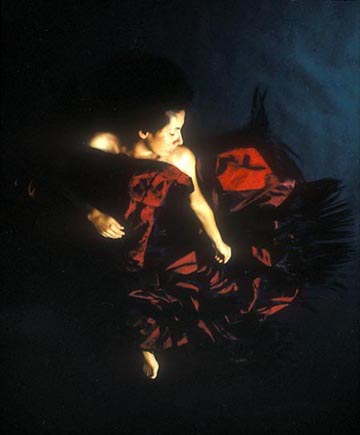
Identity is a concept of which Rebecca Belmore is entirely concerned with. In her works, she touches on these aspects of Ojibwa culture. The work she creates emits a kind of spirituality of which addresses issues of the land – a component of Native life that holds the essence of identity. With aspects of the land comes the theme of nature – she notes through her work the power that humans attempt to utilize and control nature. In the usual dichotomy of culture vs. nature, it is thought of culture as opposition to nature. The western perspective of culture rejects or separates nature, as it is thought that nature should be controlled. This is why the theme ‘getting back the land’ is so strong throughout Belmore’s work. Land or nature is integrally tied to Native culture, and when land is gone (or nature is threatened), so is Native identity. Ultimately, Belmore deconstructs the culture/nature dichotomy, and through her art she attempts to combine the notion that nature is culture in the eyes of Native Canadians. Even though Belmore’s work stresses the importance of nature, she does not forget about the female voice. She incorporates another questionable dichotomy – man vs. woman. In many of her works, she uses her own body to portray ‘identity’. Her feminist persona is definitely present when addressing the cold, uncomfortable silences that accompany the issue of violence against women – especially Native women. It is the quest for identity that fuels Rebecca Belmore’s work. With ‘identity’ come the factors of memory and territory – themes of which are integral to Native life, and therefore Belmore’s life. Throughout this presentation of Belmore the artist, it will
become evident that ‘identity’ is repeated again and again, similar to the cyclic philosophies of the Ojibwa culture.
MEDICINE WHEEL:
Legend of the Medicine Wheel
The Medicine Wheel is an important symbol in Native culture. The circle represents the cycle of life in that all life travels in a circular path. The four spokes and colored sections in the middle represent the four directions, the four colors of man and the four faces of man (physical, mental, emotional and spiritual). The Wheel at once represents one day, one year, and one lifetime. The journey begins anywhere -- but the traveler seeks the center and oneness. I think these stones can have meaning to anyone, no matter his or her path. The passage of time is the same for us all.
|
