
franw@yorku.ca
Professor, Department of Psychology
Faculty of Health, York University
4700 Keele St, Toronto Ont M3J 1P3
Phone: 416-736-2100 ext 33184
Office: Lassonde 1012D (formerly Computer Science & Engineering Bldg)
Laboratory: Lassonde 0006 (basement level) ext 70111
Courses:
As I am on sabbatical for the 2011-12 academic year I will not be teaching undergraduate or graduate courses
- Seminar in Health Psychology (HH/ PSYC 4190)
- other faculty will be offering sections of this course in the 2011-12 year; please see Psychology Department Website
- Introduction to Psychology (HH/PSYC 1010) by correspondence
- other faculty will be offering sections of this course in the 2011-12 year; please see Psychology Department Website
- Graduate Seminar in Vision Health and Visual Disability
- not offered 2011-12
Research Interests:

Migraine headache affects approximately 3 million Canadians. Many migraine sufferers are very light-sensitive, and experience visual auras at the onset of their migraine episodes. Migraine research in my laboratory addresses two fundamental issues:
1) Migraine Aura: what is the mechanism underlying migraine auras, what is their locus within the visual system, and what is it about the structural and functional organization of the visual system that makes it prone to this sort of hallucinatory activity. Auras have been attributed to cortical spreading depression within V1 - we are currently testing predictions of that hypothesis. Our studies involve having subjects make structured observations of their auras as they are in progress.
2) Visual hypersensitivity in Migraine: Are the visual systems of migraineurs abnormal in ways that are measurable using psychophysical techniques during the period between episodes? How can this hypersensitivity be characterized? Are particular aspects of vision affected more than others? We are currently examing a wide range of psychophysical measures of contrast and motion perception. We are also interested in the effects of light of different temporal frequencies and wavelengths in migraineurs.
Click here to see recent publications on this topic
Vision and Aging
With the current demographics in much of the western world, understanding age-related changes to our sensory and perceptual systems is increasingly important. We are currently investigating a number of the intermediate and high level visual functions described above in an older population of healthy adults. We are also interested in the applications of this research in terms of lighting and design of age-friendly environments
Face Perception
Of all the objects humans recognize by sight, faces are the most complex and yet in many ways the most important. Social interaction depends on recognition of conspecifics and on decoding the ongoing stream of information conveyed by facial expression that accompanies speech. Our research builds on our ongoing work on intermediate level form perception to address questions about how information about facial properties is combined configurally by the visual system, and how it is used for different purposes (individual recognition, detecting direction of gaze, gender identification etc).
Intermediate Level Form Vision
Over the past several years, studies in my laboratory have focused on understanding the intermediate levels of visual form analysis. We use psychophysical and computational approaches to ask how visual information, initially extracted from the image by the early filtering operations of the retina and V1 are combined to reveal basic information about object shape. Much of this work has been carried out using novel stimulus sets of radial frequency patterns and Glass patterns. We are currently pursuing related studies using fMRI imaging to observe the function of the ventral visual pathway in vivo in human subjects, and are also exploring a motion analogue of the static radial frequncy patterns as a tool for studying trajectory perception.
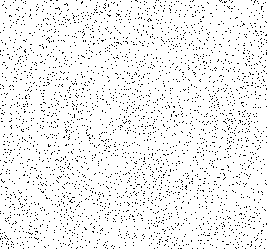
Radial Frequency Pattern Concentric Glass Pattern
Recent Publications:
Migraine:
Haigh, S. M., Karanovic, O., Wilkinson, F., & Wilkins, A. J. (2012) Aversion to patterns and cortical hyperexcitability in migraine. Cephalalgia, 32(3): 236-240 Published electronically January 10, 2012.
Wilkinson, F. (2011) Perceptual illusions provide clues to excitatory–inhibitory balance in migraine neocortex. Cephalalgia, 31(11): pp. 1155-1157 Published electronically July 4, 2011
Karanovic, O., Thabet, M. ,Wilson, H.R. & Wilkinson, F., (2011) Detection and discrimination of flicker contrast. Cephalalgia, 31(6): pp. 723-736.
Aurora, S. & Wilkinson, F. (2007) The brain is hyperexcitable in migraine. Headache Currents, Cephalalgia, 27, 1442-53.Wilkinson, F., Karanovic, O., Ross, E.C., Lillakas, L. & Steinbach, M.S.. (2006) Ocular motor function in migraine with and without aura. Cephalalgia, 26, 660-671.
Wilkinson, F. (2004) Migraine auras and other hallucinations: windows on the visual system. In Roots of Visual Awareness, D.Milner & C. Haywood (Eds), Progress in Brain Research 144: 305-320
Wilkinson, F. (2001) Migraine, eating disorders and triptans: an unrecognized risk? Headache (letter to the editor). Headache, 41, 914-915.
Crotogino, J., Wilkinson, F. & Feindel, A. (2001) Perceived flicker frequency of scintillating migraine auras. Headache, 41, 40-49.
McColl, S.L. & Wilkinson, F. (2000) Visual contrast gain controls in migraine: Measures of visual cortical excitability and inhibition. Cephalalgia., 20, 74-84.
Wilkinson, F., Crotogino, J. (2000) Orientation discrimination thresholds in migraine: a measure of visual cortical inhibition. Cephalalgia,, 20, 57-66.
Aging:
Wilson, H. R., Mei, M., Habak, C. & Wilkinson, F. (2011) Visual Bandwidths for face orientation increase during healthy aging. Vision Research, 51(1): 160-164. doi: 10.1016/j.visres.2010.10.026
Habak, C., Wilkinson, F., & Wilson, H. R. (2009). Preservation of shape discrimination in aging. Journal of Vision, 9(12):18, 1–8, http://journalofvision.org/9/12/18/, doi:10.1167/9.12.18
Habak, C., Wilkinson, F. & Wilson, H.R, (2008) Aging disrupts the neural transformations that link variations in face view, Vision Research 48:9-15 (Epub 2007 Dec 4).
Face Perception
Wilson, H. R., Mei, M., Habak, C. & Wilkinson, F. (2011) Visual Bandwidths for face orientation increase during healthy aging. Vision Research, 51(1): 160-164.
doi: 10.1016/j.visres.2010.10.026
Loffler, G., Yourganov, G., Wilkinson, F, & Wilson, H,R, (2005) fMRI evidence for the neural representation of faces. Nature Neuroscience, 8, 1386-1391.
Loffler, G., Gordon, G.E., Wilkinson, F., Goren, D. & Wilson, H.R. (2005) Configural masking of faces: evidence for high-level interactions in face perception. Vision Research, 45, 2287-2297.
Wilson, H. R., Loffler, G. & Wilkinson, F. (2002) Synthetic faces, face cubes, and the geometry of face space. Vision Research, 42, 2909-2923.
Form Vision
Or, C., Thabet, M., Wilkinson, F., Wilson, H.R. (2011) Discrimination and identification of radial frequency motion trajectories. Journal of Vision 11(8): 7; doi:10.1167/11.8.7
Bell, J., Wilson, H.R., Wilkinson, F., Loffler, G. &Badcock, D.R. (2009) Radial Frequency adaptation reveals interacting contour shape channels. Vision Research, 49: 2306–2317.
Bell J, Badcock DR, Wilson H, Wilkinson F. (2007) Detection of shape in radial frequency contours: independence of local and global form information. Vision Research, 47(11), 1518-22.
Anderson, N.D., Habak, C., Wilkinson, F., & Wilson, H.R. (2007) Evaluating shape aftereffects with radial frequency patterns. Vision Research, 47(3), 298-308.
Habak, C., Wilkinson, F. & Wilson, H.R,. (2006) Dynamics of shape interaction in human vision. Vision Research. 46(26), 4305-20
Wilson, H. R. & Wilkinson, F. (2004) Spatial channels in vision & spatial pooling. In The Visual Neurosciences, L. M. Chalupa & J. S. Werner (Eds), MIT Press: Cambridge, MA.
Habak, C., Wilkinson, F., Zakher, B. & Wilson, H. R. (2004) Curvature population coding for complex shapes in human vision. Vision Res. 44, 2815-2823.
Steeves, J.K.E., Wilkinson, F., González, E.G., Wilson, H.R., & Steinbach, M.J. (2004) Global shape discrimination at reduced contrasts in enucleated observers. Vision Research, 44, 943-949.Lewis, T.L., Ellemberg, D., Maurer, D., Dirks, M., Wilkinson, F. & Wilson, H.R. (2004) A Window on the Normal Development of Sensitivity to Global Form in Glass Patterns. Perception, 33, 409-418.
Wilson, H. R. & Wilkinson, F. (2003) Further evidence for global orientation processing in circular Glass patterns. Vision Res. 43, 563-564.
Loffler, G., Wilson, H.R. & Wilkinson, F.(2003) Local and global contributions to shape discrimination. Vision Research, 43, 519-530
Lewis, T.L., Ellemberg, D., Maurer, D., Wilkinson, F., Wilson, H.R., Dirks, M. & Brent, H.P.(2002) Sensitivity to Global Form in Glass Patterns after Early Visual Deprivation in Humans. Accepted for publication in Vision Research, 42, 939-948 .
Wilson, H. R., Loffler, G., Wilkinson, F. and Thistlethwaite, W. A. (2001) An inverse oblique effect in human vision Vision Research, , 41, 1749-1753
Wilkinson, F. , James, T.W., Wilson, H.R., Gati, J.S., Menon, R.S. & Goodale, M.S. (2000) An fMRI study of the selective activation of human extrastriate form vision areas by radial and concentric gratings. Current Biology, 10, 455-58.
Wilson, H.R., Krupa, B. & Wilkinson, F.(2000) Dynamics of inhibition-induced oscillations in form vision. Nature Neuroscience, 3, 170-176.
Wilkinson, F., Wilson, H.R. & Habak, C. (1998) Detection and recognition of radial frequency patterns. Vision Research , 38, 3555-3568.
Wilson, H.R., Wilkinson, F. & Assad, W. (1997) Concentric orientation sumation in human form vision. Vision Research, 37, 2325-2330.
last updated March 2012
Click here to return to my home page