 Introduction to Archaeology
and Palaeoanthropology:
Introduction to Archaeology
and Palaeoanthropology:
Introduction to Archaeology
and Palaeoanthropology:
Humanity's Journeys
Dr. Kathryn Denning
Anth 2140, Sept 2006 - Apr 2007
20 Feb 2007... Welcome!
Plan for class
1) Announcements
a) Looking forward to your museum assignments, due in tutorial tomorrow.
Any questions about these?
b) READINGS: The week before Reading Week, you had some online reading assigned about precontact Ontario. We'll come back to this material. Also: pdfs now posted for the reading from "The Beaver". Next week's readings, about Egypt, are online. Readings page.
2) Farming and civilizations: the big picture
Farming and Civilizations.
n.b. We are trusting that you have done your readings. In lecture and tutorial this week, we are focusing on making sure you understand the background behind the emergence of civilizations.
The details of how each ancient civilization worked can be wonderful and amazing to learn about. But we also want you to understand the big picture -- why civilizations emerged where they did and when they did, and why some people developed civilizations and others did not. This helps to explain the course of history, and why the world is the way it is today.
At the base of it all is food -- specifically, the shift to food production.
- farming developed in multiple locations more or less independently, starting around 10 000 bp
- development of farming/food production/domestication... has interesting and significant corollaries:
p 287 of Rice book:
- farming yielded more food from smaller areas
- produced surplus food for later consumption or to fulfill trade/social obligations
- underpinned settlement in a range of environments
- more substantial housing and technology
- population increase
- full-time craft specialists emerged
- social stratification, increasing social complexity etc. emerged ... ultimately civilization
ALSO:
- sedentism
- storage/accumulation of wealth
- intensification.... ecological impact
- increased territoriality
- increased interdependence for long-range resources
- often, actually, a decrease in health for most
BUT WHY DID THIS SHIFT TO INTENSIVE FOOD PRODUCTION HAPPEN IN SOME PLACES BUT NOT OTHERS?
WE TURN TO JARED DIAMOND, 'GUNS GERMS AND STEEL' TO FIND OUT. (We will return to Diamond again later in the course. This video discusses the first part of his theory. You'll be reading a short article of his soon.)
Key points:
- Yali's question -- why do white men have so much cargo, and New Guineans so little? (cargo = material objects)
- scenes from First Contact in New Guinea in 1930s (film)... white men's 'cargo' was, initially, almost magical to the New Guineans
- New Guineans are very smart and resourceful... so why didn't they develop civilization?
- to find out... we have to go back to the time when no-one was living in civilizations... and to find out why then some changed, i.e. started building pyramids, when others continued to live as they always had.
- 13 000 years ago, Middle East wasn't arid.
- hunting requires intelligence and skill but is a great lifestyle (as seen in PNG) but has certain limitations... not reliable
- foraging/gathering tends to supply more calories/ is more reliable and productive, but it is also a lot of work (e.g. sago) and cannot usually support a large population
- in the Middle East... barley and wheat grew wild... more abundant and more nutritious than sago.
- climate change 12 500bp - temps dropped, became drier... Middle East... environmental collapse.... 1000-year drought.... had to change the way they lived... e.g. site of Dhra - 40/50 people, settled 11 500 ybp... earliest known storage of wheat and barley... thus actually selecting some plants over others... thus beginning the process of domestication
- China (rice), Americas (corn, squash, beans), Africa (sorghum, millet, yams)
- but this process couldn't have worked just anywhere... in some places like New Guinea, even where farming has been going on for 10 000 years, you couldn't store the food, and it wouldn't just grow from seeds, and it was lower in protein (e.g. taro)
- so... farming was crucial to the foundations of inequality, but it also mattered what kind of farming it was. The people around the world who had access to the most productive crops became the most productive farmers - geographic luck.
The consequences were huge.
(more in tutorial tomorrow!)
THE TRAJECTORY OF FARMING... CARRIED THROUGH TO TODAY
If that was the Neolithic... we are now in the "Neocaloric" (Ernest Schusky)
“For several million years, humans have followed the simple, logical principle of never expending more calories on food production than they received in return. The principle if most obvious in food collecting, but it is just as necessary in food production. It appears that as a general rule, food production gave greater returns than food collecting, but if the only needs were food and shelter, then the increased returns from agriculture were unnecessary. That is, greater returns did not necessarily make life any better nor even insure more reliability in the food supply." Schusky, Culture and Agriculture, 1989:103
So why did agriculture start, way back when??
It wasn't necessarily only about survival. Recent research has suggested that it was due to different factors in different places... but in some, it was due to competitive feasting and status.... not the need for more food for survival.
The characteristics of agriculture now...
A vast increase in the nonhuman energy (fertilizers, pesticides, herbicides, machinery and fuel) devoted to food production (crops and livestock). Concomitant increase in production per human labour hour... because machines are doing the work... but that energy isn't free, it just comes from somewhere else.
So as we look back at the origins of agriculture and the earliest civilizations, we need to bear in mind that the labour was human and animal, and that this is a major difference between the civilizations of yesteryear, and ours here today.
MORE 'BIG PICTURE' POINTS:
n.b. Most foods we use today were domesticated in antiquity! (Not everything is domesticable.)
n.b. It increasingly appears as though agriculture was a 'last resort'. We see it as 'progress', but it may in fact have been a collapse of a preferable lifeway.
Wright 2004: 45-6 "In the magnitude of its consequences, no other invention rivals farming (except, since 1940, the invention of weapons that can kill us all). The human career divides in two: everything before the Neolithic Revolution and everything after it.... The Farming Revolution produced an entirely new mode of subsistence, which remains the basis of the world economy to this day. The food technology of the Late Stone Age [Neolithic] is the one technology we can't live without. The crops of about a dozen ancient people feed the 6 billion on earth today. Despite more than two centuries of scientific crop-breeding, the so-called green revolution of the 1960s, and the genetic engineering of the 1990s, not one new staple has been added to our repertoire of crops since prehistoric times."
What are the big issues? What are the characteristics that tie all civilizations together? How are their trajectories similar? What can we learn from studying past civilizations?
An interesting argument made recently by Ronald Wright.
(Ronald Wright, A Short History of Progress, the 2004 Massey Lectures, http://www.cbc.ca/ideas/massey.html, also in book form.
Wright's lectures are structured around the age-old questions: Where do we come from? What are we? and Where are we going?
His second lecture, "The Great Experiment", starts with the sabre-toothed cat.



More on sabre-tooths: http://www.ucmp.berkeley.edu/mammal/carnivora/sabretooth.html http://www.bbc.co.uk/beasts/evidence/prog5/page2.shtml
The sabre-tooth cats, (e.g. Smilodon, but other species too... though not tigers) were once widespread throughout the Americas and Europe in the Pleistocene. They became extinct about 10 000 years ago. Smilodon was a highly specialized predator... and when its prey became extinct (due to climate change or perhaps human over-hunting), it did too. It was so specialized that it could not change strategies. Its teeth would be very effective for killing large animals and hunting in packs, but the Smilodon would have been bad at hunting smaller animals. It was itself large and probably not very fast, and broken teeth could mean death.
Wright argues that this is an example of a "progress trap" -- an adaptation that works very well for a while, but then becomes fatal to a species.
Human beings have become experimental creatures of our own making, through our cultural adaptations. As cultures become more elaborate, they can become more specialized.
Wright contends that farming is a "progress trap" -- of a different sort from nuclear weapons (a significant 'advance', since they could kill us all).
It's farming that has made our growth and increasing specialization possible.
Since the early 1900s, Earth's population has multiplied by a factor of 4. Our economy (use of Earth's resources/footprint) has multiplied by a factor of 40. It is time, Wright contends, to bring this experiment under rational control... for the first time. (Ecological footprint: http://www.earthday.net/goals/footprint.stm )
As Wright puts it, civilization doesn't run deep, but it runs wide. It's fairly new historically (consider that for a hundred thousand years, H. sapiens lived as hunter-gatherers in small groups). But it has been so successful as an adaptation that the population increase has been huge. More people have lived a civilized life than any other kind of life.
Civilized = large, complex, based on the domestication of plants, animals, and humans.
[Civilized does not mean morally superior; consider the many historical atrocities wrought by civilizations. Civilization may not always be very nice, but we are stuck with it now, and should do our best to ensure that this experiment works.]
Since culture has essentially forestalled natural selection, we are, Wright contends, running 21st century software on hardware that was last upgraded 50 000 years ago.
Landmarks in human "progress", according to Wright.
Fire - Homo erectus.
The perfection of hunting
- by H. sapiens sapiens, e.g. CroMagnon. After the Neanderthals were displaced/replaced, there was an incredible florescence of art, more specialized hunting weaponry, etc. This couldn't be the result of new brains, since some of those things had been present before, but on a smaller scale. It is more likely to be the result of leisure time.... because there was very abundant food, due to the refinement of hunting methods.
Ice Age extinctions: Upper Palaeo sites in Europe have included butchering sites with 1000 mammoths, or 100 000 horses. This suggests that some ancient hunter-gatherers were not the same as those today. Today, H-G peoples are wise stewards of their ecosystems, but in the past, we have evidence over and over again of probable over-hunting and undoubted extinction at the end of the Palaeolithic. (Megafauna in North America and Australia, too....) n.b. climate contributed too.
e.g. Moas hunted to extinction in New Zealand shortly after human arrival http://www.duke.edu/~mrd6/moa/

More on megafauna extinctions: http://darwin.bio.uci.edu/%7Esustain/bio65/lec03/b65lec03.htm
After the "all you can kill wildlife barbecue" and the extinctions, there came the end of the way of hunting. In Europe, the great cave art stops. The flint blades got smaller. There are other signs of stress and change. Etc.
As Wright puts it, these people had violated Rule 1 for any prudent parasite: Don't kill off your host. The perfection of hunting had been a "progress trap".
People were forced, in the Mesolithic, to broaden their food base. (I call it foraging in the back of the fridge.)
Then came the Neolithic Revolution/ Invention of Farming.
Wright contends that this was as important to human history as the invention of nuclear weapons.
- the food technology of antiquity sustains us today
- the crops of a dozen ancient peoples feed us all now
- not one new staple has been added since prehistory
but n.b. most people throughout most of time have lived on the edge of hunger, as many still do today. Wright says: We are stuck in another "progress trap".
The First Civilizations! Survey
So, food production is key. It may have emerged for different reasons ( a need for surplus/luxury, e.g. competitive feasting, or a need for food security/survival when the climate changed or population increased) ... but the general result is an increase in social complexity and an increase in landscape modification. It also permitted some people to specialize in art, governance, or creating new technology etc. In the past, labour was human and animal (not machine and chemical), and labour requirements were therefore vast.
Civilizations
- arose independently in multiple parts of the world (an astonishing fact in itself!) - Nile Valley, Mesopotamia, Indus Valley, North China, Mesoamerica, Andean region. (Perhaps more complex societies yet to be discovered, but a full-blown civilization would be a big surprise.)
- civiliations are state-organized societies (archaeological ones are pre-industrial, i.e. before machines operated by fossil fuels)

Note! don't let the label 'civilization' fool you. It does describe a real phenomenon, but it's a bit fuzzy around the edges.
Think of a spectrum: where exactly does the red become orange? Where exactly does the blue become green?
We are dividing up the real world into arbitrary categories, and the exact definitions we choose are a reflection of our own preferences and ways of seeing... i.e., what matters most to us.... so we judge other societies according to how much like us they are! This is important to remember in this case because we think of 'civilized' as being a good thing... so if someone isn't 'civilized', that's a negative judgement.
That said... this is the usual characterization of civs:
THE TRAITS OF CIVILIZATIONS: (Rice book p 314-5, with additional notes):
- areas of high population density, often in a hierarchy (hamlets, villages, cities).... cities (pop of 5 000 or more; dense; centralized with division of labour, depend on hinterland for food, monumental architecture, centralized government)... you can have a state without a city, but not really a city without a state
- division of labour and specialization (freedom to work on one area and not worry about growing your own food makes it possible for people to develop a more elaborate material world - technology, art, books, architecture, irrigation, fortification. All this stuff takes time to develop... e.g. do you know how to make a metal knife from scratch?
N.B. Societies without intense specialization still do have elaborate culture -- but it tends to be more ephemeral, e.g. performances, songs, dances, knowledge kept in the mind.)
- the state extracts taxes in the form of goods and labour. (So they need a way to keep records -- hence the emergence of writing -- and they need a way to store the excess. We see both archaeologically.)
- monumental architectural projects such as temples, palaces, or irrigation systems reinforce and symbolize the organization and controlling power of the state. Such labour-intensive construction requires the harnessing of large populations. (again, remember, people and animals had to do all the work that we do with machines today)
- state societies are socially and economically stratified. A powerful ruling elite derives power from centralized control of surpluses. (Arch evidence: some richer houses, monuments with inscriptions describing the rulers, written records, and also graves -- some are richer than others, and some people clearly have the power of life and death over others -- human sacrifice is a very common feature of rulers' graves... sometimes hundreds of people)
- record keeping (forms of writing like cuneiform or hieroglyphs or ancient Chinese, or the quipu/khipu... we haven't successfully deciphered all ancient record-keeping systems.... and writing had multiple purposes... it wasn't all about accounting... religion and spiritual purposes too. And this is amazing for us because it opens up a different window of understanding ancient peoples... when we can actually read what they wrote, we gain a different kind of understanding of what they were thinking about... not just what they were doing. We have ancient written prayers, letters to loved ones, etc... And they were thinking about lots of the same things we do... love, power, fate, and warm socks.) Link - my explanations about writing systems. Great website: http://www.omniglot.com/index.htm See textbook p 332-3, too.
- state development promotes advances in sciences such as mathematics and astronomy. Scientific principles are evident in the engineering and construction of monumental structures as well as in detailed accounting and record systems. (Again, n.b.: In societies that are not 'civilizations', people also have a tremendous amount of knowledge about their environment and how to make it work to their advantage. But it works a bit differently, and leaves different sorts of signatures on the land.)
- long-distance trade expands
- people unite under a state ideology with its pantheon of gods, often including the state ruler (i.e. s/he is deified) (special buildings and objects, and there is usually a class of religious specialists, e.g. priests/esses.)
- a state army controls populations and undertakes military campaigns - a pattern clearly evident in most early states (wars were fought over territory and over resources... food surpluses, mines, access to water, luxury goods, control of trade routes)
THINKING POINTS FOR YOU TO CONSIDER:
- Civilizations have achieved remarkable things. But they have costs and benefits. Who gets most of the benefits? Who bears most of the costs?
- Which ancient civilizations did you hear the most about in your education before university? Why do you think those ones were emphasized? If there were civs you had never heard about (e.g. Aksum in Ethiopia, Jenne-jeno in Mali, the cities of the Indus (e.g. Mohenjo-daro, Harappa) ... why do you think that is?
- If a society was complex but left no writing, we can only know about it through its descendants, through the material remains/archaeological sites, and through the writings of its literate neighbours. How would this bias our knowledge of that society? (e.g. Celts, pg 342-3).
NOTE! If you want to know more about the ancient societies of Africa in particular, I recommend this video series, available at the Scott Library: Wonders of the African World. www.pbs.org/wonders/ York vid # VIDEO 5684, VIDEO 5685, VIDEO 5686
Tomorrow in tutorial: More about food!
Next week in lecture and tutorial: Egypt. Do the online readings...
For your interest...(not covered in lecture)... a little more on Mesopotamia below....
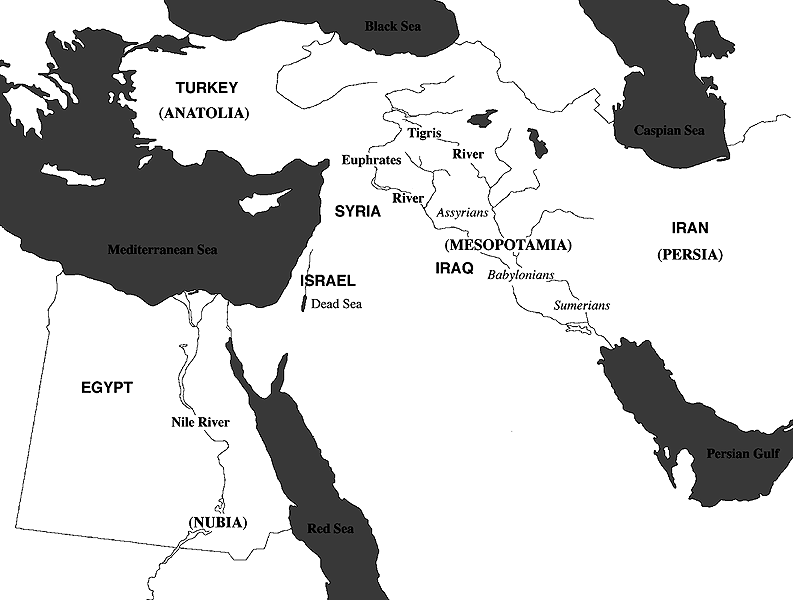
Earliest civilizations of Mesopotamia
Where?

When?
Early farming villages, irrigation: 6500-4200 BCE
Uruk: 4200 - 3100 BCE
Early Dynastic (Sumerians, early Ur): 2900-2350 BCE
Akkadian Empire: 2334-2230 BCE
Imperial Ur: 2500-2004 BCE
Assyria Resurgent: 911-700 BCE
Urartu: 830-600 BCE
Assyrian Apogee: 680-612 BCE
Neo-Babylonian Empire: 612-539 BCE
Rise of Persians: 614-490 BCE.
Of course history continued: Timeline of Iraq http://news.bbc.co.uk/2/hi/middle_east/737483.stm
Prelude: First big villages in Near East -- Jericho, Abu Hureyra, Catalhoyuk.
(Jericho plastered skull and here; Catalhoyuk, http://www.catalhoyuk.com/, http://www.smm.org/catal/artifacts/ )
First cities emerged in Mesopotamia 3500-2000
BC (i.e. 5500-4000 BP)
Ur

n.b. the water has moved!
Ziggurat of Ur - excavated and restored

Familiar things
- Letters sealed in envelopes: http://carlos.emory.edu/COLLECTION/NEAREAST/neareast07.html
- Flood narrative
- city, taxation
- Royal tomb of Ur, cylinder seals, etc... www-oi.uchicago.edu/OI/UR/Maps.html
- various art objects: http://jade.ccccd.edu/Andrade/WorldLitI2332/Meso/goatinthicket.gif
Tricky archaeological questions:
- population estimation
- how many people lived in this city?

Problem of estimating population: requires a lot of assumptions.
http://irows.ucr.edu/research/citemp/estcit/estcit.htm
Citadel of Sargon II, Khorsabad. c.742-706 BC

http://www.brynmawr.edu/Acads/Cities/wld/00130/00130a.jpg
Decipherment of Cuneiform
Development of writing: www.mesopotamia.co.uk/writing/story/sto_set.html
Gives us some access to the writing and thoughts of these people:
http://www.sumerian.org/proverbs.htm
The Epic of Gilgamesh (below)
Hammurabi
http://jade.ccccd.edu/Andrade/WorldLitI2332/Meso/hammarabi2.gif
Assyrians:
Known for:
Unbelievable sculptures, incredibly famous and highly valued.
http://jade.ccccd.edu/Andrade/WorldLitI2332/Meso/wingedguardian.gif
Empire! Warfare
Nimrud, Nineveh
Babylon
e.g. Ishtar Gate, Nebuchadnezzar
Past in the Present
The Epic of Gilgamesh, from the people who built Ur, closes:
“Since the days of yore there has been no permanence;
The resting and the dead, how alike they are”
Touring Exhibitions:
Treasures from the Royal Tomb of Ur have been on the road.
http://mcclungmuseum.utk.edu/specex/ur/ur.htm
New discoveries about Ur... in Britain
Finding new things all the time, even from well-established finds that have been sitting in museums for the better part of a century. For example, the artifacts from the Death-Pit at Ur have been in the BM since the 1920s.... but only recently, Xrays of a "group of crushed skulls" (embedded in wax by Woolley for travel) showed two previously undiscovered head-dresses.
www.thebritishmuseum.ac.uk/science/whatsnew/ur.htm
Meanwhile, back in Iraq...
The situation for archaeological sites and artifact/antiquities in Iraq today is very bad.
- destruction during war - accidental and also deliberate damage, e.g. ziggurat of Ur
- widespread looting of sites
- dramatic looting of the Baghdad Museum (National Museum of Iraq) http://news.bbc.co.uk/2/hi/in_depth/photo_gallery/2947511.stm, http://edition.cnn.com/2003/WORLD/meast/04/15/sprj.irq.museum.looting/
in April 2003.
Many of the most famous artifacts from Mesopotamia -- e.g. Ur harp, Lady of Warka, Warka Vase, all seen in the video -- were missing and only recently recovered.
e.g. Lady of Warka
Missing since the Baghdad museum was looted. Recovered Sept 2003.
Interpol listing: http://www.interpol.int/public/WorkOfArt/Items/Data/1022/1022368.asp
Narrative: https://listhost.uchicago.edu/pipermail/iraqcrisis/2003-September/000376.html
News story: http://www.sfgate.com/cgi-bin/article.cgi?file=/c/a/2003/09/24/MN14606.DTL
US Lady of Warka listing: http://exchanges.state.gov/culprop/iraq/00000027.htm , US general Iraq listing: http://exchanges.state.gov/culprop/imimage.html
Lament of Ur
("the goddess of Ur, Ningal, tells how she suffered under her sense of coming
doom.")
When I was grieving for that day of storm, that day of storm, destined for me,
laid upon me, heavy with tears, that day of storm, destined for me, laid upon me
heavy with tears, on me, the queen.
Though I was trembling for that day of storm, that day of storm destined for me
--
I could not flee before that day's fatality.
And of a sudden I espied no happy days within my reign, no happy days within my
reign.
Though I would tremble for that night, that night of cruel weeping destined for
me, I could not flee before that night's fatality. Dread of the storm's
floodlike destruction weighed on me, and of a sudden on my couch at night, upon
my couch at night no dreams weregranted me. And of a sudden on my couch
oblivion, upon my couch oblivion was not granted.
Because (this) bitter anguish had been destined for my land -- as the cow to the
(mired) calf -- even had I come to help it on the ground, I could not have
pulled my people back out of the mire.
Because (this) bitter dolor had been destined for my city, even if I, birdlike,
had stretched my wings,
and, (like a bird), flown to my city, yet my city would have been destroyed on
its foundation, yet Ur would have perished where it lay.
Because that day of storm had raised its hand, and even had I screamed out loud
and cried; "Turn back, O day of storm, (turn) to (thy) desert," the breast of
that storm would not have been lifted from me.
Then verily, to the assembly, where the crowd had not yet risen, while the
Anunnaki, binding themselves (to uphold the decision), were still seated, I
dragged my feet and I stretched out my arms, truly I shed my tears in front of
An. Truly I myself mourned in front of Enlil:
"May my city not be destroyed!" I said indeed to them. "May Ur not be
destroyed!" I said indeed to them.
"And may its people not be killed!" I said indeed to them. But An never bent
towards those words,
and Enlil never with an, "It is pleasing, so be it!" did soothe my heart.
(Behold,) they gave instruction that the city be destroyed, (behold,) they gave
instruction that Ur be destroyed, and as its destiny decreed that its
inhabitants be killed.
Enlil called the storm. The people mourn. Winds of abundance he took from the
land. The people mourn. Bood winds he took away from Sumer. the people mourn.
Deputed evil winds. The people mourn. Entrusted them to Kingaluda, tender of
storms.
He called the storm that annihilates the land. The people mourn. He called
disastrous winds. The people mourn. Enlil -- choosing Gibil as his helper
--called the (great) hurricane of heaven. The people mourn. The (blinding)
hurricane howling across the skies -- the people mourn --
the tempest unsubduable like breaks through levees, beats down upon, devours the
city's ships,
(all these) he gathered at the base of heaven. The people mourn.
(Great) fires he lit that heralded the storm. The people mourn. And lit on
either flank of furious winds the searing heat of the desert. Like flaming heat
of noon this fire scorched.
The storm ordered by Enlil in hate, the storm which wears away the country,
covered Ur like a cloth, veiled it like a linen sheet.
On that day did the storm leave the city; that city was a ruin. O father Nanna,
that town was left a ruin. The people mourn. On that day did the storm leave the
country. The people mourn.
Its people('s corpses), not potsherds, littered the approaches. The walls were
gaping;
the high gates, the roads, were piled with dead. In the wide streets, where
feasting crowds (once) gathered, jumbled they lay. In all the streets and
roadways bodies lay. In open fields that used to fill with dancers, the people
lay in heaps.
The country's blood now filled its holes, like metal in a mold; bodies dissolved
-- like butter left in the sun.
(Nannar, god of the Moon and spouse of Ningal, appeals to his father, Enlil)
O my father who engendered me! What has my city done to you? Why have you turned
away from it?
O Enlil! What has my city done to you? Why have you turned away from it?
The ship of first fruits no longer brings first fruits to the engendering
father, no longer goes in to Enlil in Nippur with your bread and food portions!
......................................................
O my father who engendered me! Fold again into your arms my city from its
loneliness!
O Enlil! Fold again my Ur into your arms from its loneliness! Fold again my
(temple) Ekishnugal into your arms from its loneliness! Let renown emerge for
you in Ur! Let the people expand for you:
let the ways of Sumer, which have been destroyed, be restored for you!
Enlil answered his son Suen (saying):
"The heart of the wasted city is weeping, reeds (for flutes) of lament grow
therein, its heart is weeping, reeds (for flutes) of lament grow therein, its
people spend the day in weeping. O noble Nanna, be thou (concerned) about
yourself, what truck have you with tears?
There is no revoking a verdict, a decree of the assembly, a command of An and
Enlil is not known ever to have been changed. Ur was verily granted a kingship
-- a lasting term it was not granted.
From days of yore when the country was first settled, to where it has now
proceeded,
Who ever saw a term of office completed? Its kingship, its term of office, has
been uprooted. It must worry. (You) my Nanna, do you not worry! Leave your
city!"
Thorkild Jacobsen, The Treasures of Darkness: A History of Mesopotamian -
(borrowed from www.ur.com.jo/lemant.htm)
Amazing Ancient Texts (not required)
The Epic of Gilgamesh www.wsu.edu/~dee/MESO/GILG.HTM
The Code of Hammurabi www.wsu.edu/~dee/MESO/CODE.HTM
Notes on Cuneiform www.wsu.edu/~dee/GLOSSARY/CUNEI.HTM


