
Post
Published on November 14, 2025

On October 1, 2025, Kaitlin Di Pierdomenico, a postdoctoral visitor in the Department of Psychology at York University presented her doctoral research on mental health reform. Her research centers around Canada, Australia and the UK and examining how and why Canada’s mental health reform has consistently lagged behind those of similar countries.
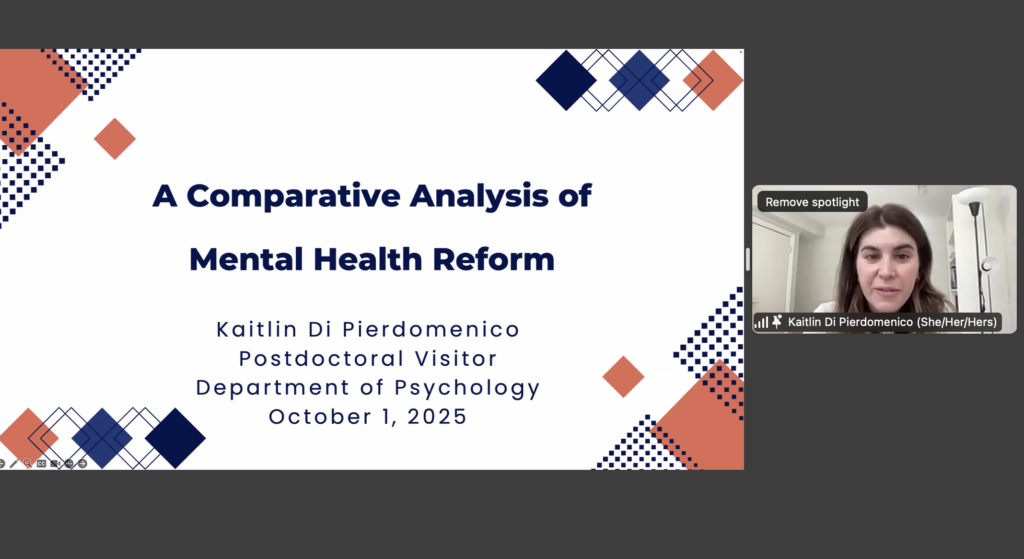
Di Pierdomenico first introduced the theoretical frameworks involved in her research. These included historical institutionalism, Esping-Anderson’s welfare state typology, mad studies and postpsychiatry. Di Pierdomenico used these frameworks to base analysis in both human rights and community voices.
When conducting her research Di Pierdomenico’s methodologies included a comparative-historical approach to examine how political and economic trends affect reform as well as a core method of archival policy research and document analysis from 1980 to present day. Di Pierdomenico also highlighted the scope of each country, with Ontario, Victoria and Britain being the source of her investigation respectively. Utilizing these methodologies Di Pierdomenico specifically examined underfunding, access gaps and calls for person-centered care in each of these locations.
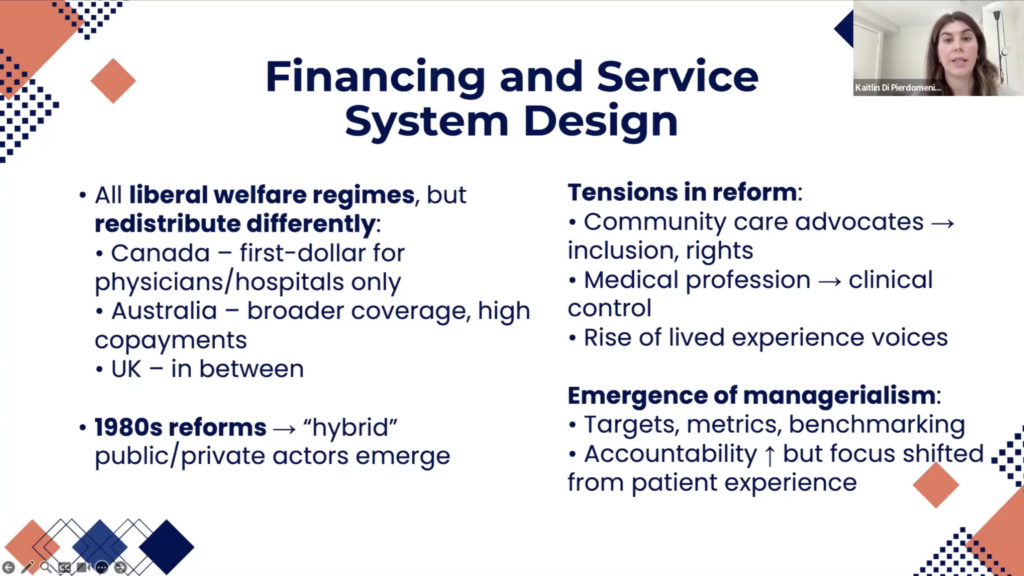
Di Pierdomenico then discussed the institutional levers, governance and government structures, financing and service system design and professional regulation and payment. Next, Di Pierdomenico drew our attention to comparisons and lessons that could be drawn from her research. Some commonalities among all three countries were a prioritization of physical health over mental health funding and neoliberal logic that prioritizes efficiency and cost control. Specific to Canada she discussed the ad-hoc consultation of lived experience, late adoption of managerial tools and the autonomy provided to the provinces on mental health funding.
To conclude, Di Pierdomenico highlighted the UK and Australia’s quicker and larger-scale reform along with their strong legal and financial frameworks in contrast to Canada’s often slow and reactive system with a history of underfunding mental health services. As a whole, Di Pierdomenico found that investment was behind the need for mental health services and there remains a strong need and desire for human-rights based care.
Connect with Kaitlin Di Pierdomenico
Watch the full seminar: https://www.youtube.com/watch?v=Z2SDPtmRHzQ
Themes | Global Health Foresighting |
Status | Active |
Related Work |
N/A
|
Updates |
N/A
|
People |
N/A
|
You may also be interested in...
Recap — Pandemic Urbanism: Looking at Past Infectious Diseases and Preparing for a Post-Pandemic World
On March 8, over 35 participants attended the launch of Pandemic Urbanism: Infectious Diseases on a Planet of Cities (Polity Press, 2022), co-authored by S.Harris Ali, Creighton Connolly and Roger Keil. Prof. Syed Harris Ali ...Read more about this Post
Inclusive Design Premises, Policies, Protocols, and Practices: From Usability to Empowerment
A new scholarly book co-authored by Shital Desai (York University) with Deborah Fels (Toronto Metropolitan University), Margot Whitfield (University of Toronto), Peter Pennefather (University of Toronto), and Evan Hibbard(California State University) has been released by Springer. ‘Inclusive ...Read more about this Post
Recap — It is Time to Rescue the Decolonization of Global Health Movement: The Pressing Need for a Shift in Paradigm, with Luchuo Engelbert Bain
On January 8, Dahdaleh research fellow Luchuo Engelbert Bain emphasized the urgent need for a paradigm shift to save the decolonization of the global health movement from stagnation and superficiality. Bain underscored that decolonizing global ...Read more about this Post