Roig-Maimó, M. F., Mas-Sansó, R., & MacKenzie, I. S. (2026). Design of 2D Fitts' law experiments: An odd thing about targets. Applied Ergonomics, 131, 104680. doi:10.1016/j.apergo.2025.104680. [Open Access] [PDF]
Design of 2D Fitts' Law Experiments: An Odd Thing About Targets
M. F. Roig-Maimóa, R. Mas-Sansóa, I. S. MacKenzieb
aDepartment of Mathematics and Computer Science
University of the Balearic Islands, Palma, 07122, Spain
xisca.roig@uib.es, ramon.mas@uib.esbDept. of Electrical Engineering and Computer Science
York University, Toronto, M3J 1P3, Canada
mack@yorku.ca
Abstract:
We explored the ISO 9241-411 multi-directional tapping (2D) test for evaluating computer pointing techniques. Based on Fitts' law, the test evenly distributes targets around a circular layout and requires the same movement distance between targets for all trials in a sequence. We demonstrate that this is only possible when using an odd number of targets. We reviewed 200 research papers using the 2D task and found that about a third of them use an even number of targets, and consequently report incorrect values for throughput, reinforcing the need to advertise this overlooked but relevant issue. Our fndings imply that adhering to an odd number of targets and to the correct defnition of movement distance ensures methodological consistency, leading to valid throughput values. Consequently, we argue for revisiting and updating the ISO 9241-411 standard to explicitly state that an odd number of targets is required for the 2D task.Keywords: Fitts' law, ISO 9241-411, multi-directional pointing task
1 Introduction
Fitts' law (Fitts, 1954) describes the relationship between movement time, movement distance, and selection accuracy for rapid-aimed target selection tasks. In human-computer interaction (HCI), Fitts' law applies to point-select operations using input devices and interaction methods. Since Fitts' original publication (Fitts, 1954), the law has proven to be one of the most robust, highly cited, and widely adopted models to emerge from experimental psychology (MacKenzie, 1992; Soukoreff and MacKenzie, 2004). For these reasons and in an effort to bring consistency and promote best practices, it is crucial to understand Fitts' law assumptions, especially on the often-overlooked parameters in Fitts' law experiments.In this paper, we point out two common errors in calculations when applying Fitts' law in a two-dimensional (2D) reciprocal target- selection task (see Fig. 1), as per ISO 9241-411 (ISO, 2012, 2002).1 The errors are minor, but they are errors, and they result in small deviations in reported values from the correct values. Furthermore, we demonstrate in an extensive literature review that the errors are common in published research.
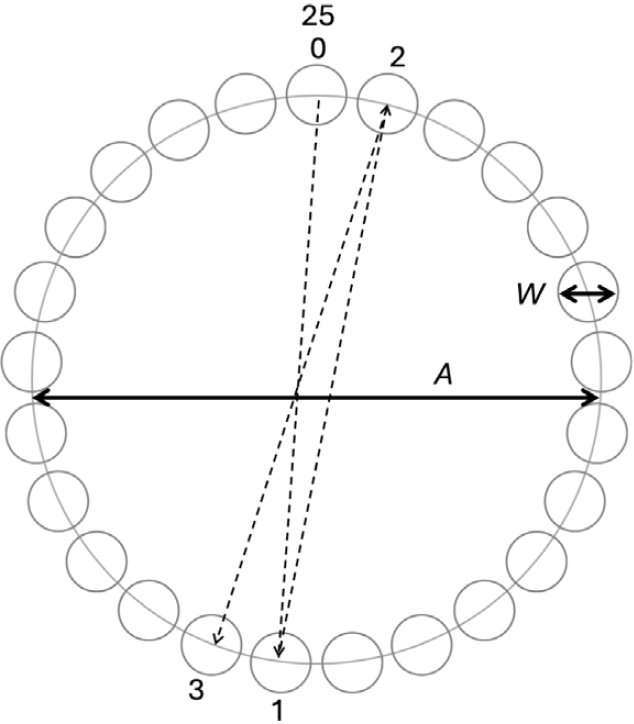
Fig. 1. The multi-directional pointing task layout as exemplified in ISO 9241-411 (ISO, 2012, Annex B).
An aspect that has not received sufficient attention is the number of targets in the 2D test. See Fig. 2. In particular and as demonstrated in this paper, accurate performance measurement requires an odd number of targets in the 2D multi-directional tapping test. To our knowledge, there are no published sources that explicitly state that an odd number of targets is required for the 2D task. This important point is not mentioned in the ISO 9241-411 standard, nor is it mentioned in the 2004 paper by Soukoreff and MacKenzie (2004) which is the most-cited paper describing the 2D task.
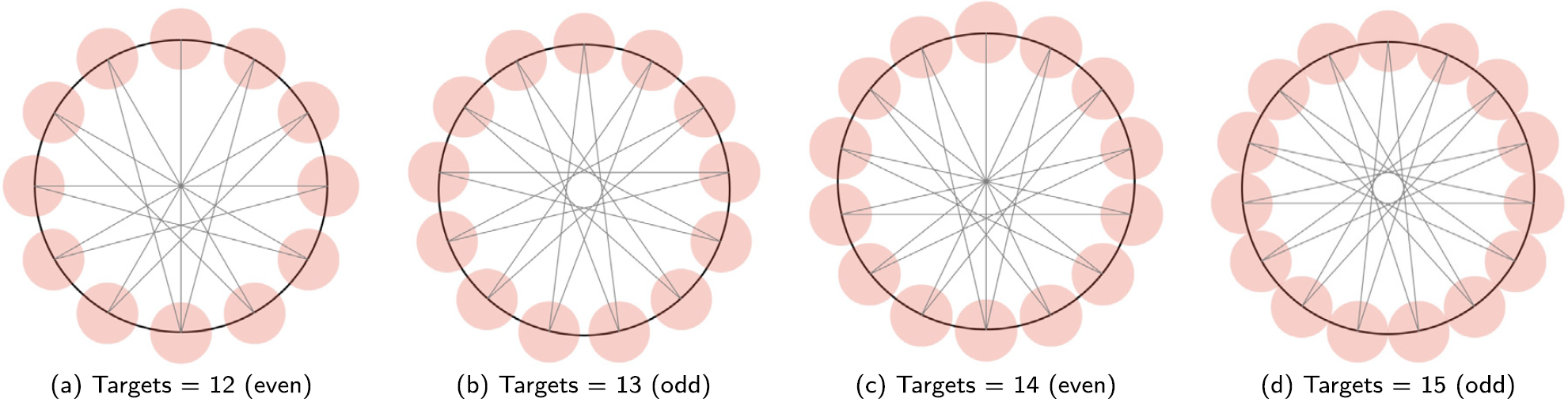
Fig. 2. ISO multi-directional pointing task layouts with targets equally spaced around a layout circle: (a) 12 targets, (b) 13 targets, (c) 14 targets, (d) 15 targets. Gray lines show the movement distances or amplitudes (A) from target to target. For an odd number of targets, the movement distance is the same from trial to trial. For an even number of targets, there are two movement distances that alternate trial to trial.
There are, however, unpublished sources briefly mentioning this topic. As an example, the GoFitts application2 – a tool for Fitts' law experiments – only allows an odd number of targets for the 2D task, with the API explaining as follows: "Using an odd number ensures that the distance between successive targets is the same for each trial". However, a contrary approach is found in an HTML5-based implementation3 that only allows an even number of targets, and without providing a rationale. While GoFitts is used in some published research (e.g., (Pagan et al., 2022; Wührl et al., 2024; Li et al., 2022; Thushara et al., 2024; Schachner and Doyon-Poulin, 2024)), the vast majority of research using the 2D task relies on custom software developed by the researchers. While many experienced Fitts' law researchers may be aware of the need for an odd number of targets in the 2D task, our literature review reveals that many researchers are clearly unaware of this requirement. This paper aims to clarify and correct this often overlooked but significant point.
Related to this is another point, also demonstrated herein: Movement amplitude (A) is slightly less than the diameter of the layout circle (d) around which targets are positioned. The GoFitts application also reinforces this in the API: "[The movement] distance is a bit less than the specified amplitude, which is the diameter of the layout circle". The ISO standard mentions as well that the amplitude movements are not equal to the diameter of the circle. These points – movement amplitude and the number of targets – have a direct effect, albeit small, on the accuracy of the throughput measures in Fitts' law studies using ISO-conforming 2D tasks. Therefore, it is important for researchers to understand how target parity (odd vs. even; and that an even number of targets should never be used) and the definition of movement amplitude (using A vs. incorrectly using the diameter of the layout circle d) affect throughput in the multi-directional tapping (2D) test, and to provide guidance for configuring Fitts' law experiments accordingly. We conclude with a literature review on 2D Fitts' law testing where an even number of targets was used, revealing that many researchers are unaware of the importance of these parameters.
2. The calculation of ISO throughput
In HCI user studies, Fitts' law is adopted mainly as a procedure to measure throughput (Fitts' index of performance) in comparing pointing devices or interaction techniques. Although user performance is typically evaluated with multiple dependent variables (e.g., speed, accuracy), the only performance measure stipulated in the ISO standard is throughput. Throughput (TP) in bits per second (bps) is calculated as follows:
TP = ID / MT (1)
where ID in the index of difficulty in bits and MT is the movement time in seconds. ID is computed as
ID = log2(A / W + 1) (2)
where A is the distance to the target and W is the width of the target. Testing proceeds in sequences of trials covering a range of movement amplitudes and target widths. Thus, ID provides a theoretical measure of the difficulty of the tapping task based on the target size and movement distance. Of course, a user will not hit the target perfectly every time. To account for the spatial variability in hits, an "effective" index of difficulty (IDe) is used instead of ID. IDe is a measure of the difficulty and user precision in accomplishing a task, computed as
IDe = log2 (A / We + 1) (3)
where We is the effective target width, calculated from the width of the distribution of selection coordinates made by a participant over a sequence of trials. The effective target width is calculated as
We = 4.133 × SDx (4)
where SDx is the standard deviation in the selection coordinates in the direction that movement proceeds.
Therefore, the recommended calculation for throughput is defined by Eq. (5):
TP = IDe / MT (5)
The effective amplitude (Ae), which is the mean of the actual movement amplitudes in the sequence of trials, can also be used to compute IDe if there is an overall tendency to overshoot or undershoot (Soukoreff and MacKenzie, 2004).
Using the effective values (We, Ae), throughput is a single human performance measure that embeds both the speed and accuracy in human responses. The index of difficulty calculated without the effective values (ID) quantifies the movement task that the experimenter wants subjects to perform; however, subjects often do not actually perform at this index of difficulty.
A detailed description of the calculation of throughput is found in other sources (Soukoreff and MacKenzie, 2004; Roig-Maimó et al., 2018; Magee et al., 2015; MacKenzie, 2018).
3. Number of targets (Odd vs. Even)
As stated by the ISO standard (ISO, 2012), the procedure for the multi-directional tapping test is to move a cursor across a circle to sequentially select targets. See Fig. 1. Testing for each sequence starts upon selecting the topmost target (0 in Fig. 1). Then, the user moves the cursor and sequentially selects the remaining set of nearly diametrically opposed targets. In practice, since the time to select the first target is not recorded, a sequence typically continues until the first target is selected again (25 in Fig. 1). As such, there are 25 selections for 25 targets. Although the ISO standard illustrates the test with 25 targets (as in Fig. 1), most research uses fewer targets, just to keep the testing time reasonable.
It is also stated in the ISO standard that the targets "should be equally spaced around the circumference of the circle" and arranged "so that the movements are nearly equal to the diameter of the circle" (ISO, 2012, Annex B). It is also noted that the diameter of the layout circle, and thus the distance between the targets, should vary between sequences; meaning that the movement distance for all trials in a sequence should be equal. Although not stated in the ISO standard, that last requirement only occurs when an odd number of targets is used. Also, it should be noted that the movement distance between targets (A) is not equal to the diameter of the layout circle: It is nearly equal.
Fig. 3 illustrates configurations of multi-directional pointing tasks with 5 targets (Fig. 3a) and 6 targets (Fig. 3b) placed around a layout circle with diameter d = 300 px. All targets are equally spaced around the circle. For the configuration with 5 targets (an odd number of targets) the movement distance (A) is the same for all the trials. In particular, A = 285.3 px or 95.1%4 of the diameter of the circle, d. Henceforth in this paper, we use d as the diameter of the layout circle as distinct from A, the movement amplitude between targets.
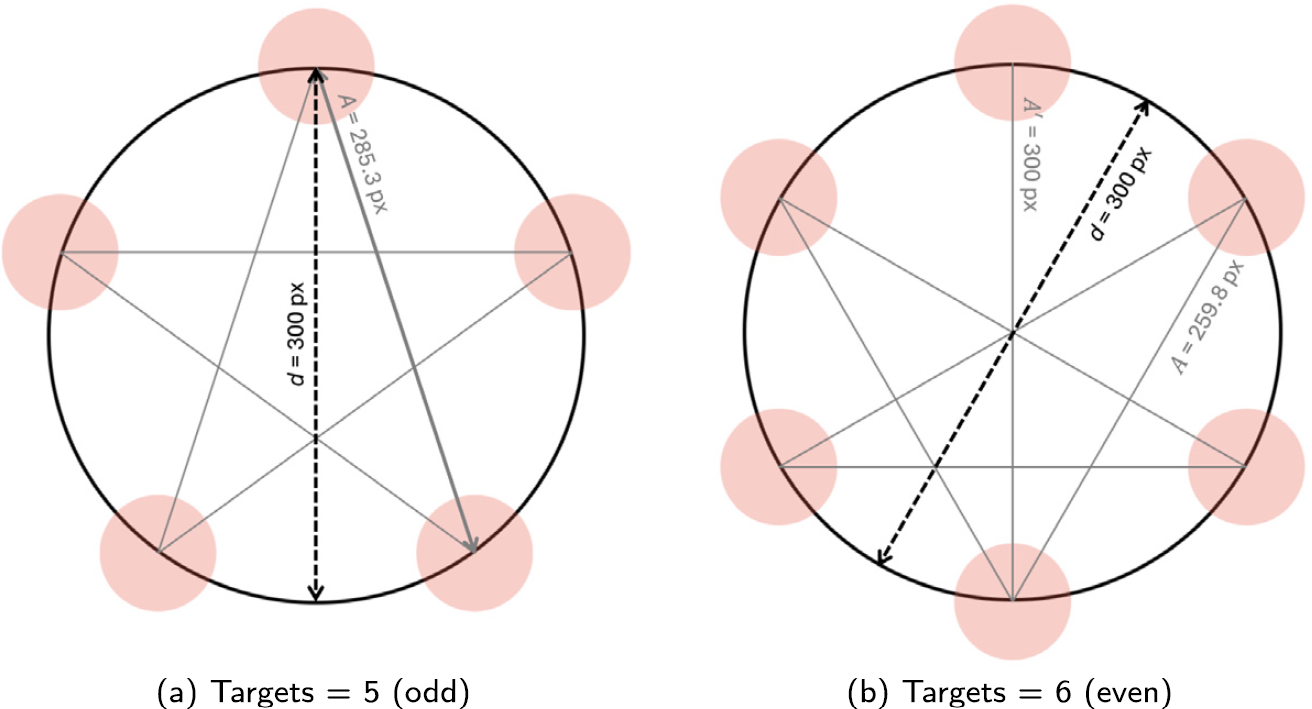
Fig. 3. Odd vs. even: Task layouts with (a) 5 targets and (b) 6 targets. Targets are equally spaced around a layout circle with diameter d = 300 px. The diameter of the circle (d) is depicted with a black dashed line. Gray lines show the movement distances (A) between targets.
For the configuration with 6 targets (an even number of targets), a problem is revealed since there are two movement distances: The distance for odd trials (A') is equal to the diameter of the circle, while the distance for even trials (A) is lower (A = 259.8 px, which is 86.6% of A'). This is simply wrong, since the target-to-target distance varies from trial to trial in a sequence. When evaluating a pointing device or interaction technique for multi-directional pointing (i.e., using the 2D multi-directional tapping test), the same movement distance is required for all trials in a sequence; otherwise, the evaluations are biased towards particular trials within a sequence.
3.1. Amplitude calculations for an odd number of targets
When positioning an odd number of targets, the difference between the distance of movement to a target (A) and the diameter of the circle (d) depends on the number of targets and decreases as the number of targets increases. Fig. 4 shows the effect of a different number of targets on the target-to-target distance (A) given a layout circle with d = 300 px. With 7 targets, A is 292.5 px or 97.5% of d; with 9 targets, A is 295.4 px or 98.5% of d; and with 11 targets, A is 296.9 px or 99.0% of d.
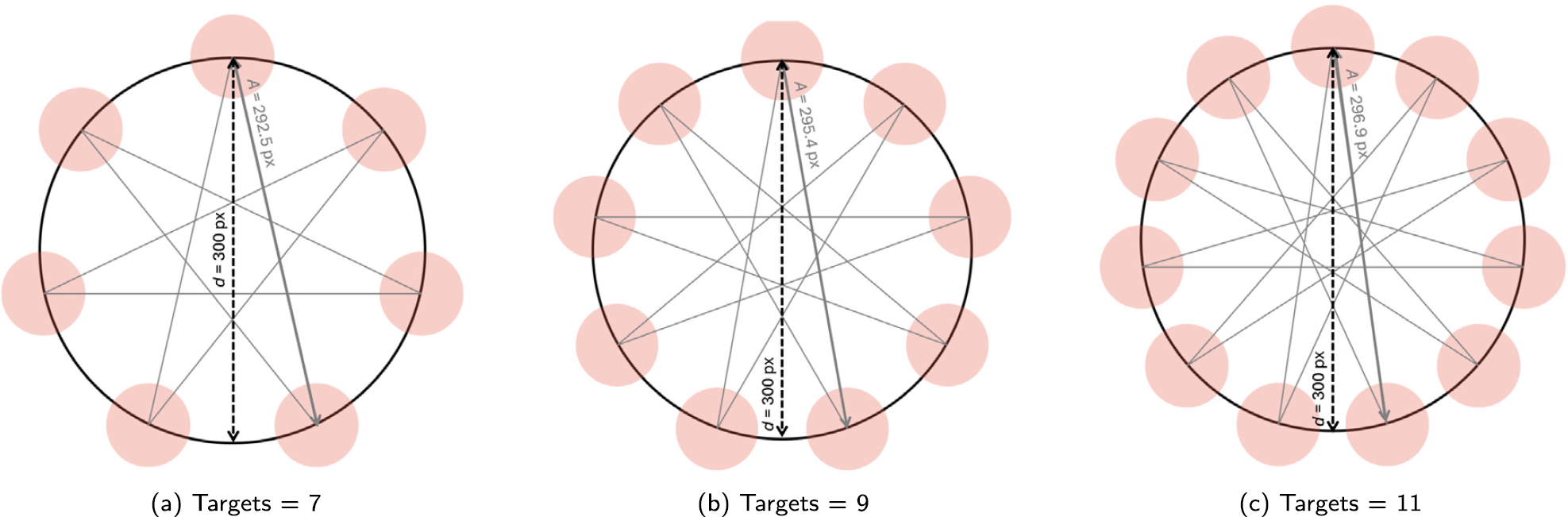
Fig. 4. Layout configurations varying the number of targets around a layout circle with diameter d = 300 px. (a) 7 targets, (b) 9 targets, and (c) 11 targets. The diameter (d) is depicted with a black dashed line. Gray lines show the movement distances (A) between targets.
Given the above summary of movements for layouts with an odd number of targets, it is worthwhile to have equations to assist researchers. Two variations seem relevant: (i) an equation for the actual movement distance (A) given the diameter of the layout circle, and (ii) an equation for the required diameter of the layout circle for a desired movement distance (A). Of course, the number of targets is also needed in the calculations. These equations are developed next.
Given a circle of diameter d and an odd number of targets n equally spaced around the circle, all targets are visited with the same movement amplitude A. See Fig. 5 where a sequence begins at target i. Following selection of target i, the farthest target (i+1) is visited, then the farthest target diametrically opposed to that target is visited (i+2), and so on until all targets are visited.
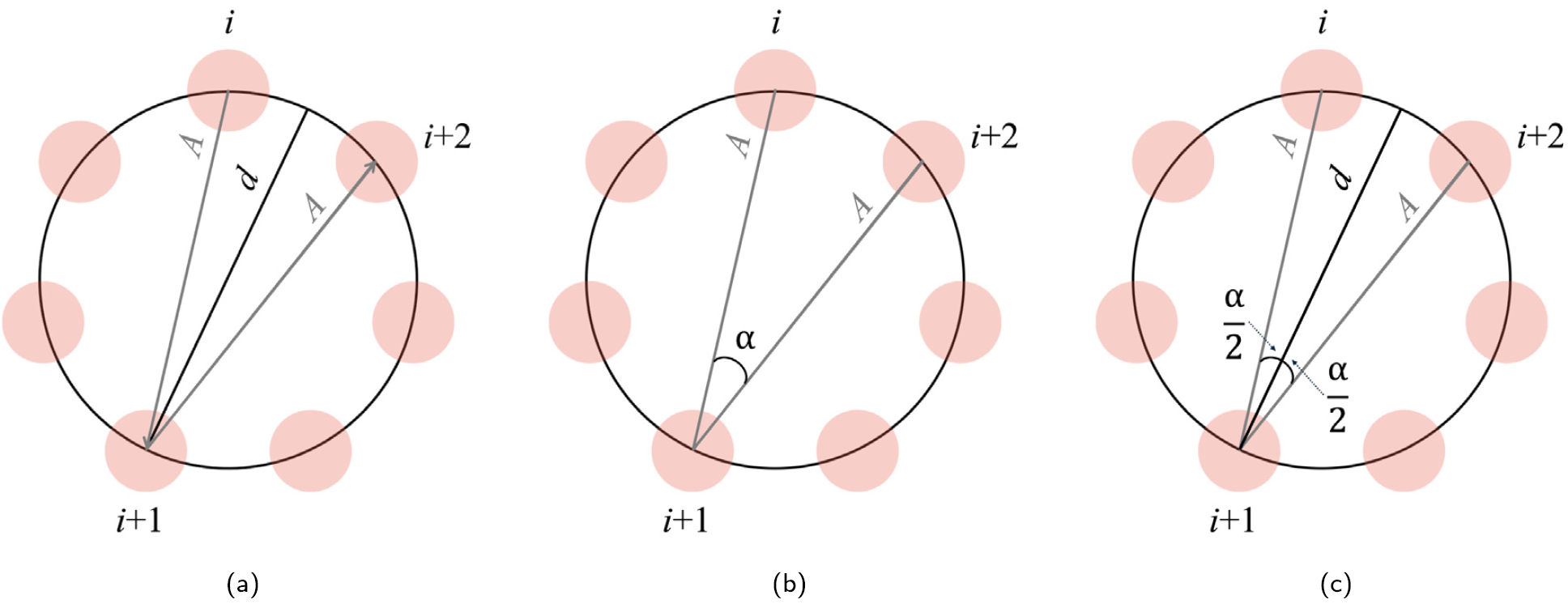
Fig. 5. Example of consecutive targets to visit. The movement distance or amplitude (A) to reach each target is the same. The diameter of the layout circle (d) is depicted with a black line. Gray lines show the movement distances (A) across the targets.
Let α be the angle formed by segments joining the targets i and i+1, and the targets i+1 and i+2. See Fig. 5b. As i and i+2 are symmetric respect to the diameter from target i+1, the angle α is split by the diameter in two equal angles α/2. See Fig. 5c. Additional details of the geometry in Fig. 5 are provided in Fig. 6.
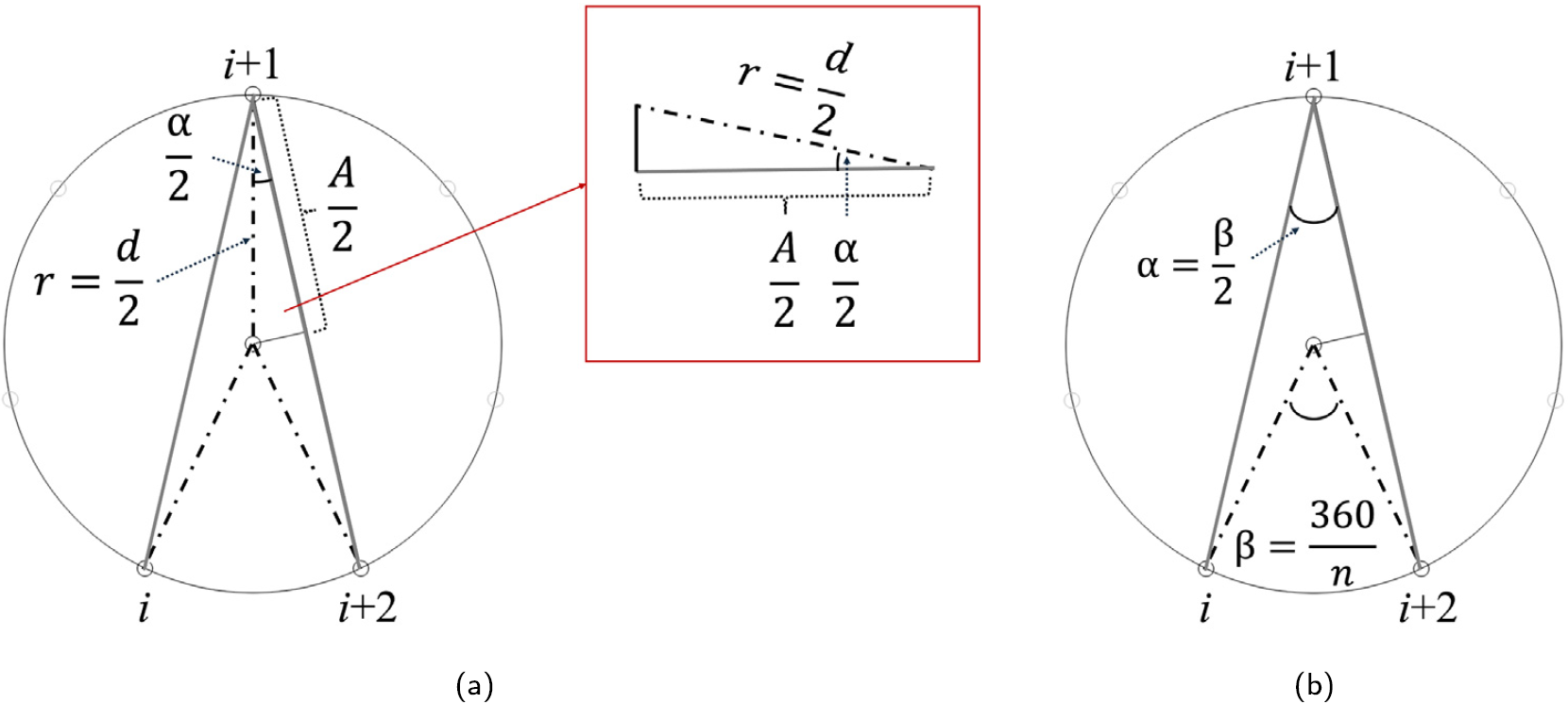
Fig. 6. Relationship between half of the movement distance (A/2) and the radius of the circle (r = d/2) for an odd number of targets equally spaced around the A/2 = d/2 × cos α/2.
In view of the geometry in Fig. 6a, the movement distance A to a target is
A = d × cos α/2 (6)
where α, as seen in Fig. 6b, is α = 180/n.
Therefore, given a circle of diameter d and an odd number of targets n equally spaced around the circle, the movement amplitude A is
A = d × cos 90/n. (7)
Solving for d yields
d = A / cos 90/n. (8)
Eqs. (7) and (8) are potentially useful for researchers designing 2D Fitts' law experiments. If the number of targets and the diameter of the layout circle are known, Eq. (7) gives the movement amplitude; that is, the target-to-target distance. If the number of targets and the "desired" movement amplitude are known, Eq. (8) provides the required diameter for the layout circle, with d slightly larger than A.
In summary, Table 1 shows the values of movement distances (A) versus the diameter of the circle (d) for different numbers of targets. This difference increases as the number of targets decreases. When computing IDe (see Eq. (3)) using A instead of the effective amplitude (Ae), A is the movement distance, not the diameter of the circle (d).
Table 1
Movement distances (A) for odd numbers of targets around a circle with diameter d = 300 px.
Targets A (px) Relation to d (%) Targets A (px) Relation to d (%) 5 285.3 95.1% 17 298.7 99.6% 7 292.5 97.5% 19 299.0 99.7% 9 295.4 98.5% 21 299.2 99.7% 11 296.9 99.0% 23 299.3 99.8% 13 297.8 99.3% 25 299.4 99.8% 15 298.4 99.5% 27 299.5 99.8%
3.2. Implications for throughput
So, what is the effect of the above analysis on the calculation of throughput? This is explored in Table 2 which distinguishes throughput calculated using d (incorrect) vs. A (correct). The first row corresponds to the incorrect calculation of throughput using the diameter of the layout circle (d = 300 px) as movement distance (A). The following rows correspond to the correct calculation of throughput using the actual target-to-target movement distance (A), which slightly differs from d depending on the number of targets (n). There is indeed a difference (right-hand column), albeit small. The correct value of throughput is slightly less than the incorrect value computed using d. The discrepancy increases as the number of targets decreases. Notably, small differences in throughput across devices or test conditions frequently appear in the HCI literature. Examples of small TP differences as a percent include 0.86% (Babu et al., 2022, Figure 4), 0.86% (Raynal and MacKenzie, 2024, Figure 3), 0.43% (Dube et al., 2022, Figure 5a), 0.75% (Imai and Misaki, 2023, Figure 6), 0.42% (Jude et al., 2014, Table 3) 0.15% (Isokoski and Raisamo, 2002, Table 3), 0.72% (Wobbrock et al., 2009, Table 2) and 0.22% (Yamanaka et al., 2022, Figure 8). Thus, the small discrepancies seen in Table 2 may surface as incorrect, slightly inflated, values for throughput or as a change in the rank order of conditions based on throughput. Inaccuracies in the calculations of throughput weaken between-study comparisons. As the main application of Fitts' law in HCI is the comparison of input devices or techniques based on throughput, it is crucial that the method of calculation is correct and consistent across studies.
Table 2
Throughput (TP) calculated using the correct value of movement distance (A) compared to the diameter of the layout circle (d). First row: Incorrect TP using the diameter of the layout circle (d) for movement distance (A). Following rows: Correct TP using the actual target-to-target movement distance. For this analysis, target width (W) is set to 50 px and movement time (MT) is set to 1000 ms. TP calculated using Eq. (1).
Details for A A (px) W (px) ID (bits) MT (ms) TP (bps) ΔTP d (layout diameter) 300 50 2.8074 1000 2.8074 - A (n = 5) 285.3 50 2.7455 1000 2.7455 −2.20% A (n = 7) 292.5 50 2.7760 1000 2.7760 −1.12% A (n = 9) 295.4 50 2.7884 1000 2.7884 −0.67% A (n = 11) 296.9 50 2.7947 1000 2.7947 −0.45% A (n = 13) 297.8 50 2.7983 1000 2.7983 −0.32% A (n = 15) 298.4 50 2.8006 1000 2.8006 −0.24% A (n = 17) 298.7 50 2.8021 1000 2.8021 −0.19% A (n = 19) 299.0 50 2.8031 1000 2.8031 −0.15% A (n = 21) 299.2 50 2.8039 1000 2.8039 −0.12% A (n = 23) 299.3 50 2.8045 1000 2.8045 −0.10% A (n = 25) 299.4 50 2.8049 1000 2.8049 −0.09%
For instance, half of the previously listed examples (differences ranging from 0.72% to 0.86%) could completely change the results of the compared devices when using less than 21 targets.
To summarize, we recommend using an odd number of targets when designing a 2D Fitts' law experiment and also using the actual value of movement distance as movement amplitude (A) to calculate throughput (TP), instead of using the diameter of the layout circle (d).
4. Review of Fitts' law studies using the multi-directional tapping test with an even number of targets
Since the publication of the ISO 9241-9 in 2002 and its subsequent update in 2012 as ISO 9241-411, there is widespread use of the standard and the prescribed evaluation tests for input devices. A general search in major bibliographic resources (Science Direct, Scopus, ACM Digital Library, IEEExplore and Google Scholar) using "ISO 9241-9 OR ISO 9241-411" as a selection criterion gives a sense of the impact of this standard, as more than 1600 references are returned.
To inquire into the effect of using an even number of targets when applying the multi-directional tapping test in the literature, we intend to analyze the results of a manageable and representative sample of articles. We do not aim to conduct an exhaustive review, as our main objective is to verify the effect that choosing an even number of targets in the multi-directional tapping test has on the calculations obtained.
To select articles, we drew a systematic random sample (interval k = 8, random start s = 3) from the corpus (N = 1671) by selecting every eighth record until 200 items were obtained. We examined their methodology and selected only publications that applied the ISO multi-directional tapping test. We also eliminated contributions that were doctoral theses, master's theses, or preprints. This first screening reduced our review to 160 articles. From this sample, we proceeded to extract information on the relevant details in the methodology.
Of the 160 papers, 52 (33%) used an even number of targets, and 108 used an odd number of targets. Of the 52 papers using an even number of targets, 22 strictly followed the reciprocal multi-directional tapping task. Papers were discarded that (i) used variations not involving reciprocal selection of targets, (ii) used a home target at start of each trial, (iii) did not specifically compute throughput, analyzing only error rate and movement time, or (iv) did not specify how throughput was calculated (e.g., Burno et al. (2015), Tao et al. (2021), Man and Wong (2007), Asque et al. (2014), Chen et al. (2019), Fernandes et al. (2023), Hemati et al. (2020)).
Table 3 summarizes the selected papers in chronological order. Where not stated directly in the paper, details on the computation of the effective values of the index of difficulty (IDe), movement distance (Ae) and target width (We) were deduced from formulas in the papers. Note that if A is used instead of Ae to compute TP, the value of TP is wrong since the diameter of the layout circle is the movement amplitude only for half the trials. Where it was not possible to deduce details from the text of the publication, the annotation not specified is used. But, even if Ae is used to compute TP (reducing, somehow, the impact of the error), the design used is still wrong.
Survey of 22 studies that used the multi-directional tapping test with an even number of targets.
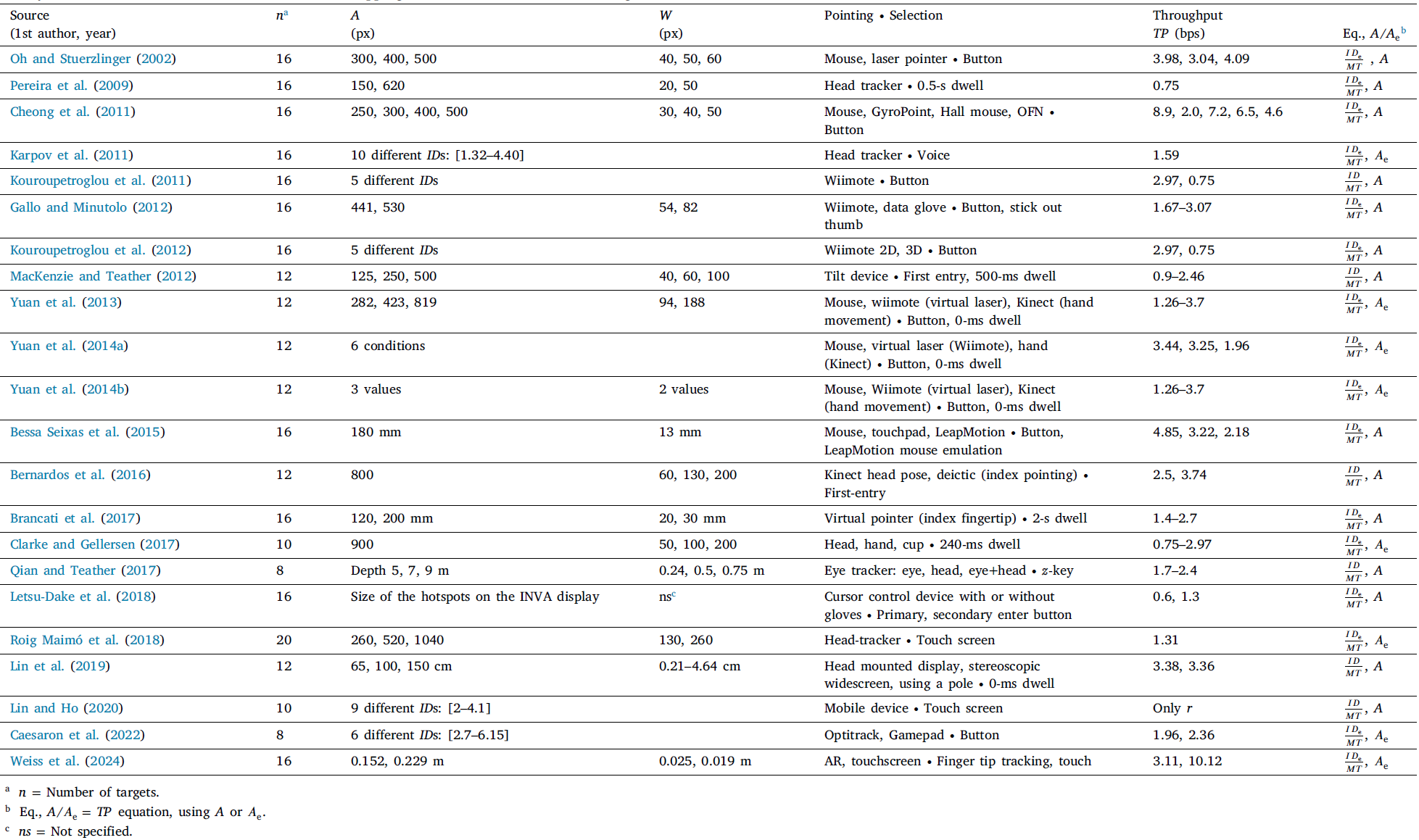
The examples in Table 3 include a variety of designs for the multi-directional tapping task. The common link for all the studies is that an even number of targets was arranged around the layout circle. The number of targets (2nd column in table) varied from as high as 20 targets for one study (Roig Maimó et al., 2018) to as few as 8 targets for two studies (Qian and Teather, 2017; Caesaron et al., 2022). As when using an odd number of targets, when using an even number of targets, the difference between A and d increases as the number of targets decreases. Although A is 98.8% of d for the 20-target arrangement the difference is more pronounced for the 8-target arrangement where A is just 92.4% of d.
As an example, Clarke and Gellersen (2017) (15th row in table) used a multi-directional tapping test with 10 targets distributed on the circumference of a layout circle with diameter d = 900 px. So, the movement distances were A' = 900 px for odd trials and A = 855.9 px for even trials (A = d × cos 180/n). This indicates a mean A of 878.0 px in a sequence of trials (97.5% of d, the diameter of the circle), but not all the trials had the same movement distance (A). As already noted, although the equation for throughput (last column in table and Eq. (5)) used the effective amplitude (Ae), the accuracy or relevance of Ae is questionable since, as demonstrated in Fig. 3b, participants performed a slightly different task for odd trials (A = 900 px) compared to even trials (A = 855.9 px). A possible effect is that variability in movement time or other behaviors might result due to the different distances presented from one trial to the next. This potentially influences the calculated values for throughput.
The case of Bernardos et al. (2016) (13th row in table) is different. The authors used 12 targets in a layout circle of diameter d = 800 px to compute the throughput for deictic and head pose pointing methods. The movement distance for odd trials was A' = 800 px and for even trials A = 772.7 px. This – as in all the examples in Table 3 – implies that not all the trials in a sequence had the same movement distance. But, unlike the previous example, the authors used A to compute TP, meaning they used the diameter of the layout circle as the movement amplitude, which was not the movement amplitude for half the trials. Therefore, the values for TP are wrong: They are too high since for half the trials in each sequence participants were given credit for moving a greater distance than they actually did. In Table 3, 14 of 22 (63.6%) studies reported similarly inaccurate values of throughput (TP).
5. Conclusion
This paper focused on a little-known aspect in the design of 2D Fitts' law experiments: the need for an odd number of targets. The multi-directional tapping test (2D) in ISO 9241-411 is an evolution of the original Fitts paradigm to evaluate pointing movements in different directions. To achieve this, targets are equally spaced around the circumference of a layout circle. The important effect in a sequence of trials is that the user performs the same movement distance but in different directions. We highlighted that this is only achieved if an odd number of targets is used and, to the best of our knowledge, there are no published sources that explicitly state this. Besides, and related to this, we also demonstrated that the movement amplitude (A) is slightly less than the diameter of the layout circle around which targets are positioned (d). In conclusion, we offer two recommendations for researchers designing 2D Fitts' law experiments:
- Use an odd number of targets.
- If using A to calculate throughput (TP) instead of the effective amplitude (Ae), as in Eq. (3), use the actual target-to-target movement distance (A) rather than the diameter of the circle layout (d). Using the effective amplitude (Ae), which is derived from the actual movement endpoints and, therefore, it is independent of the diameter of the layout circle (d), ensures a valid computation of throughput.
Beyond these methodological clarifications, our findings imply that, for researchers, adhering to an odd number of targets and to the correct definition of movement distance ensures methodological consistency and valid throughput values, thereby strengthening between-study comparisons. Explicitly stating these requirements would help prevent design flaws in experiments that rely on Fitts' law.
Finally, from a large body of studies we reviewed 22 that used an even number of targets in the multi-directional tapping test and verified that the results obtained are influenced by the different movement distances from trial to trial. This analysis highlights that some researchers may use such configurations without knowing the impact on the precision of their results, with the use of an even number of targets potentially leading to inaccurate findings. Our aim is to raise awareness of this issue and encourage the use of an odd number of targets in future studies to ensure the reliability and validity of outcomes.
Table 3 also includes articles by the authors of this paper. Of course, as with the authors of other papers in the table, the mistake was inadvertent; we were simply unaware at the time of the importance of using an odd number of targets and its impact on the calculation of throughput. We wish for future researchers to avoid this mistake and offer this paper as the remedy. The fact that some of the papers in Table 3 are from recent years and that additional papers were published using an even number of targets for 2D Fitts' law experiments while this paper was under review (e.g., Pino et al. (2025)), reinforces the need to advertise this overlooked but significant issue. Finally, we argue for revisiting and updating the ISO 9241-411 standard to explicitly state that an odd number of targets is required for the 2D task.
CRediT authorship contribution statement
M.F. Roig-Maimó: Writing - review & editing, Writing - original draft, Visualization, Validation, Supervision, Project administra- tion, Methodology, Investigation, Funding acquisition, Conceptualiza\tion. R. Mas-Sansó: Writing - review & editing, Writing - original draft, Visualization, Validation, Methodology, Investigation, Concep- tualization. I.S. MacKenzie: Writing - review & editing, Writing - original draft, Visualization, Validation, Methodology, Investigation, Conceptualization.
Funding
This work is part of the project TED2021-131358A-I00 funded by MICIU/AEI/10.13039/501100011033 and by the "European Union NextGenerationEU/PRTR".
Declaration of competing interest
The authors declare that they have no known competing financial interests or personal relationships that could have appeared to influence the work reported in this paper.
Acknowledgments
This work is part of the project TED2021-131358A-I00 funded by MICIU/AEI/10.13039/501100011033 and by the "European Union NextGenerationEU/PRTR". The authors thank the University of the Balearic Islands, Spain and the Department of Mathematics and Computer Science, Spain for their support. We also acknowledge the support of the "Visiting lecturers on short visits" programme by the Research Support Office (OSR), Spain of the University of Balearic Islands.
Data availability
All data used in this research appears explicitly in the paper.
References
Asque, C.T., Day, A.M., Laycock, S.D., 2014. Augmenting graphical user interfaces with haptic assistance for motion-impaired operators. Int. J. Hum.-Comput. Stud. 72, 689-703. https://doi.org/10.1016/j.ijhcs.2014.05.007
Babu, S.V., Huang, H.C., Teather, R.J., Chuang, J.H., 2022. Comparing the fidelity of contemporary pointing with controller interactions on performance of personal space target selection. In: Proceedings of the IEEE International Symposium on Mixed and Augmented Reality - ISMAR '22. IEEE, New York, pp. 404-413. https://doi.org/10.1109/ISMAR55827.2022.00056
Bernardos, A.M., Gómez, D., Casar, J.R., 2016. A comparison of head pose and deictic pointing interaction methods for smart environments. Int. J. Human-Comput. Interact. 32, 325-351. https://doi.org/10.1080/10447318.2016.1142054
Bessa Seixas, M.C., Cardoso, J.C.S., Dias, M.T.G., 2015. The leap motion movement for 2D pointing tasks: Characterisation and comparison to other devices. In: Proceedings of the International Conference on Pervasive and Embedded Computing and Communication Systems - PECCS '15. IEEE, New York, pp. 15-24, ISSN: 978-989-758-137-3.
Brancati, N., Caggianese, G., Frucci, M., Gallo, L., Neroni, P., 2017. Experiencing touchless interaction with augmented content on wearable head-mounted displays in cultural heritage applications. Pers. Ubiquitous Comput. 21, 203-217. https://doi.org/10.1007/s00779-016-0987-8
Burno, R.A., Wu, B., Doherty, R., Colett, H., Elnaggar, R., 2015. Applying Fitts' law to gesture based computer interactions. Procedia Manuf. 3, 4342-4349. https://doi.org/10.1016/j.promfg.2015.07.429
Caesaron, D., Lin, C.J., Mufidah, I., Febiyani, A., 2022. Evaluating direct pointing and indirect cursor interactions with Fitts' law in stereoscopic environments. J. Eng. Technol. Sci. 54, https://www.academia.edu/download/84505052/5630.pdf
Chen, H.J., Lin, C.J., Lin, P.H., 2019. Effects of control-display gain and postural control method on distal pointing performance. Int. J. Ind. Ergon. 72, 45-53. https://doi.org/10.1016/j.ergon.2019.04.004
Cheong, K.k., Kim, I., Park, S.k., Park, Y.j., 2011. User performance measures for evaluating interactive TV pointing devices. IEEE Trans. Consum. Electron. 57, 1236-1244. https://doi.org/10.1109/TCE.2011.6018879
Clarke, C., Gellersen, H., 2017. MatchPoint: Spontaneous spatial coupling of body movement for touchless pointing. In: Proceedings of the ACM Symposium on User Interface Software and Technology - UIST '17. ACM, New York, pp. 179-192. https://doi.org/10.1145/3126594.3126626
Dube, T.J., Ren, Y., Limerick, H., MacKenzie, I.S., Arif, A.S., 2022. Push, tap, dwell, and pinch: Evaluation of four mid-air selection methods augmented with ultrasonic haptic feedback. ISS, In: Proceedings of the ACM on Human-Computer Interaction, vol. 6, pp. 565.1-565.19. https://doi.org/10.1145/3567718
Fernandes, A.S., Murdison, T.S., Proulx, M.J., 2023. Leveling the playing field: A comparative reevaluation of unmodified eye tracking as an input and interaction modality for VR. IEEE Trans. Vis. Comput. Graphics 29, 2269-2279. https://doi.org/10.1109/TVCG.2023.3247058
Fitts, P.M., 1954. The information capacity of the human motor system in controlling the amplitude of movement. J. Exp. Psychol. 47, 381-391. https://doi.org/10.1037/h0055392
Gallo, L., Minutolo, A., 2012. Design and comparative evaluation of smoothed pointing: A velocity-oriented remote pointing enhancement technique. Int. J. Hum.-Comput. Stud. 70, 287-300. https://doi.org/10.1016/j.ijhcs.2011.12.001
Hemati, K., Mirjalili, S., Ghasemi, M.S., Abdolahian, Y., Siroos, R., Sanati, P., Aghilinejad, M., Dehghan, N., 2020. Functional parameters, wrist posture deviations and comfort: A comparison between a computer mouse and a touch pen as input devices. Work 65, 701-706. https://doi.org/10.3233/WOR-203124
Imai, A., Misaki, D., 2023. Hands-free interface using breath for robot-assisted operation. In: Proceedings of the 32nd IEEE International Conference on Robot and Human Interactive Communication - RO-MAN '23. IEEE, New York, pp. 159-164. https://doi.org/10.1109/RO-MAN57019.2023.10309538
ISO, 2002. 9241-9. 2000. Ergonomics Requirements for Office Work with Visual Display Terminals (VDTs) - Part 9: Requirements for Non-Keyboard Input Devices. Report, International Organization for Standardization. ISO, 2012. 9241-411. 2012. Ergonomics of Human-System Interaction - Part 411: Evaluation Methods for the Design of Physical Input Devices. Report, International Organization for Standardization.
Isokoski, P., Raisamo, R., 2002. Speed-accuracy measures in a population of six mice. In: Proceedings of the Fifth Asia Pacific Conference on Human-Computer Interaction - APCHI '02. Science Press, Bejing, pp. 765-777.
Jude, A., Poor, G.M., Guinness, D., 2014. An evaluation of touchless hand gestural interaction for pointing tasks with preferred and non-preferred hands. In: Proceedings of the 8th Nordic Conference on Human-Computer Interaction - NordiCHI '14. ACM, New York, pp. 668-676. https://doi.org/10.1145/2639189.2641207
Karpov, A., Ronzhin, A., Kipyatkova, I., 2011. An assistive bi-modal user interface integrating multi-channel speech recognition and computer vision. In: Proceedings of the 14th International Conference on Human-Computer Interaction - HCII '11. LNCS 6762, Springer, Berlin, pp. 454-463. https://doi.org/10.1007/978-3-642-21605-3_50
Kouroupetroglou, G., Pino, A., Balmpakakis, A., Chalastanis, D., Golematis, V., Ioannou, N., Koutsoumpas, I., 2012. Using wiimote for 2D and 3D pointing tasks: Gesture performance evaluation. In: Proceedings of the 9th International Gesture Workshop - GW'12. LNAI 7206, Springer, Berlin, pp. 13-23. https://doi.org/10.1007/978-3-642-34182-3_2
Kouroupetroglou, G., Pino, A., Balmpakakis, A., Golematis, V., Chalasyanis, D., Ioannou, N., Koutsoumpas, I., 2011. Performance evaluation of gesture-based 2D and 3D pointing tasks. In: Proceedings of the 9th International Gesture Workshop - GW '11. LNAI 7206, Springer, Berlin, pp. 10-15.
Letsu-Dake, E., Alves, E., Khatwa, R., Dodd, S., 2018. Motion simulator evaluation of a flight deck cursor control device (CCD). In: Proceedings of IEEE/AIAA 37th Digital Avionics Systems Conference - DASC '18. IEEE, New York, pp. 1-10. https://doi.org/10.1109/DASC.2018.8569593
Li, G., Wang, M., Arippa, F., Barr, A., Rempel, D., Liu, Y., Harris Adamson, C., 2022. Professional and high-level gamers: Differences in performance, muscle activity, and hand kinematics for different mice. Int. J. Human-Comput. Interact. 38, 691-706. https://doi.org/10.1080/10447318.2021.1960742
Lin, C.J., Abreham, B.T., Woldegiorgis, B.H., 2019. Effects of displays on a direct reaching task: A comparative study of head mounted display and stereoscopic widescreen display. Int. J. Ind. Ergon. 72, 372-379. https://doi.org/10.1016/j.ergon.2019.06.013
Lin, C.J., Ho, S.H., 2020. The development of a mobile user interface ability evaluation system for the elderly. Appl. Ergon. 89, 103215. https://doi.org/10.1016/j.apergo.2020.103215
MacKenzie, I.S., 1992. Fitts' law as a research and design tool in human-computer interaction. Human-Comput. Interact. 7, 91-139. https://doi.org/10.1207/s15327051hci0701_3
MacKenzie, I.S., 2018. Fitts' law. In: Norman, K.L., Kirakowski, J. (Eds.), Handbook of Human-Computer Interaction. Wiley, Hoboken, NJ, pp. 349-370. https://doi.org/10.1002/9781118976005
MacKenzie, I.S., Teather, R.J., 2012. FittsTilt: The application of Fitts' law to tilt-based interaction. In: Proceedings of the 7th Nordic Conference on Human Computer Interaction - NordiCHI '12. ACM, New York, pp. 568-577. https://doi.org/10.1145/2399016.2399103
Magee, J., Felzer, T., MacKenzie, I.S., 2015. Camera mouse clickerAID: Dwell vs. single-muscle click actuation in mouse-replacement interfaces. In: Proceedings of the 17th International Conference on Human-Computer Interaction - HCII '15. LNCS 9175, Springer, Cham, pp. 74-84. https://doi.org/10.1007/978-3-319-20678-3_8
Man, D.W.K., Wong, M.S.L., 2007. Evaluation of computer-access solutions for students with quadriplegic athetoid cerebral palsy. Am. J. Occup. Ther. 61, 355-364. https://doi.org/10.5014/ajot.61.3.355
Oh, J.Y., Stuerzlinger, W., 2002. Laser pointers as collaborative pointing devices. In: Proceedings of Graphics Interface - GI '02. Canadian Information Processing Society, Toronto, pp. 141-149.
Pagan, P., Choi, H., Magee, J., 2022. Camera mouse: Sound-based activation as a new approach to click generation. In: Proceedings of the 24th International Conference on Human-Computer Interaction - HCII '22. LNCS 13521, Springer, Cham, pp. 501-509. https://doi.org/10.1007/978-3-031-17902-0_35
Pereira, C.A.M., Neto, R.B., Reynaldo, A.C., de Miranda Luzo, R.P., 2009. Development and evaluation of a head-controlled human-computer interface with mouse-like functions for physically disabled users. Clinics 64, 975-981. https://doi.org/10.1590/S1807-59322009001000007
Pino, A., Papatheodorou, N., Kouroupetroglou, G., Giannopoulos, P.A., Makris, G., Papageorgiou, C., 2025. Hand dexterity evaluation grounded on cursor trajectory investigation in children with adhd using a mouse and a joystick. Technologies 13, https://doi.org/10.3390/technologies13030099
Qian, Y.Y., Teather, R.J., 2017. The eyes don't have it: An empirical comparison of head-based and eye-based selection in virtual reality. In: Proceedings of the 5th Symposium on Spatial User Interaction - SUI '17. ACM, New York, pp. 91-98. https://doi.org/10.1145/3131277.3132182
Raynal, M., MacKenzie, I.S., 2024. Automatic bars with single-switch scanning for target selection. In: Proceedings of the 19th International Conference on Computers Helping People with Special Needs - ICCHP '24. LNCS 14751, Springer, Cham, pp. 76-83. https://doi.org/10.1007/978-3-031-62849-8_10
Roig Maimó, M.F., MacKenzie, I.S., Manresa-Yee, C., Varona, J., 2018. Head-tracking interfaces on mobile devices: Evaluation using Fitts' law and a new multi-directional corner task for small displays. Int. J. Hum.-Comput. Stud. 112, 1-15. https://doi.org/10.1016/j.ijhcs.2017.12.003
Roig-Maimó, M.F., MacKenzie, I.S., Manresa-Yee, C., Varona Gómez, J., 2018. Ley de Fitts: Sobre el cálculo del rendimiento y tareas no iso. Rev. Colomb. Comput. 19, 7-28. https://doi.org/10.29375/25392115.3226
Schachner, A., Doyon-Poulin, P., 2024. Avionic touchscreen interaction under vibration: Supported versus freehand target selection in cockpit conditions. Int. J. Human-Comput. Interact. 40, 4335-4364. https://doi.org/10.1080/10447318.2023.2212225
Soukoreff, R.W., MacKenzie, I.S., 2004. Towards a standard for pointing device evaluation, perspectives on 27 years of Fitts' law research in HCI. Int. J. Hum.-Comput. Stud. 61, 751-789. https://doi.org/10.1016/j.ijhcs.2004.09.001
Tao, D., Diao, X., Wang, T., Guo, J., Qu, X., 2021. Freehand interaction with large displays: Effects of body posture, interaction distance and target size on task performance, perceived usability and workload. Appl. Ergon. 93, 103370. https://doi.org/10.1016/j.apergo.2021.103370
Thushara, B., Adithya, V., Sreekanth, N.S., 2024. Gesture centric interaction: Evaluating hand and head gestures in touchless cursor control. Ergonomics 1-21. https://doi.org/10.1080/00140139.2024.2411302
Weiss, H., Tang, J., Williams, C., Stirling, L., 2024. Performance on a target acquisition task differs between augmented reality and touch screen displays. Appl. Ergon. 116, 104185. https://doi.org/10.1016/j.apergo.2023.104185
Wobbrock, J.O., Fogarty, J., Liu, S.Y.S., Kimuro, S., Harada, S., 2009. The angle mouse: Target-agnostic dynamic gain adjustment based on angular deviation. In: Proceedings of the ACM SIGCHI Conference on Human Factors in Computing Systems - CHI '09. ACM, New York, pp. 1401-1410. https://doi.org/10.1145/1518701.1518912
Wührl, C., Schmid, A., Hößl, S., Wimmer, R., 2024. Comparing the effectiveness and ergonomics of smartphone-based gamepads. In: Proceedings of Mensch Und Computer 2024 - MuC '24. ACM, New York, pp. 207-218. https://doi.org/10.1145/3670653.3670676
Yamanaka, S., Usuba, H., Miyashita, H., 2022. Bivariate effective width method to improve the normalization capability for subjective speed-accuracy biases in rectangular-target pointing. In: Proceedings of the ACM SIGCHI Conference on Human Factors in Computing Systems - CHI '22. ACM, New York, pp. 211.1-211.13. https://doi.org/10.1145/3491102.3517466
Yuan, H., Ćalić, J., Fernando, A., Kondoz, A., 2013. Investigation and evaluation of pointing modalities for interactive stereoscopic 3D TV. In: Proceedings of the IEEE International Conference on Multimedia and Expo - ICME '13. IEEE, New York, pp. 1-6. https://doi.org/10.1109/ICME.2013.6607621
Yuan, H., Ćalić, J., Kondoz, A., 2014a. Facilitating interaction with stereoscopic 3D display devices. In: Proceedings of the IEEE 3DTV-Conference - 3DTV-CON '13. IEEE, New York, pp. 1-4. https://doi.org/10.1109/3DTV.2014.6874770
Yuan, H., Ćalić, J., Kondoz, A., 2014b. Quality of interaction experience in stereoscopic 3D TV. In: Proceedings of the IEEE International Conference on Image Processing - ICIP '14. IEEE, New York, pp. 748-752. https://doi.org/10.1109/ICIP.2014.7025150
-----
Footnotes:
1ISO 9241-411 is an updated version of ISO 9241-9. With respect to performance evaluation, the two versions of the standard are the same.
2https://www.yorku.ca/mack/FittsLawSoftware/doc/index.html?GoFitts.html
3https://vrevan2.github.io/fittsLaw/report.html
4These results in percentages are approximations as they are a discretization into pixels as the result of using a continuous trigonometric function.