Roig-Maimó, M. F., Mas-Sansó, R., and MacKenzie, I. S. (2026). A standardized comparison of blink, wink, and dwell as selection methods for gaze-based interaction. Proceedings of the ACM Symposium on Eye Tracking Research & Applications – ETRA '26, Article No. 1, pp. 1-6. New York: ACM. doi:10.1145/3797246.3803034. [PDF]
Abstract. Gaze-based interaction is increasingly used in hands-free and accessible interfaces. Although modern eye-trackers provide sufficient spatial and temporal resolution, accurate and efficient target selection remains a challenge. In this work, we compared three selection methods (wink, blink, dwell) and tested whether displaying or hiding the cursor affects performance in a 2D pointing task. Testing was standardized, as per ISO 9241-411, with performance evaluated using throughput, movement time, and error rate. Cursor visibility produced no significant effects. Concerning throughput, blink achieved the highest value (2.11 bps), followed by dwell-time (1.95 bps; ≈7.5% lower), whereas wink performed worst (1.56 bps). Although throughput was higher, only 16.7% of participants preferred blink; most favored dwell-time. Error rates further disadvantaged wink (20.4%), while dwell-time showed the lowest errors (1.82%). Overall, considering throughput, error rate, and user preference, wink is not recommended. Dwell-time selection is the best overall choice, offering a better balance for gaze-controlled interaction. A Standardized Comparison of Blink, Wink, and Dwell as Selection Methods for Gaze-based Interaction
Maria Francesca Roid-Maimó1, Ramon Mas-Sansó1, & I. Scott MacKenzie2
1Department of Mathematics and Computer Science
University of the Balearic Islands, Palma, Spain 07122
{xisca.roig, ramon.mas}@uib.es2Dept. of Electrical Engineering and Computer Science
York University, Toronto, Canada M3J 1P3
mack@yorku.ca
CCS Concepts
• Human-centered computing — Empirical studies in HCI; Pointing; Accessibility systems and tools.
1 Introduction
Eye tracking is a well-established input modality for human-computer interaction (HCI), enabling hands-free interaction in domains such as accessibility, virtual reality, and rehabilitation systems [Park and Manduchi 2024; Pfeuffer et al. 2020]. Despite continuous improvements in eye-tracking hardware, efficient and reliable target selection remains a challenge, as gaze is inherently ambiguous and lacks an explicit confirmation mechanism. To address this, a variety of gaze-based selection techniques have been proposed, among which dwell-time is the most common. Dwell-time techniques rely on maintaining gaze within a target for a predefined duration and are widely used due to their effectiveness and simplicity [Huckauf and Urbina 2011]. However, dwell-based selection introduces unavoidable latency prior to selection confirmation and imposes an upper limit to the interaction speed, which can negatively affect user experience [Majaranta et al. 2009; Mutasim et al. 2021]. Blink-based selection has been investigated as an alternative to reduce dwell-induced delays. Prior work on blink-only interaction operationalizes intentional blinks by applying duration thresholds to distinguish voluntary and involuntary blinks and to map blink input to commands [MacKenzie and Ashtiani 2011].
In contrast, wink-based selection, which relies on single-eye closure, has received less systematic evaluation. While winks enable fast and explicit selection, they introduce perceptual and motor demands by disrupting binocular vision. A contrary perspective is that winks—since one eye remains open—do not interrupt visual perception of the environment. Single-eye closure also has the advantage of being rare as an involuntary behavior, which makes it less susceptible to false-positive activations [Kowalczyk and Sawicki 2019]. Recent work on eyes-only interaction suggests that unilateral eye closure interferes with gaze stability and visual control, particularly during continuous or precision-demanding tasks [Ramirez Gomez et al. 2021].
Wink-based interaction introduces a user-specific factor that is rare in gaze interaction studies: ocular dominance. Ocular dominance is reliably assessed using procedures such as the Miles test [Miles 1929; Prummer et al. 2025]. Some studies suggest that users are more accurate when fixating with their dominant eye when winking [Nyström et al. 2013] and that the choice of dominant versus non-dominant eye had no effect on performance during specific interaction techniques [Ramirez Gomez et al. 2021], yet its impact on wink-based selection performance remains largely unexplored. Another design question concerns the role of visual cursor feedback in gaze-based interaction. While some systems display a gaze cursor to provide explicit feedback, others omit the cursor to reduce visual clutter or improve immersion.
Recent studies suggest that cursor visibility may have limited impact on performance once users become familiar with gaze interaction, though findings remain mixed and task or context-dependent [Pfeuffer et al. 2020; Wei et al. 2025].
There are studies in the literature analyzing the effect on throughput of dwell-time and blink selection, jointly with a third base-line condition. MacKenzie [2012] compared dwell-time and blink with mouse, whereas Wei et al. [2025] compared them with air tap. Both studies favored dwell-time over blink. However, the study herein is, to our knowledge, the first to combine a comparison of dwell-time, blink, and wink as selection methods for gaze input: (1) dwell-time with a fixed duration of 600 ms, (2) blink using intentional bilateral eye closure, and (3) wink using unilateral eye closure with the eye used for winking chosen by the user. Moreover, use of a standardized ISO-conforming methodology provides both internal validity (i.e., observed differences are reliable) and external validity allowing comparisons with other studies using the same ISO methodology (of which there are many [Roig-Maimó et al. 2026, Table 3] [Soukoreff and MacKenzie 2004, Table 4]).
The dominant eye was determined using the Miles test, enabling analysis of wink-based interaction in relation to ocular dominance. A research question, then, is whether there is a performance difference using the dominant vs. non-dominant eye for wink-based selection.
Each selection method was also evaluated with the gaze cursor either visible or hidden to also assess the impact of visual feedback on performance.
Summarizing, we conducted a standardized comparison of blink, wink, and dwell as selection methods for gaze-based interaction following the ISO 9241-411 standard for the evaluation of non-keyboard input devices [ISO 2012]. The study also investigates whether cursor visibility affects performance metrics. Besides comparing selection methods and cursor visibility, the study also provides reference values that facilitate between-studies comparison by using a standard methodology.
2 Method
This user study explores whether showing a visual cursor using gaze-based interaction affects Fitts' law throughput (as defined in ISO 9241-411) and compares the usability of three gaze-based selection methods recommended by prior work (wink, blink, dwell-time). Throughput is particularly valuable as a performance measure since it combines the speed and accuracy of user actions, resulting in an evaluation of the overall efficiency and effectiveness of each condition. Satisfaction is approached through qualitative feedback.
2.1 Participants
A gender-balanced set of 12 participants were recruited from the local university campus. Ages ranged from 24 to 60 years (M = 41.5 years, SD = 10.8). None of the participants had previous experience with eye-tracking.
Using the Miles Test for eye dominance, five participants were left-eye dominant, seven were right-eye dominant. Regarding preference for winking, 3 of 12 participants choose the dominant eye (i.e., a participant with left-eye dominance choosing the left eye to wink or a participant with right-eye dominance choosing the right eye).
2.2 Apparatus
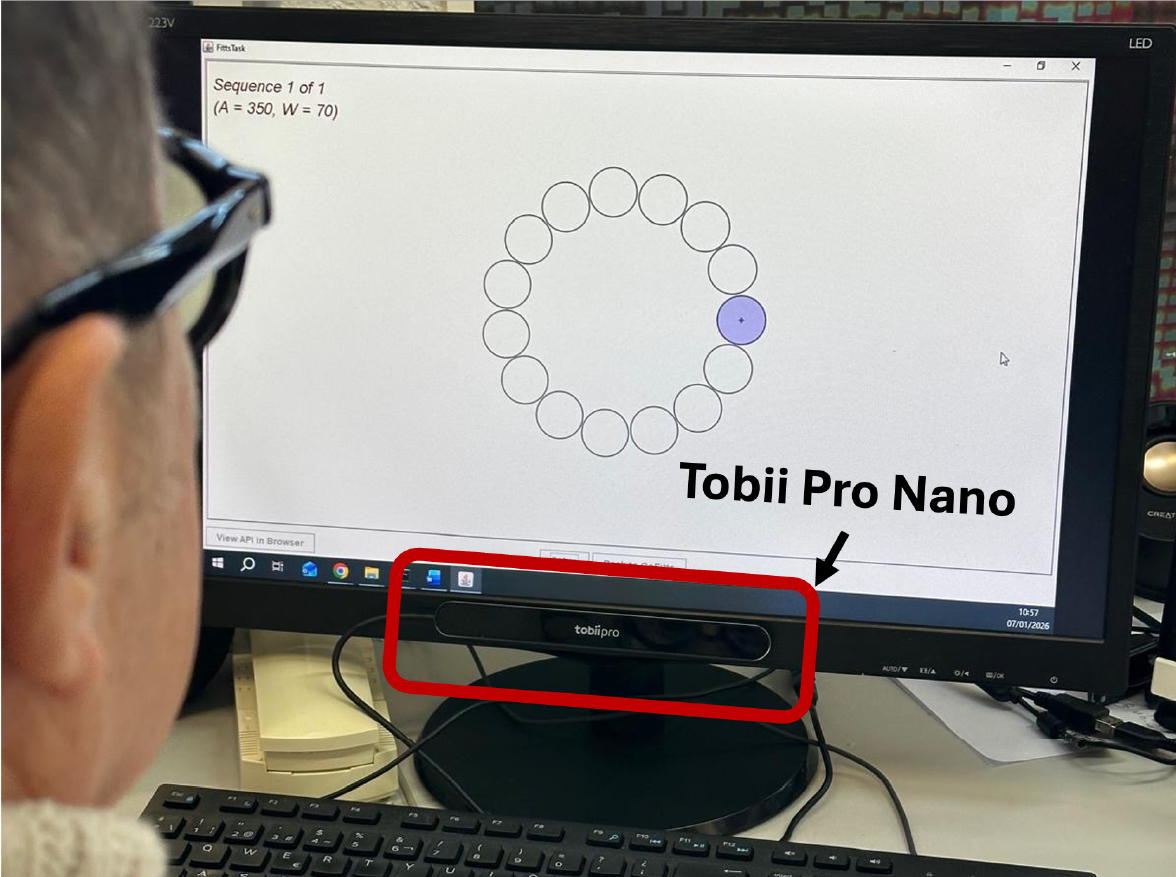
The apparatus included a Tobii Pro Nano eye tracker connected to an Intel i5-10400 desktop computer and positioned below an external display with a resolution of 1280 × 800 pixels. See Fig. 1. The participants were positioned with their eyes ≈60 cm in front of the display. At this distance, the display resolution corresponds to visual angles of 45.5° × 29.5°.
Fig. 1. Participant in front of the desktop computer with the Tobii eye-tracker connected. The experiment task is seen in the display.
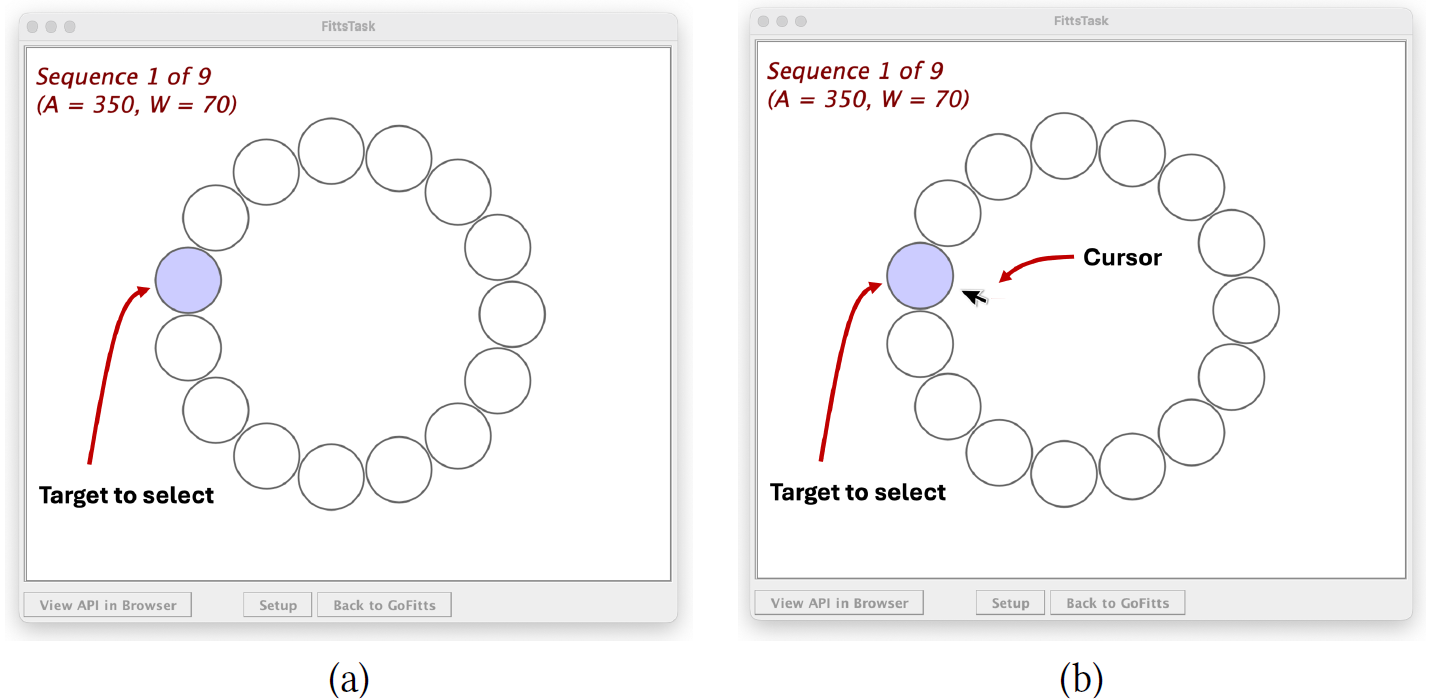
The software was GoFitts1, a Java implementation for experiments using ISO testing of input techniques. We used the two-dimensional (2D) task with the Mouse-over highlight option checked, which highlights the target with a different color when the cursor is above a target. For the cursor mode conditions, the Hide cursor option was checked for Hide, unchecked for Show (see Cursor in Fig. 2b).
Fig. 2. Screenshot of an experiment condition with A = 350 px and W = 70 px. The task was to select the highlighted circle. (a) The option Hide cursor is checked, hiding the cursor; (b) The option Hide cursor is unchecked, showing the cursor.
User input combined eye-tracking for pointing and three selection methods. For Blink selection, a mouse button event was triggered when the user closed both eyes (i.e., blinking) for at least 200 ms. For Wink selection, the mouse button event was triggered when the user closed her/his preferred eye for winking for at least 500 ms while the other eye stayed open. For Dwell-time selection, the mouse-button event was triggered upon the cursor remaining inside the target for a fixed duration of 600 ms, a typical value for gaze-based target selection [Majaranta and Räihä 2002].
2.3 Procedure
On entering the experiment room, participants were briefed on the research goals, signed a consent form, then performed the Miles Test for eye dominance. They also indicated their preferred eye for winking.
Participants sat on an office chair in front of the eye-tracker system and display (at a viewing distance of ≈60 cm). The height of the chair and the position of the display were adjusted for calibrating the eye-tracker system. Calibration was performed using a custom routine implemented in PsychoPy [Peirce et al. 2022].
After calibration, the experiment task was explained and participants did a few practice sequences. The instructions were to proceed as quickly and accurately as possible. Participant were told that if they were unable to select a target, they could force selection outside the target area (i.e., generating a selection error) by pressing the Esc key. They rested as needed between sequences. At the end of the experiment, users were asked about their preference for showing or not showing the cursor, about their preferred method for selection, and about which interaction method felt the most fatiguing. Testing lasted about 1 hr per participant.
2.4 Design
The experiment was a 2 × 3 × 3 × 3 within-subjects design with the following independent variables and levels:
- Cursor mode: Hide, Show
- Selection method: Wink, Blink, Dwell-time
- Amplitude (A): 200, 350, 550 px
- Width (W): 37, 50, 70 px
The primary independent variables were cursor mode and selection method. For cursor mode, the levels were either showing a visual cursor on the gaze position (show) or not showing the cursor (hide). For selection method, the levels were performing the selection action by closing both eyes (blink), by closing one eye (wink), or by dwelling a target for 600 ms (Dwell-time). Amplitude and width were included to gather a sufficient quantity of data over a reasonable range of task difficulties: with index of difficulties (IDs) from 1.95 bits to 3.99 bits.
For each A-W condition, participants performed a sequence of 15 trials. As the test is the multi-directional tapping, an odd number of targets is required [Roig-Maimó et al. 2026]. The cursor mode conditions were counterbalanced using a Latin square. The selection method conditions were randomized within cursor mode conditions. The amplitude and width conditions were randomized within cursor mode and selection method conditions.
The dependent variables were throughput, movement time, error rate, and target re-entries. Target re-entries is the number of times per trial the cursor entered the target after previously entering it [MacKenzie et al. 2001, Figure 3]. The gaze coordinates returned by the eye-tracker were also collected, jointly with the cursor trace and selection data from the GoFitts application.
Following the sex and gender equity in research (SAGER) guidelines [Heidari et al. 2016], we gathered a balanced set of participants and included sex as a between-subjects factor in the analysis.
The total number of trials was 9720 (=12 participants × 2 cursor modes × 3 selection methods × 3 amplitudes × 3 widths × 15 trials/sequence).
3 Results and Discussion
In this section, results are given for throughput, movement time, and error rate. Analyses for the collected gaze, cursor, and selection coordinates are also reported.
First, we note that the group effect was not statistically significant (p > .05) for all dependent variable; thus, counterbalancing had the desired effect of offsetting order effects. Also, the effect of sex on all dependent variables was not statistically significant (p > .05).
3.1 Throughput
The grand mean for throughput was 1.87 bps. This aligns with values in the literature which range from about 1.7 to 3.1 bps for gaze input [Hansen et al. 2018; Minakata et al. 2019; Qian and Teather 2017; Zhang and MacKenzie 2007]. See Fig. 3. The means by cursor mode were 1.91 bps (Hide) and 1.83 bps (Show), representing a 4.4% advantage for target selection when the cursor is hidden, although 7 of 12 participants (58.3%) showed a preference for the visible cursor. The effect of cursor mode on throughput was not statistically significant (F1,11 = 0.89, ns).
Fig. 3. Results for throughput (bps) by (a) cursor mode and (b) selection method. Error bars show ±1 SE.
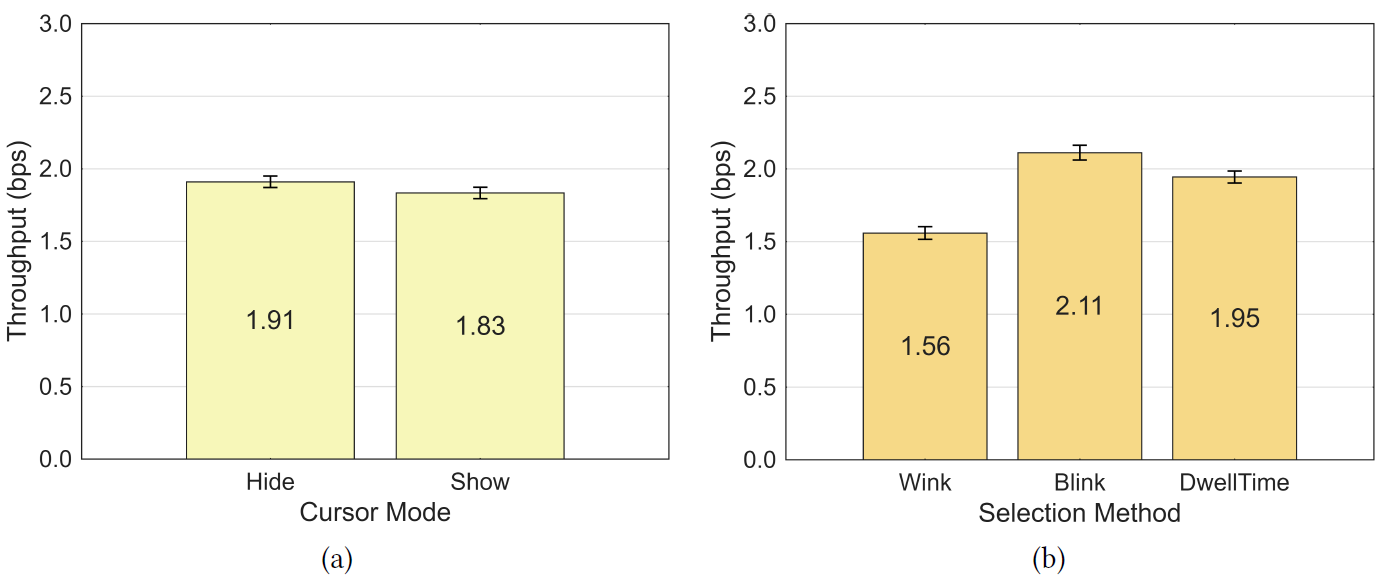
Throughput for wink selection was 1.56 bps, about 26% lower than the value of 2.11 bps for blink selection, which achieved the highest throughput. The mean throughput for dwell-time selection was 1.95 bps. The effect of selection method on throughput was statistically significant (F2,22 = 13.00, p < .001). A Scheffé test revealed that the difference between the pairs wink vs. blink was statistically significant (p < .05). Although the highest throughput was with blink selection, only two participants (16.7%) preferred this selection method; the others all preferred dwell-time selection (the selection method that achieved the second highest throughput). No participant postulated in favor of wink selection, which was cited as the most tiring method by nine participants (75%). This result leads to a conclusion that wink was the worst selection method, dwell-time best (even though dwell-time throughput was about a 7.6% lower than blink).
A result worth mentioning is that participants using their dominant eye for winking achieved 27% lower throughput using the wink selection method (1.25 bps) than the participants who kept open their dominant eye and used their non-dominant eye for winking (1.71 bps). Closing the dominant eye also affected error rate, generating almost a 46% higher error rate (26.8%) than closing the non-dominant eye (error rate = 18.4%). This result suggests that closing the dominant eye could be too disruptive to participants' vision, leading to a decrease in the accuracy of the selections.
Although all participants were able to wink with at least one eye, not all humans are able to wink voluntarily, as winking is a learned ability [Lin et al. 2019]. This capability could explain the worse performance of winking as selection method; however, results could improve with practice.
3.2 Movement Time
The grand mean for movement time was 1663 ms. See Fig. 4.
Fig. 4. Results for movement time (ms) by (a) cursor mode, and (b) selection method. Error bars show ±1 SE.
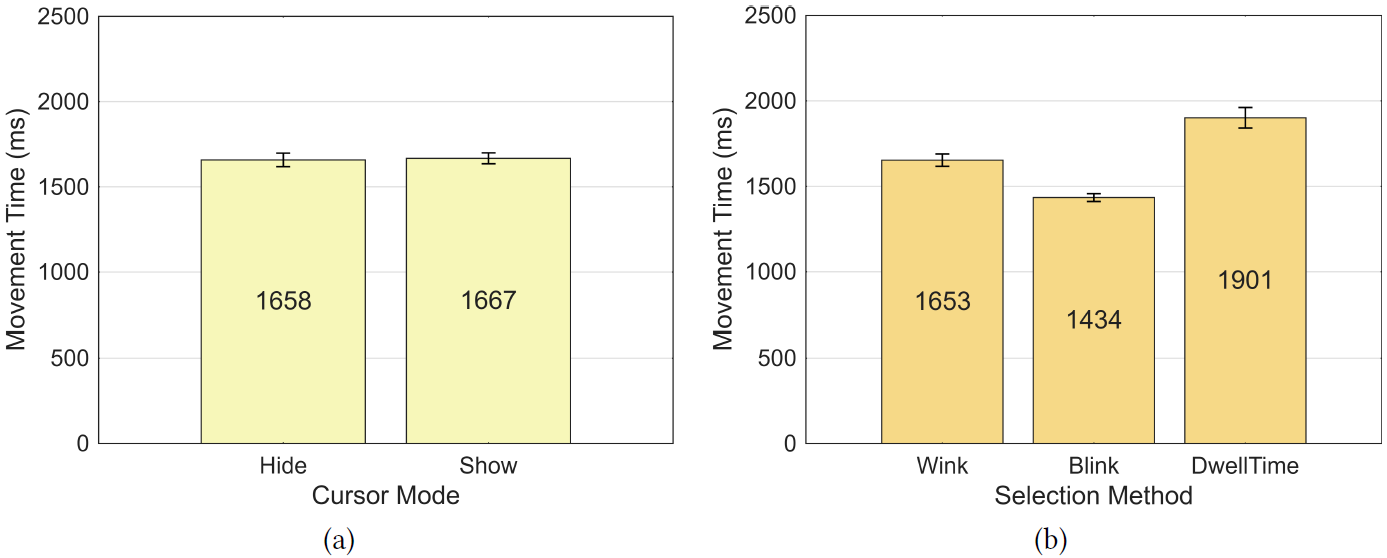
The means by cursor mode were 1658 ms (Hide) and 1667 ms (Show). See Fig. 4a. The difference was not statistically significant (F1,11 = 0.02, ns). The means by selection method were 1653 ms (Wink), 1434 ms (Blink), and 1901 ms (Dwell-time). See Fig. 4b. The fastest movement time was for blink, which was almost a 25% faster than dwell-time, the slowest selection method. The effect of selection method on movement time was statistically significant (F2,22 = 15.60, p < .001). A Scheffé post hoc analysis revealed a significant difference only for blink vs. dwell-time (p < .05).
3.3 Target Re-entries
Fig. 5. Results for target re-entries (count/trial) by (a) cursor mode, and (b) selection method. Error bars show ±1 SE.
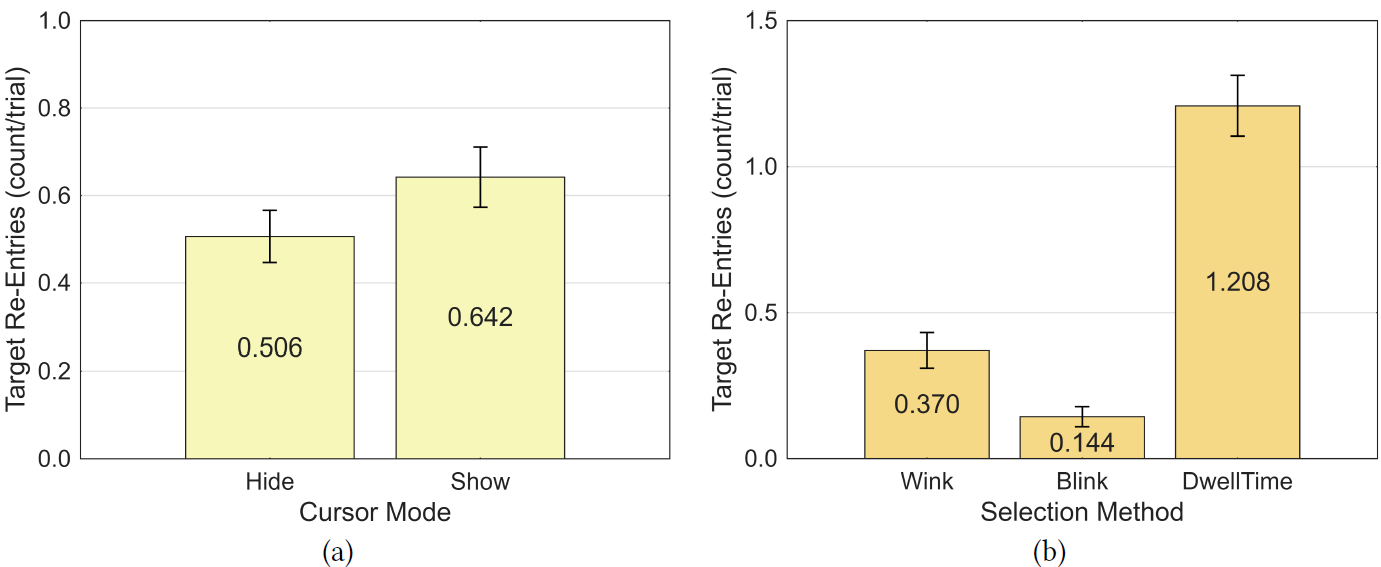
The grand mean for target re-entries was 0.574 per trial. See Fig. 5. The results of target re-entries by selection method (see Fig. 5b) are proportional to those for movement time (see Fig. 4b): dwell-time selection generated the highest number (1.208 per trial), while blink generated the lowest number of target re-entries (0.144 per trial). The difference was statistically significant (F2,22 = 15.77, p < .001), with a Scheffé post hoc analysis revealing significant differences between the pairs blink vs. dwell-time and dwell-time vs wink. Although the effect of cursor mode on target re-entries was not statistically significant (F1,11 = 1.30, p < .05), it is worth noting that the number of target re-entries when the cursor is shown is almost 27% higher than when the cursor is hidden (see Fig. 5a). This suggests participants used backward or compensatory movements to get feedback on the cursor position, even when the gaze coordinate is inside the target (see Section 3.5 and Fig. 7).
3.4 Error Rate
The grand mean for error rate was 10.7%. See Fig. 6 for results by cursor mode (see Fig. 6a) and selection method (see Fig. 6b). The means by cursor mode condition were 10.41% (Hide) and 10.99% (Show). The difference was not statistically significant (F1,11 = 0.29, ns).
For the wink selection method, the mean error rate was 20.40%; which was the highest error rate. The mean error rate for blink selection method was 9.88%, less than the half the error rate for wink. For dwell-time selection, the mean was 1.82% (the lowest error rate), about 82% less than for blink selection. The difference was statistically significant (F2,22 = 34.48, p < .001) with a Scheffé post hoc analysis indicating significant differences between all pairs.
Considering the results for throughput, participant's preferences, and error rate, wink is the least recommended selection method, whereas the most recommended selection method is dwell-time, surpassing blink.
Fig. 6. Results for error rate (%) by (a) cursor mode, and (b) selection method. Error bars show ±1 SE.
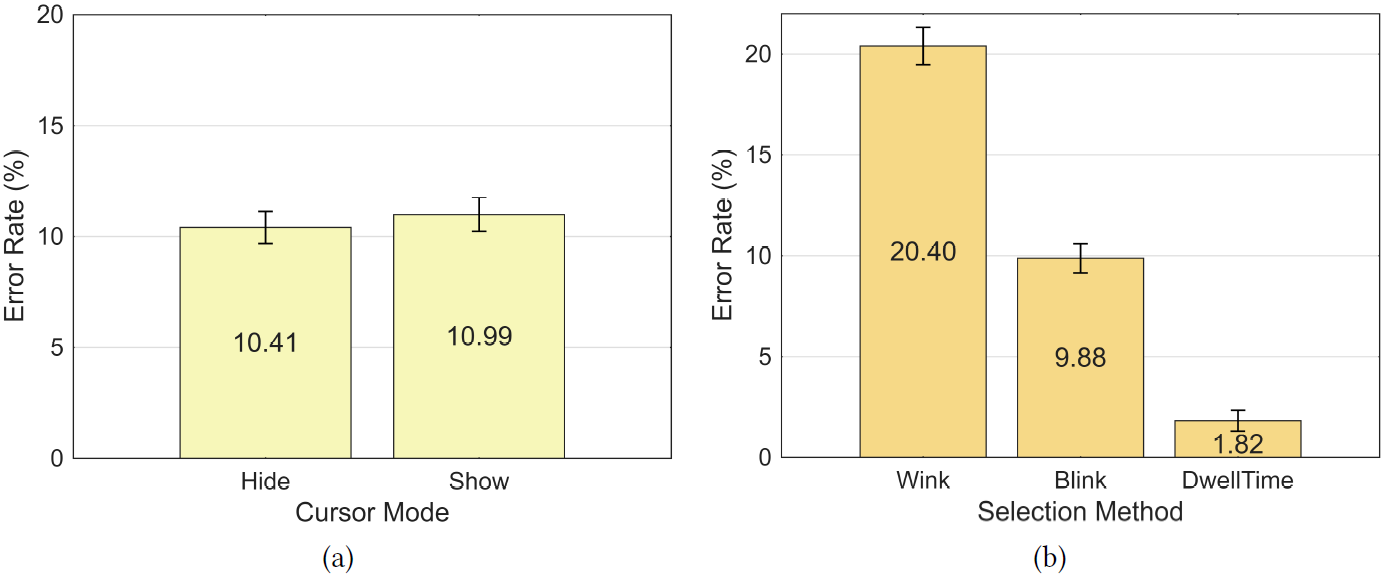
Fig. 7. Example gaze path and selection coordinates for one participant, P07 under condition A = 550 px and W = 70 px with cursor hidden (first row) and shown (second row). Columns depict selection methods: wink (left), blink (center), and dwell-time (right). Eye-tracker data are blue. Coordinates recorded by GoFitts are red with lines as the cursor path and circles for selection points.

3.5 Gaze and Selection Coordinates
Despite no significant effect of cursor mode on throughput, movement time, or error rate, when overlapping eye tracking gaze coordinates with the cursor coordinates (Fig. 7), eye movements when the cursor is hidden (blue points in the first row in Fig. 7) seem more oriented to reach the targets than when the cursor is shown (blue points in the second row on Fig. 7), where some backward movements are observed. These effects suggest that the visual cursor may distract participants, redirecting their attention to the visual cursor instead of the target.
4 Conclusion
Wink, blink and dwell-time selection were compared in an ISO 9241-411 2D pointing task, testing each selection method with the cursor either visible or hidden. Cursor visibility had no significant effect on throughput, movement time, or error rate, suggesting that visual cursor feedback is not essential for target selection in this context. However, qualitative preferences slightly favored showing the cursor. Eye movement overlays further suggest that a visible cursor can induce corrective or backward movements, potentially shifting attention from the target to the visual cursor.
Among the selection techniques, blink achieved the highest throughput, indicating that bilateral eye closure provides fast and effective selection. Dwell-time produced slightly lower throughput, the lowest error rate, and was the most preferred method, providing the best balance between speed and accuracy. In contrast, wink performed worst, with higher errors and lower throughput, and it was also perceived as the most fatiguing. Moreover, wink performance varied with ocular dominance: closing the dominant eye was associated with poorer results, consistent with the idea that it may interfere with visual control during selection. From a user interaction perspective, dwell-time is robust when accuracy and user acceptance are priorities, and blink is a good alternative when maximizing speed is more important and users are comfortable with explicit eye closure. However, if a learning process is not envisaged and considering that winking is a learned ability, wink does not appear to be suitable as a gaze selection technique.
To the best of our knowledge, there is no prior work comparing gaze selection based on wink, blink and dwell-time under a common ISO 9241-411 pointing-task protocol. Use of ISO-conforming testing provides both internal and external validity allowing results to be compared with those in other studies using the same standardized methodology.
Ethics Statement
The experiment was conducted according to the guidelines of the Declaration of Helsinki, and approved by the Research Ethics Committee (079CER25).
Acknowledgments
This work is part of the Project PID2022-136779OB-C32 (PLEISAR) funded by MICIU/AEI/10.13039/501100011033/ and FEDER, EU. The authors thank the University of the Balearic Islands and the Department of Mathematics and Computer Science for their support.
References
John Paulin Hansen, Vijay Rajanna, I. Scott MacKenzie, and Per Bækgaard. 2018. A Fitts' law study of click and dwell interaction by gaze, head and mouse with a head-mounted display. In Proceedings of the Workshop on Communication by Gaze Interaction - COGAIN '18. ACM, New York, 7.1-7.5. https://doi.org/10.1145/3206343.3206344
Shirin Heidari, Thomas F Babor, Paola De Castro, Sera Tort, and Mirjam Curno. 2016. Sex and gender equity in research: Rationale for the SAGER guidelines and recommended use. Research Integrity and Peer Review 1, 1 (May 2016), 2.
Anke Huckauf and Mario H. Urbina. 2011. Object selection in gaze controlled systems: What you don't look at is what you get. ACM Trans. Appl. Percept. 8, 2 (Feb. 2011), 13.1-13.14. https://doi.org/10.1145/1870076.1870081
ISO. 2012. 9241-411. Ergonomics of human-system interaction - Part 411. Report. International Organization for Standardization.
Piotr Kowalczyk and Dariusz Sawicki. 2019. Blink and wink detection as a control tool in multimodal interaction. Multimedia Tools and Applications 78, 10 (01 May 2019), 13749-13765. https://doi.org/10.1007/s11042-018-6554-8
Chou-Ching K. Lin, Kuo-Jung Lee, Chih-Hsu Huang, and Yung-Nien Sun. 2019. Cerebral control of winking before and after learning: An event-related fMRI study. Brain and Behavior 9, 12 (2019), e01483. https://doi.org/10.1002/brb3.1483
I. Scott MacKenzie. 2012. Evaluating eye tracking systems for computer input. In Gaze interaction and applications of eye tracking: Advances in assistive technologies, P. Majaranta, H. Aoki, M. Donegan, D. W. Hansen, J. P. Hansen, A. Hyrskykari, and K.-J. Räihä (Eds.). IGI Global Scientific Publishing, New York, 205-225. ISBN:978-1-61350-098-9.
I. Scott MacKenzie and Behrooz Ashtiani. 2011. BlinkWrite: efficient text entry using eye blinks. Universal Access in the Information Society 10, 1 (01 Mar 2011), 69-80. https://doi.org/10.1007/s10209-010-0188-6
I. Scott MacKenzie, Tatu Kauppinen, and Miika Silfverberg. 2001. Accuracy measures for evaluating computer pointing devices. In Proceedings of the ACM SIGCHI Conference on Human Factors in Computing Systems - CHI '01. ACM, New York, 9-16. https://doi.org/10.1145/365024.365028
Päivi Majaranta, Ulla-Kaija Ahola, and Oleg Špakov. 2009. Fast gaze typing with an adjustable dwell time. In Proceedings of the ACM SIGCHI Conference on Human Factors in Computing Systems - CHI '09. ACM, New York, 357-360. https://doi.org/10.1145/1518701.1518758
Päivi Majaranta and Kari-Jouko Räihä. 2002. Twenty years of eye typing: Systems and design issues. In Proceedings of the 2002 Symposium on Eye Tracking Research & Applications - ETRA '02. ACM, New York, 15-22. https://doi.org/10.1145/507072.507076
Walter Miles. 1929. Ocular dominance demonstrated by unconscious sighting. Journal of Experimental Psychology 12, 2 (1929), 113-126. https://doi.org/10.1037/h0075694
Katsumi Minakata, John Paulin Hansen, I. Scott MacKenzie, Per Bækgaard, and Vijay Rajanna. 2019. Pointing by gaze, head, and foot in a head- mounted display. In Proceedings of the ACM Symposium on Eye Tracking Research & Applications - ETRA '19. ACM, New York, 69.1-69.9. https://doi.org/10.1145/3317956.3318150
Aunnoy K Mutasim, Anil Ufuk Batmaz, and Wolfgang Stuerzlinger. 2021. Pinch, click, or dwell: Comparing different selection techniques for eye- gaze-based pointing in virtual reality. In ACM Symposium on Eye Tracking Research & Applications - ETRA '21. ACM, New York, 15.1-15.7. https://doi.org/10.1145/3448018.3457998
Marcus Nyström, Richard Andersson, Kenneth Holmqvist, and Joost van de Weijer. 2013. The influence of calibration method and eye physiology on eyetracking data quality. Behavior Research Methods 45, 1 (01 Mar 2013), 272-288. https://doi.org/10.3758/s13428-012-0247-4
Youn Soo Park and Roberto Manduchi. 2024. A functional usability analysis of appearance-based gaze tracking for accessibility. In Proceedings of the 2024 Symposium on Eye Tracking Research & Applications - ETRA '24. ACM, New York, 54.1-54.7. https://doi.org/10.1145/3649902.3656363
Jonathan Peirce, Michael MacAskill, and Rebecca Hirst. 2022. Building experiments in PsychoPy. SAGE, Thousand Oaks, CA. https://www.torrossa.com/ it/resources/an/5282591
Ken Pfeuffer, Lukas Mecke, Sarah Delgado Rodriguez, Mariam Hassib, Hannah Maier, and Florian Alt. 2020. Empirical evaluation of gaze-enhanced menus in virtual reality. In Proceedings of the 26th ACM Symposium on Virtual Reality Software and Technology - VRST '20. ACM, New York, 20.1-20.11. https://doi.org/10.1145/3385956.3418962
Franziska Prummer, Mohamed Shereef Abdelwahab, Florian Weidner, Yasmeen Abdrabou, and Hans Gellersen. 2025. It's not always the same eye that dominates: Effects of viewing angle, handedness and eye movement in 3D. In Proceedings of the ACM SIGCHI Conference on Human Factors in Computing Systems - CHI '25. ACM, New York, 748.1-748.10. https://doi.org/10.1145/3706598.3713992
Yuan Yuan Qian and Robert J. Teather. 2017. The eyes don't have it: An empirical comparison of head-based and eye-based selection in virtual reality. In Proceedings of the 5th Symposium on Spatial User Interaction - SUI '17. ACM, New York, 91-98. https://doi.org/10.1145/3131277.3132182
Argenis Ramirez Ramirez Gomez, Christopher Clarke, Ludwig Sidenmark, and Hans Gellersen. 2021. Gaze+Hold: Eyes-only direct manipulation with continuous gaze modulated by closure of one eye. In ACM Symposium on Eye Tracking Research &Applications - ETRA '21. ACM, New York, 10.1-10.12. https://doi.org/10.1145/3448017.3457381
M. F. Roig-Maimó, R. Mas-Sansó, and I. S. MacKenzie. 2026. Design of 2D Fitts' law experiments: An odd thing about targets. Applied Ergonomics 131 (2026), 104680. https://doi.org/10.1016/j.apergo.2025.104680
R. William Soukoreff and I. Scott MacKenzie. 2004. Towards a standard for pointing device evaluation: Perspectives on 27 years of Fitts' law research in HCI. International Journal of Human-Computer Studies 61, 6 (2004), 751-789. https://doi.org/10.1016/j.ijhcs.2004.09.001
Yushi Wei, Rongkai Shi, Sen Zhang, Anil Ufuk Batmaz, Pan Hui, and Hai-Ning Liang. 2025. Reevaluating the gaze cursor in virtual reality: A comparative analysis of cursor visibility, confirmation mechanisms, and task paradigms. IEEE Transactions on Visualization and Computer Graphics 0, 1 (2025), 1-13. https://doi.org/10.1109/TVCG.2025.3622042
Xuan Zhang and I. Scott MacKenzie. 2007. Evaluating eye tracking with ISO 9241 - Part 9. In Proceedings of HCI International - HCII '07 (LNCS 4552). Springer, Heidelberg, 779-788. https://doi.org/10.1007/978-3-540-73110-8_85
-----
Footnotes:
1
https://www.yorku.ca/mack/FittsLawSoftware/doc/index.html?GoFitts.html