|
with Naomi Nagy (University of Toronto)
Variationist studies tend to examine one language at a time, essentially treating speakers as monolingual. A full understanding of how linguistic variation is used to construct identity requires examining multilingual speakers’ full repertoires. We undertake this by pursuing analysis of heritage language (HL) in those ethnic enclaves selected for analysis of English: Cantonese, Faetar, Italian, Korean, Russian, Ukrainian, and Urdu. This project permits us to address questions such as: Which features, structures, rules or constraints are cross-linguistically relevant to borrowing? Which are borrowed earlier and more often in this type of contact situation? Which social factors are cross-linguistically relevant to borrowing? Do the same (types of) speakers lead changes in HLs and in English? Is leadership in language change inherent, or do leaders choose to use one language for this social “work”? The ultimate goal of this project is multivariate analysis of cross-linguistic variables to test for parallel conditioning across HLs.
funded by the Social Sciences and Humanities Research Council of Canada
with Michol Hoffman
(York University)
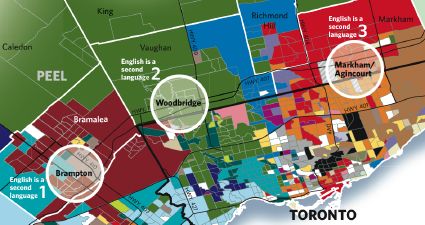
Toronto, considered the most multicultural city in the world, features
a high degree of contact among speakers of different minority languages
in an English-dominant context. However, ethnic groups tend to settle
in particular neighbourhoods, leading to “ethnic enclaves” which have
been argued to impede the acquisition of English and result in “ESL varieties”
of English. This project represents the first large-scale attempt to systematically
address the effects of language contact in this multicultural setting.
We are interviewing residents of Toronto, stratified according to generation
and ethnic origin. We further stratify younger speakers according to their
perceived degree of orientation to the relevant ethnic group. We are exploring
the ways in which people use linguistic variation to construct and express
ethnic identities by examining the social and linguistic patterning of
several linguistic features.
funded by the
Social Sciences and Humanities Research
Council of Canada and the Faculty
of Arts, York University
with
Jack Sidnell (University
of Toronto) and Miriam Meyerhoff
(University of Edinburgh)
The
island of Bequia is located in St. Vincent and the Grenadines. The majority
of its roughly 5,000 inhabitants descend from
Africans brought to the Caribbean during the 17th and 18th centuries,
while a small minority trace their ancestry to British indentured laborers
relocated from Barbados in the mid-19th century. Despite the small
size of the island (7 square miles), people tend to live in
geographically and socially distinct communities, resulting in a surprising
degree of dialectal diversity. This project combines sociolinguistic
interviews and recordings of daily and group interaction with more in-depth
ethnographic observation, to examine the role of ethnic boundaries in
maintaining separate grammatical systems. We are providing a detailed
analysis of an array of interrelated grammatical features which have been
implicated in studies of English-based creoles, nonstandard varieties
of English and African American Vernacular English. The coexistence of
different linguistic varieties in the same communities offers a valuable
opportunity to investigate the interaction of different underlying grammatical
systems.
funded
by the United States National Science Foundation
and the Social Sciences and Humanities Research
Council of Canada
with
Shana Poplack (University
of Ottawa)
The
unparalleled success of Quebec‘s language laws has fundamentally
altered the relationship of English and French in the province. The received
wisdom is that English has undergone language change as a result of its
minority-language status and its contact with French, This project tests
this claim by examining variable grammatical structures of spoken Quebec
English. We compare the speech of older anglophones who grew up before
the Quiet Revolution of the 1960s with that of younger generations. If
contact-induced language change has occurred, it should be most evident
among those who grew up after Bill 101 (1977). We supplement this generational
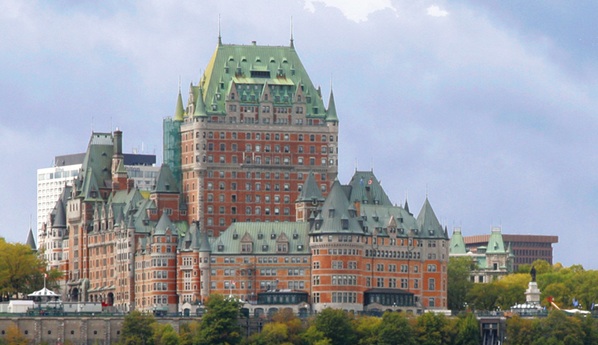
comparison by comparing the English spoken in urban centres in which the
proportion of English mother-tongue claimants varies widely: Quebec City
and Montreal. If contact-induced change is a result of minority status,
its effects should be most apparent in Quebec City, where anglophones
have constituted a minority since at least 1796. We focus on English grammatical
structures with apparent counterparts in French, which are said to be
prime candidates for transfer.
funded
by the Social Sciences and Humanities Research
Council of Canada
|