MacKenzie, I. S. (2026). Looking back to the future: Characterizing feedback loops in adaptive systems. Proceedings of the 31st International Conference on Intelligent User Interfaces - IUI '26, pp. 77-80. New York: ACM. doi:10.1145/3742414.3794729 [PDF]
Looking Back to the Future: Characterizing Feedback Loops in Adaptive Systems.
I. Scott MacKenzie
Dept. of Electrical Engineering and Computer Science
York University, Toronto, ON, Canada
mack@yorku.ca
Abstract. We examine adaptive systems wherein feedback loops adjust system properties to enhance the user experience or interaction performance. Through examples it is illustrated that the range of durations for feedback loops is huge, from less than one second to months, even years. To fully encapsulate the range of possibilities, a modified time-scale of human action model is presented. The model uses world views and bands to position human actions by their durations. Using a log scale, actions are positioned in bands with durations ranging from less than one second to years and beyond. This paper is a call to research in intelligent and adaptive systems to more fully describe, quantify, and characterize the feedback loops for adaptation.
CCS Concepts
• Human-centered computingKeywords: adaptive systems, intelligent systems, feedback loops, time scale of human action
1 Introduction
One goal of intelligent systems is to support interactions that are adaptive. System properties or interactions are automatically changed or fine-tuned in some way based on events in the past—events relating to user behaviour or environmental circumstances [6, 18, 20]. The goal is to improve the user experience or the efficiency of interactive tasks. Using events in the past to alter current or future interaction is, in essence, a feedback loop. The system looks back and makes adjustments to improve future interactions.
This short paper is a call to action for research in adaptive systems to acknowledge and explicitly detail temporal properties in the feedback loops for adaptive interaction. Important properties are the extent back in time for the feedback loop and the duration and history of events considered. That is, how far back in time is information gathered and what is the duration of the events in which corrective information occurs? These are what drive adaptive interaction. As we demonstrate shortly, the range of timelines is huge, from less than a second at one extreme to months, even years, at the other.
2 Time scale of human action
Our model for positioning feedback loops according to their timeline builds on Newell's time scale of human action [21, p. 122]. See Fig. 1. The model positions human action into world views: historical, social, rational, cognitive, and biological. Each world view is divided into three bands with time scales ranging from 104 seconds in B1 at the bottom of the biological world view to 108 seconds in B13 in the historical world view. Although the historical world view was not included in the original model, Newell speculated in subsequent analyses on historical and evolutionary world views positioned above the social world view [21, p. 152]. Our model adds an historical view, but tops-out at "years" in B13. Bands for "decades" (B14) and "centuries" (B15) complete the model but are set in gray due to their limited relevance to adaptive systems.
Figure 1: Time scale of human action [21]. The behaviour of adaptive systems is modified based on recent events (e.g., band B5, seconds) or events from months or years past (e.g., band B13, years).
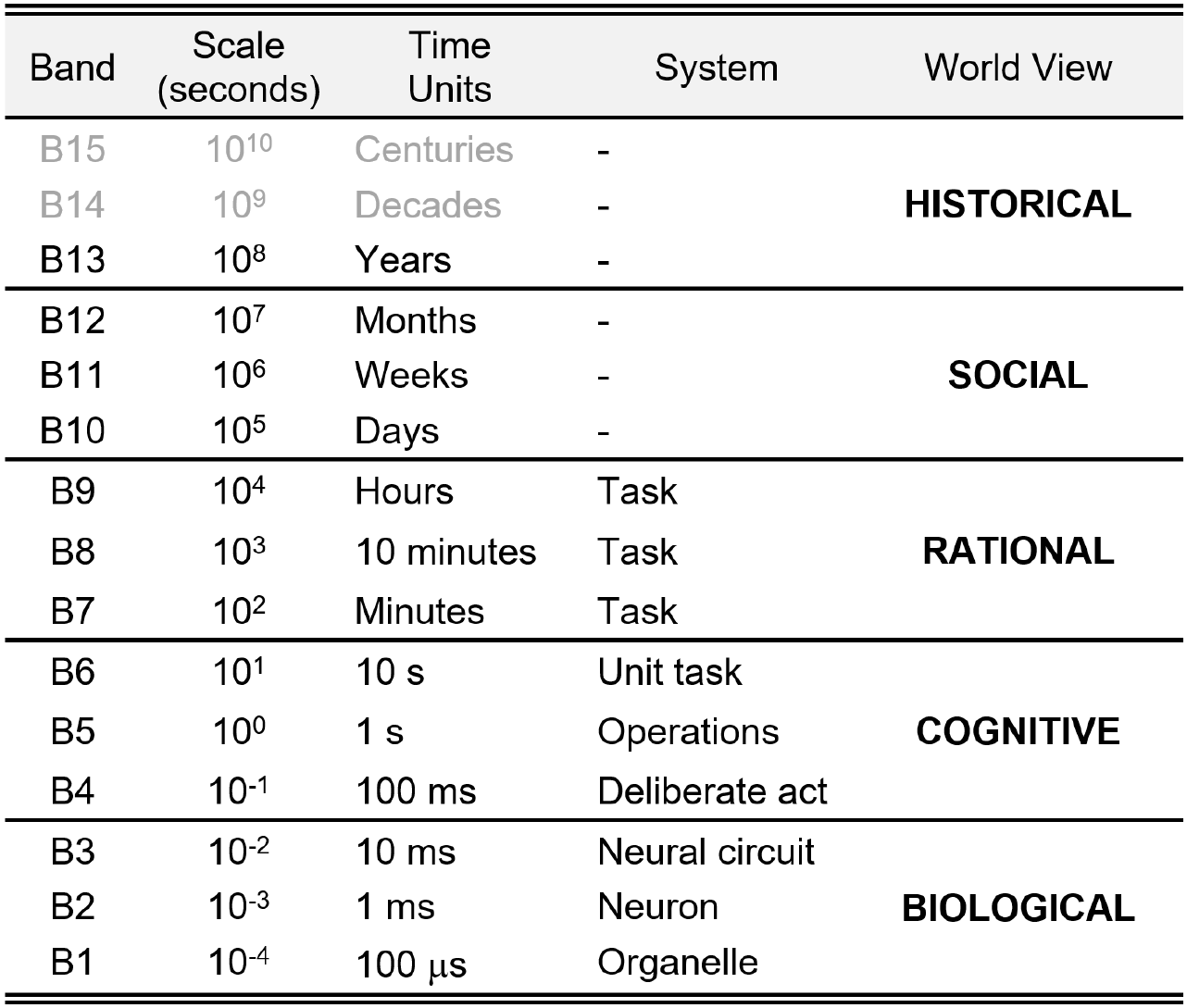
A key message herein is for research in adaptive systems to identify, describe, and position feedback loops for adaptation into world views or bands, as per Fig. 1. In the top bands are adaptive interactions where the feedback loop considers user interactions and histories looking back in time, for example, weeks, months, or even years. An example is a newsfeed tailored to a user's habits in reading online news. The bottom bands are for adaptive interactions with a shorter timeline on the information considered. An example is an exergame where game intensity is altered according to the user's recent achievements in playing the game.
The time-scale model in Fig. 1 is an example of a descriptive model (cf. predictive model). There are many examples in the literature, including Buxton's three-state model for graphical input [5, Figure 3], Russell's circumplex model of affect [26, Figure 1], MacKenzie and Castellucci's frame model of visual attention [16, Figure 3], or Johansen's quadrant model for groupware [11, Figure 1]. By and large, descriptive models avoid equations or analytics and instead seek to partition a problem space into constituent parts [15, p. 294]. There are no proofs, equations, or r-values for descriptive models; they are simply tools for thinking about relevant issues in a UI problem space—to describe and distinguish, but also to challenge and offer opportunities for novel ways to think about the domain. The time-scale model in Fig. 1 provides such an opportunity for adaptive systems.
Timelines for adaptive interfaces are not fixed points. They are fluid and adjusted with weightings and other heuristics, as per the context of interaction [13]. Considering the newsfeed example, if a user is fond of reading about, say, volcanoes, then recent news about volcanoes is a good choice for the newsfeed. However, if the user has not read any stories about volcanoes for eight months (or eight years!), then the relevance diminishes. So, the band in Fig. 1 for a newsfeed is not simply a net that collects topical information in a given timeframe; relevance through weightings and other considerations is essential, although not included in the discussions herein.
One motivation for this short paper is that most research on adaptive interaction is vague on the timelines for the feedback loop or only uses simulated data [7, 9, 14, 24, 25, 31]. This is particularly true for high-level tasks and commercial products where information on, for example, a user's reading patterns or purchasing habits is processed in proprietary algorithms.
3 Examples
There is no shortage of examples of research on adaptive systems; all use feedback from earlier behaviour to inform change in the system, sometimes using machine learning (ML) or large language models (LLM), but often just using a novel algorithm on collected data. Fig. 2 positions a few examples within bands from the time-scale model in Fig. 1. The goal is simply to highlight the wide range of possibilities.
Figure 2: Example timelines of feedback loops for adaptive systems. The band (Bn) corresponds to the elapsed time looking back from "now" wherein relevance is below a threshold to be considered for adaptation. See text for discussion.
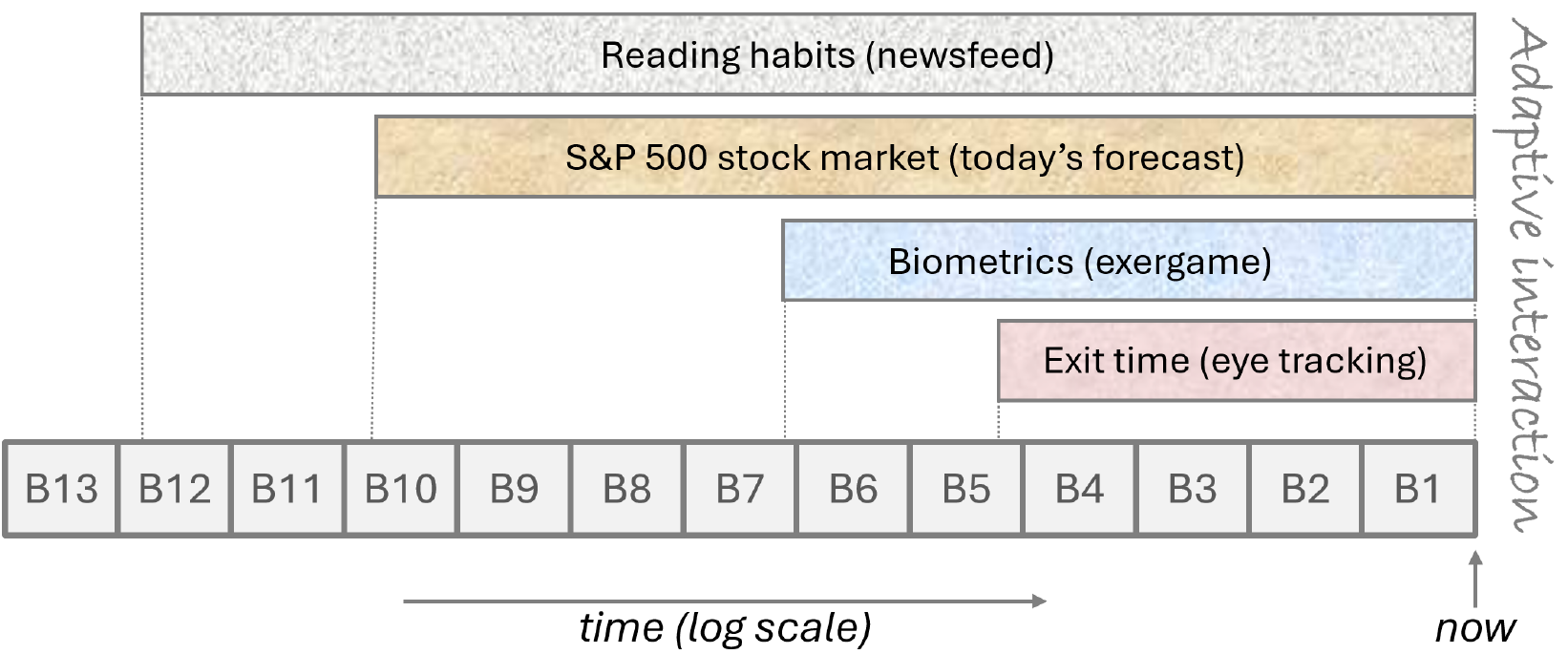
The top example is for adjusting a newsfeed based on a user's reading habits. There are many examples [3, 19, 23, 25, 27, 28]. The timelines are long for reading habits, perhaps months, which is to say, B12 in the time-scale model in Fig. 1. Systems that generate suggestions for online purchasing or movie viewing (aka recommender systems) have a similar timeline.
Below the example for newsfeed adaptation, we place daily forecasts for phenomena such as tracking (and predicting!) daily movement in the stock market, for example, using Kaggle.1 Weather forecasting and traffic monitoring are similar. Here, information is considered during the current day so the feedback loop aligns with band B10 in Fig. 1.
Adaptive systems may also work with low-level tasks, taking on the order of seconds or tens of seconds. The feedback loop is shorter and often works with a user's behavioural biometrics or sensorimotor interactions. Adaptive games, often exergames, are examples, such as adjusting game difficulty in a VR environment based on a player's heart rate [32], or adjusting game parameters based on eye movements [1, 22, 29], brain signals [6, 10, 12], or user proficiency [2]. For these examples, the change in system behavior occurs through information gathered within a short timeframe prior to the change. Bands B7 (minutes) or B6 (10s of seconds) are typical.
Some interactions may be improved by adjustments at an even lower level. Fig. 2 cites eye tracking interaction where targets are typically selected using a dwell-time criterion. That is, selection occurs when the cursor enters and remains inside a target for specified duration, typically about 600 ms. Considerable research has explored low-level mechanisms to automatically adjust the dwell-time interval based on patterns of short-duration eye movement [4, 9, 17, 30]. Špakov et al. [30] used "exit time"—the time from target selection to the user's gaze point exiting the target. The durations are short—a second, typically less [30, Figure 4]—so the timeline is placed at band B5 in Fig. 1. There are many other short-term examples, including Duraisamy et al.'s [6, p. 131] use of a 0.5 second window for eye blink durations (measured using EEG signals) for dynamically adjusting the difficulty and environment of a game, or Putz et al.'s [24, p. 265] use of a 1 s window in a touch-based card-matching task. A slightly longer feedback loop of 4 s was used by Gomaa et al. [8, p. 5] in a multi-modal task involving pointing and driving. The B6 band seems appropriate in this case.
4 Conclusion
At this juncture, it is worth summarizing a key motivation of descriptive models such as the time scale of human action. Above, the model was shown capable of partitioning the problem space of adaptive systems according to the timelines in feedback loops. Using the model, we exposed behaviours that are dramatically different and seemingly unrelated—for example, exit time (previous paragraph) and a user's reading habits—and demonstrated that they are simply points at opposing ends of the same property in a particular context. The property is timelines and the context is feedback loops in adaptive systems. Enabling this type of thinking and organization is a key trait of descriptive models. For adaptive systems, the model offers an opportunity for a novel way of thinking about and characterising mechanisms of adaptation, with the proviso that requisite information is provided in research papers.
This short paper presented a call to action for research in intelligent and adaptive systems to more carefully detail and characterize the feedback loops used for adaptation. We demonstrated through examples that the range of durations for the feedback loops is huge, from less than a second to months, even years. Behaviours that on the surface appear distinct, unrelated, and of vastly different mechanisms, are well served and unified by the world views and time bands in a descriptive model for the time scale of human action.
GenAI Usage Disclosure
In preparing this work, the author did not employ any Generative AI tools.
References
[1] Hamdi Ben Abdessalem, Maher Chaouachi, Marwa Boukadida, and Claude Frasson. 2019. How do players' eye movement relate to their excitement in a VR adaptive game? In Proceedings of the Thirty-Second International Florida Artificial Intelligence Research Society Conference – FLAIRS '19. AAAI, Washington, DC, 270–274. https://cdn.aaai.org/ocs/18222/18222-78841-1-PB.pdf
[2] Kleber de O. Andrade, Guilherme Fernandes, Glauco A.P. Caurin, Adriano A.G. Siqueira, Roseli A.F. Romero, and Rogerio de L. Pereira. 2014. Dynamic player modelling in serious games applied to rehabilitation robotics. In 2014 Joint Conference on Robotics: SBR-LARS Robotics Symposium and Robocontrol. IEEE, New York, 211–216. https://doi.org/10.1109/SBR.LARS.Robocontrol.2014.41
[3] Nattapat Boonprakong, Saumya Pareek, Benjamin Tag, Jorge Goncalves, and Tilman Dingler. 2025. Assessing susceptibility factors of confirmation bias in news feed reading. In Proceedings of the ACM SIGCHI Conference on Human Factors in Computing Systems – CHI '25. ACM, New York, 418.1–418.19. https://doi.org/10.1145/3706598.3713873
[4] Seamus P. L. Burnham, Sonja Bonar, Mackenzie Collins, and T. Claire Davies. 2025. The effects of dynamic dwell time systems on the usability of eye-tracking technology: A systematic review and meta-analyses. Human-Computer Interaction 0, 0 (5 2025), 1–25. https://doi.org/10.1080/07370024.2025.2497236 Open Access.
[5] William Buxton. 1990. A three-state model of graphical input. In Proceedings of the IFIP TC13 Third International Conference on Human-Computer Interaction – INTERACT '90. Elsevier, Amsterdam, 449–456. https://billbuxton.com/3stateModel.pdf
[6] Saravanakumar Duraisamy, Nick Roeser, Mateusz Dubiel, and Luis A. Leiva. 2025. An adaptive brain-computer interface game with blink controls and cognitive state monitoring. In Companion Proceedings of the 30th International Conference on Intelligent User Interfaces – IUI '25. ACM, New York, 129–132. https://doi.org/10.1145/3708557.3716365
[7] Chengyu Fan, Zaynab Tariq, Nafis Saadiq Bhuiyan, Michael G. Yankoski, and Trenton W. Ford. 2024. Comp-HuSim: Persistent digital personality simulation platform. In Proceedings of the 32nd ACM Conference on User Modeling, Adaptation and Personalization – UMAP '24. ACM, New York, 98–101. https://doi.org/10.1145/3631700.3664883
[8] Amr Gomaa, Guillermo Reyes, Michael Feld, and Antonio Krüger. 2024. Looking for a better fit? An incremental learning multimodal object referencing framework adapting to individual drivers. In Proceedings of the 29th International Conference on Intelligent User Interfaces – IUI '24. ACM, New York, 1–13. https://doi.org/10.1145/3640543.3645152
[9] Katarzyna Harezlak, Pawel Basek, and Pawel Kasprowski. 2023. Adaptive dwell time for eye typing. Procedia Computer Science 225 (2023), 4015–4023. https://doi.org/10.1016/j.procs.2023.10.397
[10] Baosheng James Hou, John Paulin Hansen, Cihan Uyanik, Per Bækgaard, Sadasivan Puthusserypady, Jacopo M. Araujo, and I. Scott MacKenzie. 2022. Feasibility of a device for gaze interaction by visually-evoked brain signals. In Proceedings of the 2022 Symposium on Eye Tracking Research & Applications – ETRA '22. ACM, New York, Article 62, 7 pages. https://doi.org/10.1145/3517031.3529232
[11] Robert Johansen. 1991. Groupware: Future directions and wild cards. Journal of Organizational Computing and Electronic Commerce 1, 2 (1991), 219–227. https://doi.org/10.1080/10919399109540160
[12] Alexander Y. Kaplan, Sergei L. Shishkin, Ilya P. Ganin, Ivan A. Basyul, and Alexander Y. Zhigalov. 2013. Adapting the P300-based brain–computer interface for gaming: A review. IEEE Transactions on Computational Intelligence and AI in Games 5, 2 (2013), 141–149. https://doi.org/10.1109/TCIAIG.2012.2237517
[13] Yehuga Koren. 2009. Collaborative filtering with temporal dynamics. In Proceedings of the 15th ACM SIGKDD International Conference on Knowledge Discovery and Data Mining – KDD '09. ACM, New York, 447–456. https://doi.org/10.1145/1557019.1557072
[14] Maciej Korzepa, Michael Kai Petersen, Jakob Eg Larsen, and Morten Mørup. 2020. Simulation environment for guiding the design of contextual personalization systems in the context of hearing aids. In Proceedings of the 28th ACM Conference on User Modeling, Adaptation and Personalization – UMAP '20. ACM, New York, 293–298. https://doi.org/10.1145/3386392.3399291
[15] I. Scott MacKenzie. 2024. Human-computer interaction: An empirical research perspective (2nd ed.). Morgan Kaufmann (an imprint of Elsevier), Cambridge, MA. https://www.yorku.ca/mack/HCIbook2e/
[16] I. Scott MacKenzie and Steven J. Castellucci. 2013. Eye on the message: Reducing attention demand for touch-based text entry. International Journal of Virtual Worlds and Human-Computer Interaction (VWHCI) 1, 1 (2013), 1–9. https://doi.org/10.11159/vwhci.2013.001
[17] Päivi Majaranta, Ulla-Kaija Ahola, and Oleg Špakov. 2009. Fast gaze typing with an adjustable dwell time. In Proceedings of the ACM SIGCHI Conference on Human Factors in Computing Systems – CHI '09. ACM, New York, 357–360. https://doi.org/10.1145/1518701.1518758
[18] Mark Maybury. 1998. Intelligent user interfaces: An introduction. In Proceedings of the 4th International Conference on Intelligent User Interfaces – IUI '98. ACM, New York, 3–4. https://doi.org/10.1145/291080.291081
[19] Federico Milana, Enrico Costanza, and Joel E. Fischer. 2023. Chatbots as advisers: The effects of response variability and reply suggestion buttons. In Proceedings of the 5th International Conference on Conversational User Interfaces – CUI '23. ACM, New York, 14.1–14.10. https://doi.org/10.1145/3571884.3597132
[20] Constantinos Mourlas and Panagiotis Germanakos (Eds.). 2008. Intelligent user interfaces: Adaptation and personalization systems and technologies. IGI Global, Hershey, PA. ISBN: 978-1-60566-032-5.
[21] Allen Newell. 1990. Unified theories of cognition. Harvard University Press, Cambridge, MA. ISBN: 0-674-92101-1.
[22] João Perdiz, Luís Garrote, Gabriel Pires, and Urbano J. Nunes. 2021. A reinforcement learning assisted eye-driven computer game employing a decision tree-based approach and CNN classification. IEEE Access 9 (2021), 46011–46021. https://doi.org/10.1109/ACCESS.2021.3068055
[23] Aditya Kumar Purohit, Kristoffer Bergram, Louis Barclay, Valéry Bezençon, and Adrian Holzer. 2023. Starving the newsfeed for social media detox: Effects of strict and self-regulated Facebook newsfeed diets. In Proceedings of the ACM SIGCHI Conference on Human Factors in Computing Systems – CHI '23. ACM, New York, 196.1–196.16. https://doi.org/10.1145/3544548.3581187
[24] Felix Putze and Mazen Salous. 2021. Multimodal differentiation of obstacles in repeated adaptive human-computer interactions. In Proceedings of the 26th International Conference on Intelligent User Interfaces – IUI '21. ACM, New York, 260–269. https://doi.org/10.1145/3397481.3450641
[25] Qin Ruan, Jin Xu, Susan Leavy, Brian Mac Namee, and Ruihai Dong. 2024. Rewriting bias: Mitigating media bias in news recommender systems through automated rewriting. In Proceedings of the 32nd ACM Conference on User Modeling, Adaptation and Personalization – UMAP '24. ACM, New York, 67–77. https://doi.org/10.1145/3627043.3659541
[26] James A. Russell. 1980. A circumplex model of affect. Journal of Personality and Social Psychology 39, 6 (1980), 1161–1178. https://doi.org/10.1037/h0077714
[27] Nina Sakhnini and Debaleena Chattopadhyay. 2022. A review of smartphone fact-checking apps and their (non) use among older adults. In Adjunct Publication of the 24th International Conference on Human-Computer Interaction with Mobile Devices and Services – MobileHCI '22. ACM, New York, 24.1–24.8. https://doi.org/10.1145/3528575.3551448
[28] Jules Sinsel, Anniek Jansen, and Sara Colombo. 2023. Facebook data shield: Increasing awareness and control over data used by newsfeed-generating algorithms. In Proceedings of the Seventeenth International Conference on Tangible, Embedded, and Embodied Interaction – TEI '23. ACM, New York, 46.1–46.6. https://doi.org/10.1145/3569009.3573116
[29] Stephen Vickers, Howell Istance, and Aulikki Hyrskykari. 2013. Performing locomotion tasks in immersive computer games with an adapted eye-tracking interface. ACM Transactions on Accessible Computing 5, 1 (Sept. 2013), 2.1–2.33. https://doi.org/10.1145/2514856
[30] Oleg Špakov and Darius Miniotas. 2004. On-line adjustment of dwell time for target selection by gaze. In Proceedings of the Third Nordic Conference on Human-Computer Interaction – NordiCHI '04. ACM, New York, 203–206. https://doi.org/10.1145/1028014.1028045
[31] Jason Wu, Kashyap Todi, Joannes Chan, Brad A Myers, and Ben Lafreniere. 2024. FrameKit: A tool for authoring adaptive UIs using keyframes. In Proceedings of the 29th International Conference on Intelligent User Interfaces – IUI '23. ACM, New York, 660–674. https://doi.org/10.1145/3640543.3645176
[32] Soojeong Yoo, Callum Parker, and Judy Kay. 2017. Designing a personalized VR exergame. In Proceedings of the 25th Conference on User Modeling, Adaptation and Personalization – UMAP '17. ACM, New York, 431–435. https://doi.org/10.1145/3099023.3099115
-----
Footnotes:
1 https://www.kaggle.com