
Student Research Projects

Mushtari Afroz (MA)
Published Paper: Afroz, M. (2024). De-stabilizing creative placemaking in the creative city. Journal of Art, Media, and Visual Culture, 6(1), 159–179. ojs.lib.uwo.ca
Abstract: Recent decades have seen a surge in the implementation of creative placemaking initiatives in cities worldwide. Often considered a facet of a new urban vision in the post-modern era, creative placemaking aims to rejuvenate public spaces by integrating art and cultural activities in the urban design process. By acknowledging the transformative potential of art and culture and positioning them as catalysts for social change, this approach seeks to enhance livability, foster diversity and stimulate economic development in previously overlooked and underserved neighbourhood communities. Despite the realization of some promises and the abandonment of others, a critical question arises - To what extent, under the veneer of creative expression, does creative placemaking genuinely serve benevolent purposes? I argue in this essay that creative placemaking, masquerading as an art-centred strategy, is in reality a political urban plan aligned with the principles of neoliberal capitalism to tame the city.
Hurmat Ain (PhD)
Presented a Performance Lecutre entitled Hold Your Tongue at the University of Vienna in May, 2024
Hurmat presented a sensory lecture and artist talk exploring encounters of the tongue, focusing on the intersecting positionalities of orality and tasting. The presentation examined artistic practices rooted in storytelling and performative expressions of mourning, particularly around food and medicine, as pathways toward healing and restitution. In this work, the audience was invited to engage with a tasting palette of "healing spices" drawn from South Asian culture and cuisine. The act of tasting served as a performative medium to build anatomical, visceral, and gustatory connections, linking the tongue to historical complexities and the legacies of colonial violence.

Danielle Alfaro (PhD)
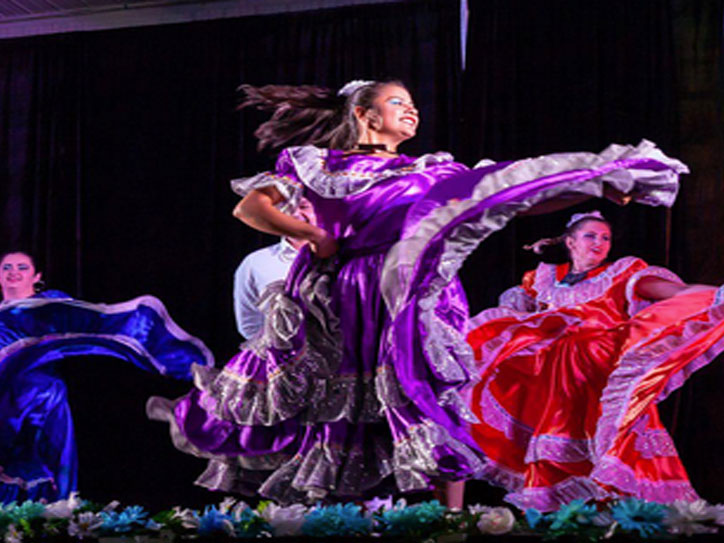
Research Interest: Traditional folk dancing performed by the Salvadoran diaspora in Canada and its relationship to activism and identity.
Laurel Green (PhD)
Recently published an article in the Canadian Theatre Review (Vol. 197, Winter 2024) entitled Seeding the Future (This Is Not a Metaphor): Creative Acts of Public Gardening with Yarrow Collective.
Abstract: In a world beset by climate crisis, how can artists create participatory performance work that moves audiences from distant spectators to become active agents with an awareness of the role they play in a larger ecosystem? On lək̓ʷəŋən territory, colonially known as Victoria, BC, Yarrow Collective creates multidisciplinary installations that invite communities into creative acts of public gardening. In this case study, co-creators Sammie Gough and Laurel Green trace the development of their new work for Pacific Opera Victoria’s Voices in Nature that toured city parks. Drawing from a wide variety of influences, they envision the transformative potential of weaving together their artistic practices in an ongoing collaborative relationship with the life cycles of Indigenous plants and pollinators. They confront their own settler-inherited, extractive notions of what a garden should be and explore what becomes possible when gardening is shifted from expert labour to a shared creative act. Yarrow Collective’s installations become meeting places for intergenerational temporary communities that offer ecological resources, hold space for uncomfortable truths, and yield opportunities for ongoing stewardship as both collective journeys and site-responsive living artworks.
Yarrow Collective: yarrowcollective.ca/about-us
Social Media: @yarrowcollective_
Laurel Green's website: laurel-green.com/


Published a paper in Capacious: Journal for Emerging Affect Inquiry [Vol. 3. No. 2 ( May 2024)] entitled A Driving Force: Relational Bodies in the Ethnographic Periphery.
Abstract: This paper examines how the act of driving a car shapes identity through relational moments of contact. So often in our social interactions individuals are recognized through the roles they inhabit or actions they repeatedly undertake, whether that be teacher, father, gardener, etc. These roles are not solidified identities, but are rather momentary performances that an individual must temporarily embody in accordance with the circumstances they find themselves in. For many people, driving is a mundane practice that enables ‘more important’ activities in their daily lives, and yet for the time that a person operates a motor vehicle they must make their embodiment of that role a top priority. Using auto-ethnography, I will be looking at how a person ‘becomes’ a driver when they are driving by locating themselves in relation with their surroundings and how those interactions may shape identity for the duration of time that a person is driving. I will be considering how the individual is an intermediary point of contact in a web of relations and how responses to those interactions can shape how that person shows up in the world by considering how a person recognizes and accommodates for their relations with the objects, environments, and people they come into contact with while operating a motor vehicle.
Deanne Kearney (PhD)
Recently published a paper in Critical Stages the IATC Journal (Vol. 29, June 2024) entitled Dancing with AI: Unveiling the Potentials and Pitfalls of ChatGPT for a New Wave of Dance Critics and Criticism.
Abstract: This study aims to examine the multifaceted implications of employing ChatGPT in dance criticism, focusing on its potential for instant editing, the ability to aid writing in diverse critical styles and its potential pitfalls, such as algorithmic biases, privacy and copyright issues and the perpetuation of racist or incorrect stereotypes within movement and dance genres. I argue that ChatGPT will initiate a new age of dance criticism, different from the scholarly attention that has been given to the transition to digital criticism. This research will explore the extent to which biases in training data can impact the quality and objectivity of ChatGPT’s output in relation to dance and movement. By identifying and addressing these pitfalls, this study aims to promote responsible AI integration into dance criticism, ensuring that critics harness ChatGPT’s potential while remaining vigilant against the adverse effects of algorithmic biases.
Deanne also runs her own dance review website, The Dance Debrief (dancedebrief.ca), where she covers dance and theatre performances in Ontario. Deanne’s full portfolio is available at DeanneKearney.com.


Sodienye Waboso Amajor (PhD)
Performance Installations at Metanoia: The Experience in Downtown St. Catharines, ON (September 2023) entitled REST.
A methodology of denouncing mindless productivity and a physical resistance to the corporatization and privatization of Black energy and time. .As part of a journey through a guided tour of site-specific audio, visual, and performance installations, participants were invited to momentarily re-imagine various public spaces in the downtown core. This experience transformed the everyday landscape of downtown St. Catharines, concluding at the Civic Centre.
Kelly Jean Lynch (PhD)
Recently published a paper in Women's Innovations in Theatre, Dance and Performance (Vol 1, 2024) entitled “Moving Away from Delsarte: Conversations on the History and Practice of Psycho-Physical Culture”, Co-authored with Magdalena Kraler, Maria Meindl, Selma Landen Odom, and Libby Smigel, edited by Kim Daniher and Marlis Schweitzer.
Abstract: As a group of scholars researching a set of specific yet variously-named traditions of embodied practice, the authors consider how the issue of naming affects historiography. Over two centuries, terms associated with this tradition have included American Delsartism, Aesthetic Dance, Yoga, Dalcroze Eurhythmics, Elsa Gindler, and Somatics. Approaches to naming have included associating an individual with a practice, choosing descriptive terms, or refusing to name. Drawing on a conversational format which the group has evolved over two years of virtual gatherings, the essay includes remarks by each contributor on how naming enters her research, along with group exploration of historiographic issues and implications for ongoing study. In libraries and archives, naming affects outcomes because it impacts searchability, and the lack of attention to naming contributes to the under-studying of this often female-led tradition. The discussion suggests moving toward “psycho-physical culture” as an overarching term for these and other distinctive yet related practices.


Derek Manderson (PhD)
Recently published a paper in Canadian Theatre Review (Vol 196, pp 87–89, February 2024) entitled “A Negotiation of Collaborative Play: Asses.Masses”.
Abstract: What happens when an audience is presented with a video game and a single controller? Such is the conceit of the ongoing episodic performance asses.masses, developed by Patrick Blenkarn and Milton Lim. From the crowd, a player must step up to control a donkey tasked with the preservation of its animal workforce as new advancements in farm machinery threaten to displace the entire collective. In this piece of writing, the author discusses how the show cultivates an environment for emergent strategies of play and social negotiation. Situated within the context of returning to live theatre, the author blends influences from performance and game studies theory in an auto-ethnographic analysis of the player experience. In the process, notions of choice, leadership, and positionality are explored as key considerations in audience collaboration.
utppublishing.com
Jayna Mees (PhD)
Movement Director, working with Professor Peter Kuling (University of Guelph) on Macbeth VR Experience in Spring 2024.
Project Description: The Macbeth VR Experience aimed to explore how VR theatre might be used as an educational tool for high school students studying Shakespeare and was published on the Ontario Exchange Network in spring 2024.
U of G Researcher Reimagines Theatre with Virtual Reality Experience | Office of Research


Collett Murray (PhD)
Recently published a chapter: Chapter 3 Integrating Anti-Racist Collaboration with African-Diasporic Teaching Artists in Tanya Berg’s book, Arts-Based Pedagogies: Integrating Culturally Relevant Creative Processes in K-12 Education.
Decription: Arts-Based Pedagogies explores the transformative potential of creative-learning through the implementation of arts integration in K–12 classrooms. Contributors share real-world experiences of bringing the arts into their curriculum and share success stories of using interdisciplinary approaches to build vibrant, student-centred environments that enrich student experience without sacrificing academic rigour.
Written from a Canadian perspective, Arts-Based Pedagogies merges theory and practice, providing practical implementations of teaching, learning, evaluation, and assessments that have enriched their own teaching practice and helpful steps pre-service and experienced educators alike can use to engage students in their own classrooms.
Expert contributors explore how various arts including dance, drama, visual arts, and music can cultivate critical thinking, independence, and confidence in students through decentering the Eurocentric methods of teaching and provide more tools and approaches to educators to meet the diverse needs of each student.
A perfect resource for those studying to be the next generation of teachers, this unique text brings the fine arts to the forefront of teaching methodologies and provides practical strategies to implement that will inject the exciting creativity of the arts into any subject for both the educator and the students.
Arts-Based Pedagogies – Canadian Scholars
Mariló Núñez (PhD)
Field Research with Canadian Playwrights.
Description: Mariló Núñez is conducting field research with six to eight Canadian playwrights, exploring how race influences the dramatic writing process. The study employs the Fornes Method, a playwriting pedagogy that encourages writers to enter the creative process without preconceived ideas, focusing instead on character development. Over the course of a two-week intensive, playwrights will engage in movement, visualization, found object/word exercises, drawing, and a communal writing process to build their worlds. Throughout the research, discussions will center on how race shapes characterization, story, and theme, as writers of color draft the first version of a new play. This study aims to deepen understanding of race-conscious storytelling and the ways in which structured improvisational techniques influence the creative process.

Faculty Research Projects

Hemispheric Encounters
The Hemispheric Encounters research project is led by Dr. Laura Levin, an Associate Profession of Theatre, Dance & Performance Studies at York University. Hemispheric Encounters: Developing Transborder Research-Creation Practices brings together scholars, artists, activists, and community organizations from across the Americas to explore hemispheric performance as an artistic practice for addressing social and environmental justice.
For more information, please review the Hemispheric Encounters website.
Imaginative Ethnography
The Imaginative Ethnography project, led by Dr. Rebecca Caines, is a transnational, independent research and creation network whose work spans Canada, China, Cuba, Haiti, Ireland, Italy, Kenya, and Poland, and is home to 84 members located around the world. A space for hospitality that welcomes you to join conversations about new ethnographic writing, and multisensory, multimedia, and multimodal storytelling in practice, in theory, and in learning and teaching. A point of departure that invites you to live and work differently, to reimagine the pasts, presents and futures of the worlds we inhabit.
For more information about Imaginative Ethnography, please visit the Imaginative Ethnography website.


International Institute for Critical Studies in Improvisation
The International Institute for Critical Studies in Improvisation (IICSI) is a research institute focused on exploring improvisation as a model for social practice. It examines how improvisation can promote social justice, community-building, and creative collaboration across various disciplines, including music, performance, and digital media. The institute brings together scholars, artists, and community leaders to investigate the cultural, social, and political significance of improvisation.
Fore more information about the International Institute for Critical Studies in Improvisation, please visit the IICSI website.
MultiPLAY
Dr. Rebecca Caines’ MultiPLAY project is a Canadian initiative that explores digital art and community engagement through improvisation. It incorporates a range of media including sound, music, sculpture, virtual reality, theatre, and more. Led by artist Rebecca Caines, the project involves workshops, live-streamed talks, open studio sessions, and artist hackathons, with a focus on interactive and experimental art forms. MultiPLAY collaborates with festivals, galleries, and community groups across Canada and is supported by the Canada Council for the Arts.
For more information, please review the MultiPLAY website.


(Re)Setting the Stage
The (Re)Setting the Stage research project is led by Dr. Marlis Schweitzer, who serves as the Principal Investigator. The project also involves several co-investigators from the Department of Theatre, Dance & Performance, including Jamie Robinson, Keira Loughran, Mariló Núñez, and Courtney Ch’ng Lancaster. (Re)Setting the Stage seeks to situate debates about theatrical representation and the politics of casting in Canada within a broader historical context, advancing dialogue with directors, playwrights, actors, educators, students, and other creators who are actively transforming professional Canadian theatre and university-level theatre training.
To learn more about (Re)Setting the Stage, and their upcoming projects, carefully review the (Re)Setting the Stage website.
Sensorium
Sensorium is a research center based at York University that focuses on digital arts and technology, exploring how art intersects with science, performance, and digital media. It serves as a hub for innovative projects, research-creation, and critical studies, with a particular emphasis on emerging technologies like virtual reality (VR), augmented reality (AR), and immersive environments. Sensorium brings together scholars, artists, and technologists to foster interdisciplinary collaborations and to explore the role of art in understanding complex global issues.
For further details about Sensorium, including current projects and future research opportunities, please review the Sensorium website.


Toasterlab
Led by Professor Ian Garrett, Toasterlab is a mixed reality performance and immersive media studio that focuses on using technology to enhance storytelling in live performance and art. It explores the intersection of theatre, virtual reality (VR), augmented reality (AR), and other digital technologies to create innovative, immersive experiences. Toasterlab collaborates with artists, researchers, and communities to push the boundaries of interactive and site-specific performances.
For more information, please visit the Toasterlab website.

Learn More
The Graduate Program in Theatre, Dance & Performance Studies at York is an exciting environment to pursue innovative, socially engaging, career-ready education. Contact our Graduate Program Assistant to learn more.