
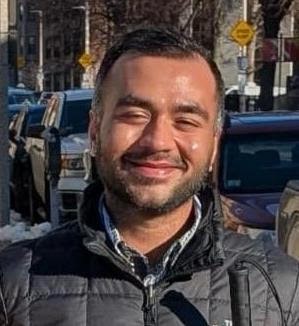
YCAR is delighted to welcome Dr Harsha Anantharaman as the inaugural YCAR Postdoctoral Fellow in Asian Studies. From a large and exceptionally strong pool of applicants, the interview committee was pleased to make this recommendation. YCAR would like to thank Professors Ranu Basu, Laam Hae, Jennifer Hyndman, Joan Judge, Philip Kelly, Marissa Largo, and Muyang Li for adjudicating the files at different stages of the review process.
Dr. Ananthraman’s term begins 01 September 2025. He will be working with YCAR Director Shubhra Gururani (Anthropology) as his supervisor.
Dr Anantharaman is a recent Geography graduate of the University of Minnesota. His research shows how the political economy of labour, the cultural politics of caste-patriarchy, and the material politics of waste converge in the fraught transformation of solid waste management infrastructures in urban India. Prior to his doctoral studies, Dr Anantharaman worked in multiple action-research organizations based in Chennai, India.
During his fellowship, Dr Anantharaman will focus on his book project, “To Caste Away Waste: Racialized Labor and the Political Economy of Commodity Detritus in Urban India.” His research that informs the book examines the impact of formalization policies on informal workers’ lives and livelihoods in urban India. Informal waste-workers (or ‘waste-pickers’) who, as in other Global South contexts, play lynchpin roles in the rapidly transforming domain of urban Solid Waste Management (SWM) in the country.
Through a combination of ethnographic and archival research in four Indian cities, his study reveals that ostensibly progressive efforts towards inclusion through economic formalization and socio-cultural recognition politics in fact deepen labour precarity for most workers and continue to reflect caste-based hierarchies. To account for these evidently paradoxical outcomes, he argues that as state and corporate enclosures turn municipal waste into a private asset and elite-led reform efforts reproduce caste logics, labour relations in urban waste economies are reshaped by two connected processes. Specifically, the informal subsumption of labour and the renewing proliferation of forms of caste-coded recognition. Framing these developments against existing critical scholarship on urban India, his research also highlights more promising alternative pathways.
With Professor Gururani, Dr Anantharaman will be applying for a SSHRC Connection grant to organize a workshop on the politics of waste in global South. He will present his research on 19 November as part of the Demos, Democracy, Democratization: the South Asia Lecture Series in a talk titled The Misrecognition of Misrecognition: Caste, Recognition and the Politics of Waste Work in Urban India.
You can reach Dr Anantharaman at hanant[at]yorku.ca.