
Advancing socially responsible technologies
By: Wendy McCann

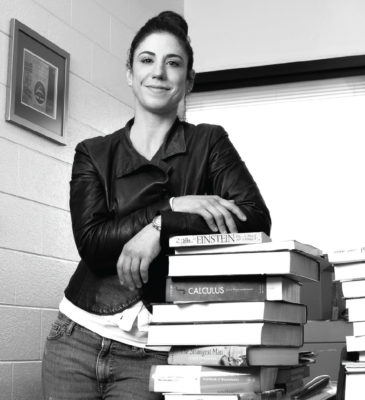
There is a well-thumbed novel on Pina D’Agostino’s bookshelf that keeps her up at night, but also propels her forward.
It is Nobel Prize-winning writer Kazuo Ishiguro’s futuristic fiction Klara and the Sun, in which an anxious generation of parents buy humanoid robots to act as “artificial friends” for their lonely kids. The more privileged parents also leverage genetic enhancement technology to make their children smarter.
“That is my nightmare, and I want to make sure we don’t get to that world,” says D’Agostino, who is the scientific director of Connected Minds, the massive York University-led, next-generation research project that seeks to understand and predict the opportunities and risks to society associated with advancing technology.
“That is why Connected Minds and its work is important. We’re trying to get ahead of the development aspects of technology and advance socially responsible technologies to leave the world a better place – one where we are connected to each other in a human way, not disconnected.”
D’Agostino says Connected Minds is more than a research program; it is a movement toward a future where technology and human well-being evolve together in a more socially beneficial way. With Canada providing $105.7 million in funding toward the $318-million transformational project, creating a new national Ministry of Artificial Intelligence and Data Innovation and putting in place a voluntary code of conduct for technological advances, D’Agostino views the country as a world leader in this type of responsible AI. She expects legislation will come next.
A key player with Connected Minds since before its launch, D’Agostino’s background makes her a natural to lead it. She is a professor at Osgoode Hall Law School and the Tier 1 York Research Chair in Intellectual Property, Artificial Intelligence and Emerging Technologies. She is also founder and director of the IP Innovation Clinic, the country’s largest intellectual property clinic, helping York faculty and researchers as well as the broader community.
"My focus is on how the law and interdisciplinary collaboration can help ensure that no one is left behind."
In the spring of 2025, D’Agostino was appointed as York’s associate vice-president of research, and in October as the Chair of the Board of the Ontario Centre for Innovation.
Connected Minds is already making an impact, and D’Agostino takes particular pride in its interdisciplinary nature. The program brings together universities and industries, hospitals and policy-makers, artists and Indigenous communities, and is engaging more than 50 community partners and research collaborators over seven years to create a responsible and inclusive approach to technological development.
“When we cross over and we work together, great things happen. There is an array of different projects that we are working on, confronting how technologies interplay with human behaviour and ensuring that the goals and outcomes are going to really change the world in a positive way,” says D’Agostino, recognized by Canadian Lawyer magazine as one of the Top 25 Most Influential Lawyers in 2022.
“My DNA has always been one rooted in, I would say, social justice and fairness, and an evidence-based approach to everything I do. I’ve always been fascinated by technology, and how throughout history new forms bring promise, but also challenge different communities. My focus is on how the law and interdisciplinary collaboration can help ensure that no one is left behind.
“We need to get ahead of these challenges and have appropriate governance frameworks in place to ensure we are strong as a society.”
While she’s got her eye on those big picture issues, D’Agostino is also concerned about the impact of technology on her own four children, including her triplets.
“Kids and the next generation, that’s what I come back to,” she says. “Being a mother of four little ones, I see a new generation and a new way of seeing technology. They’re early adopters of it. For better or for worse, the kids are inheriting the world we’re leaving behind for them.”
Read more
The Biophysics of age-related visual brain diseases
Innovative technique will bring to light new treatments and diagnostics for vision-related diseases
Research for a better future
Creating positive change in areas related to decolonization; the integration of AI in healthcare; mitigating racism in classrooms; sustainable arts; and inclusive health care
Full Circle: Alum partners with Cinespace studios and creates student opportunities
Partnership will let students experience behind-the-scenes of a billion-dollar film industry