
Johann Sander Puustusmaa, PhD Student
PhD student, Johann Sander Puustusmaa, multimodal poster presentation at AAA (America Anthropological Association), title - The fleeting city: Density, sound and atmospheres in the everyday urban spaces.
"This poster, displayed at the AAA conference, engaged with the poster format as a playful and conversational engagement. Rather than allow distanced viewing, the poster is without any content which can be consumed in passing. What happens when nobody is around? The city is made up of fragments (McFarlane 2021), overlapping, side-by-side, and superimposed (Moretti 2015). There is always something happening, a reaction or aftermath of something else. The city is evidently eventful (de Certeau 1984; Low 2009).With this work, I wonder how we can study the gaps in-between, or places, where seemingly little happens. This is not to suggest that these places are in any way dormant, or outside of the sociopolitical logics and working of the city.
I juxtapose movements of solitude with conversations, casual exchanges, and recorded interviews. I pay attention to the porosity and multiplicity (Choy 2011; Le Breton 2020; Low 2023) within the spaces and encounters which emerge through an attention to the everyday and ordinary. Attunement, as an "everyday way of attending to" (Peterson 2021: 45), figures in this work as a way of engaging with everyday encounters as they happen, sometimes fleeting and passing, and coming to terms with the contingencies of change. What starts in the dense, busy, and fast-moving Toronto, switches to pockets of activity in Tallinn, and continues onto the empty streets of Reykjavík."

A photo of Johann Sander Puustusmaa

A photo of Aarushie Sharma
Aarushie Sharma, PhD student
PhD student Aarushie Sharma's essay, Inequalities of caste and contract in sewage work in Delhi-NCR, has been published by 360info.org.
Rising contractual employment in sanitation work draws upon and reproduces historical inequalities of caste and class in urban India. In October 2024, Swachh Bharat Mission (SBM), India’s largest sanitation project to make the country ‘open defecation-free’, turned ten. The project constructed over a hundred million toilets and launched behavioural change initiatives encouraging toilet use and hygiene practices to promote ‘cleanliness’. In response to the increasing load on sewerage systems due to rising urban density, SBM’s urban component, SBM-U 2.0, focuses on improving sewage management and developing sewage treatment plants to create a sustainable and comprehensive urban sanitation system. However, these interventions neglect the issues of sewage workers, who constitute the backbone of urban sewage infrastructures. This is seen in the rising contractualisation in sanitation work—outsourcing to private entities or third-party agencies, often with exploitative conditions for workers—that draws upon and reproduces historical inequalities of caste and class in urban India.
This piece draws upon the author’s doctoral research on sewage work and infrastructure in Delhi, alongside fact-finding surveys on sewer and septic tank deaths in 2024, conducted as part of a team of researchers and activists organised by Dalit Adivasi Shakti Adhikar Manch, a social and advocacy forum for sewer workers’ rights in the city. It addresses two forms of contractualisation: privately contracting sewage work to informal workers or casual labourers, and the rising contractualisation in civic bodies that compounds caste inequality for sewer workers mostly belonging to marginalised caste communities. Read the full report on 360info.org.
Shifa Zoya, MA Student
MA student Shifa Zoya's essay, titled: Hum Dekhenge (We Shall See), has been published in the New Sociology Journal of Critical Praxis.
In 2019, protests erupted across India after the Citizenship Amendment Act (CAA) was introduced just before parliamentary elections took place. The act grants expedited Indian citizenship to “illegal” and undocumented migrants belonging to six religious minorities (Hindus, Parsis, Sikhs, Buddhists, Jains and Christians) who escaped to India from religious persecution in Muslim-majority Afghanistan, Bangladesh and Pakistan before December 31, 2014, even without valid visas or other required paperwork. However, the Act excludes Muslims from availing this benefit, resulting in backlash for the Islamophobic policy. It was introduced along with the National Register of Citizens (NRC), which is a list of people who entered India before March 24, 1971, a day before Bangladesh became an independent country. While the register claims to enable the identification and deportation of “illegal” immigrants, it can only identify, apart from Muslims, those without the required documents, an overwhelming majority of whom are women, the poor, marginalised and Indigenous communities, orphans or illiterate people. The CAA and NRC represent two of the many discriminatory laws and policies that have been used to target Muslims in India in a push for a Hindu nation.

A photo of Shifa Zoya
A photo of Sarah Yusuf
Sarah Yusuf, PhD Candidate
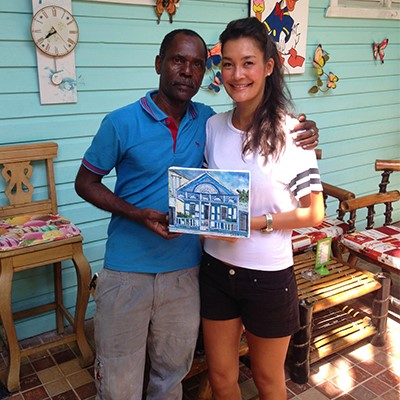
Puerto Plata, Dominican Republic has always held a special place in my heart. It has hosted our family vacations, it is where I learned to dance bachata, it has witnessed the sunburns, the indulgences, and the days spent relaxing under the swaying fronds of palm trees that decorate the beautiful beaches. As a tourist, you pursue that “something more,” you seek to capture a story, a photo, a souvenir of sorts to prove you were “there.” My research traces this idea of the “something more,” but is angled differently, exploring how local encounters with and within the touristic milieu can look and feel while caught up in the overwhelming presence and power of Carnival Cruises – Puerto Plata’s new cruise ship tourism endeavour. Informed by affect theory, this research draws on “haunting” as a way to speak through the ways power makes itself felt, throwing into stark relief the structures of power that reach across time and space to make themselves known in the present. In the field, I spoke with those who found themselves caught up in the cruise ship tourism milieu. These conversations traced their personal experiences, their dreams, nightmares, frustrations, and hopes, often taking us in directions that didn’t lead to anywhere in particular but to an attempt to make sense of it all, of the way events unfolded. I paid close attention to what people said and when, their bodily dispositions, the restraints, the embellishments, the ways the tourism frame worked on people, and the ways people worked on the tourism frame.

Learn More
The Graduate Program in Social Anthropology at York is an exciting environment to pursue innovative, socially engaging, career-ready education. Contact our Graduate Program Assistant to learn more.