

Fenella Amarasinghe is a PhD Candidate in the Faculty of Education,York University. Her research considers the ways that ethics as an attentive relationship to the human and more-than-human world is pedagogically-culturally constituted in engineering education. In addition, Fenella works with Dr. Jeff Harris on a cross-institutional study with colleagues from the University of Manitoba, Waterloo, and Memorial University, investigating the Tech Stewardship Practice Program launched by Engineering Change Lab and MaRS Discovery District. As well, she is collaborating with Dr. Alpha Abebe at McMaster University to investigate students' perspectives on generative AI technologies and higher education.

Arvind Babajee, is a finance professional with a specialisation in Finance and Tech. He also advises clients on international corporate affairs. Dr. Kristin Andrews is York Research Chair in Animal Minds and Professor of Philosophy at York University, where she also helps coordinate the Cognitive Science program and the Greater Toronto Area Animal Cognition Discussion Group. Kristin is on the board of directors of the Borneo Orangutan Society Canada, a member of the College of the Royal Society of Canada, and the author of several books on social minds, animal minds, and ethics.

Guita Banan is a PhD student in the Science and Technology Studies program at York University. She studies history of neuroscience and neurobiological conceptions of humanness through the lens of Feminist STS and Black Studies. The focus of her PhD research is early clinical neurology in the late 19th century United States within the racial context of post-slavery. She aims to understand the entanglements between the emergence of a field concerned with studying bodyminds and the racial shifts and continuations that worked to preserve a privileged and overrepresented category of “human,” as well as implications for contemporary (neuro)ethical discourses.

Muhammad Bilal is a PhD candidate in Science and Technology Studies at York University, with a background in engineering, public policy, and management science. I have over a decade of experience across higher education delivery and technical leadership in the telecommunications and energy sectors. My research focuses on AI governance, privacy and data protection, and the political economy of technoscience, with a particular interest in regulation, assetization, and digital infrastructure studies. I am committed to bridging critical STS scholarship with policy relevant research that supports democratic, accountable, socially just and inclusive governance frameworks for emerging technologies in Canada & beyond.

Guilherme Cavalcante Silva is a PhD Candidate in the Graduate Program in Science and Technology Studies at York University. His research interests cover the topics of AI governance, science and technology policy, and Latin American STS. His PhD dissertation investigates how socioeconomic development is articulated within the country's AI governance scenario, with particular attention to the long-standing issue of technological dependency and how it permeates the articulation of AI futures for Brazil. He was a Visiting Fellow at the Institute for Advanced Studies on Science, Technology and Society (IAS-STS) at Graz University of Technology (TU Graz) in Austria ( May-June 2025).

Jorge Daza is a PhD candidate in Science and Technology Studies at York University. His research is at the intersection of Science and Technology Studies and Health Sciences, having studied neuroscientific visual cultures, psychiatric and dental education, health participation, and forced displacement. Currently, his PhD dissertation focuses on understanding Latin American psychiatric classifications through postcolonial lenses. Jorge has taught courses in medicine, dentistry, psychiatry, psychology, social science, and engineering. He has also published articles in the Journal of Science Communication, Tapuya, Revista Ciencias de la Salud, Trilogía and other journals. Similarly, Jorge was recently awarded the Ontario Graduate Scholarship.

Trevor Doe is a Master’s student in Social Anthropology at York University. His research examines how anticipation of artificial intelligence shapes action in the present for Canadians. Drawing on the anthropology of time and affect, Trevor explores how emotions generated through prominent AI thinkers’ future-making narratives organize public attention, debate, and decision-making today.

Brittany Fields is a PhD Candidate in the Science and Technology Studies program at York University. She also holds a Master’s degree in Information Security & Digital Forensics. Her research interests primarily center on the social impact of digital technologies, with particular attention to dimensions such as privacy, power, culture, equity, and identity. Brittany’s current research investigates the impact of biometric technologies (such as facial recognition), examining how identities are shaped through ongoing, entangled, and mutually constitutive intra-actions.

Yoonmee Han finished her Masters in Critical Disability Studies and started pursuing a PhD in Science and Technology Studies. Yoonmee is interested in community development, co-design of assistive technologies, accessibility, and disability justice.

Hana Holubec is a PhD student at York University in the Science and Technology Studies program. Her ongoing research project looks at the programming of humour and laughter into AI and social robotics. She holds an honours undergraduate degree in Psychology and a Master’s degree in Science and Technology Studies. Her research is informed by her experience as a comedy writer and Improv/clown performer and her work as an arts-based instructor within the disability community, with those living with addiction and mental health issues, and with groups and individuals in bereavement and hospice care.

Dayna is a PhD Candidate in the Science and Technology Studies program at York University. Her work focuses on technoscientific future narratives and their impact on our presents.

Julianna Kowlessar is a PhD student in the joint Communication & Culture program at York and Toronto Metropolitan Universities. She holds an Honours Bachelor of Science in Psychology, an Honours Bachelor of Arts in Communication Studies, summa cum laude, and an MA in Communication & Culture from York University. Her research centres on the benefits of teaching critical media literacy education in K-12 Canadian classrooms and gamified learning. The research Julianna conducted for her master's thesis explored how Ontario pre-service teachers understood and approached critical media literacy to discover practical and unique methods of teaching it to future students.

Andrea Lachmansingh is a PhD Candidate at York University. Supported by the SSHRC (Social Sciences and Humanities Research Council) Doctoral Fellowship, her interdisciplinary research examines AI-driven surveillance technologies in Canadian policing and intelligence institutions.

Mishall Lallani (nee Ahmed) is a PhD Candidate in the Department of Politics at York University. Her research focuses on the use and applications of artificial intelligence (AI) and machine learning in North American governance and immigration processes. She is interested in the challenges posed by the proliferation of AI in everyday life, the processes of data abstraction, data imperialism, and the political economy of techno-scientific innovations.

Katelyn Wan Fei Ma is a PhD candidate researching cybercrime in the Graduate Program of Science and Technology Studies at York University, and a contract teaching faculty member at Wilfrid Laurier University where she teaches topical courses related to cybercriminology. Katelyn also works for TD Bank’s North American Fraud Operations as a Manager of Strategic Initiatives, working primarily as a lead in corporate strategic planning and transformational initiatives.
Visit her website for more academic and professional experiences: https://www.katelynwanfeima.com/

Katrina Matheson returned to graduate school to pursue an MA in the Science and Technology program at York University in 2021, as a continuation of my undergraduate degree in STS from Stanford University. Now as a PhD Candidate, my research centres around artificial intelligence and related technoscientific components, focusing on political economy and policy/governance. Specifically, my dissertation research examines the potential role of third-party liability insurance and/or corporate assurance as mechanisms for standard-setting and accountability in global AI safety.
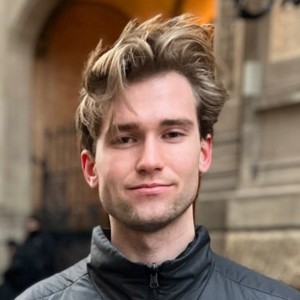
Alexander Martin is a PhD student in the Science and Technology program at York University. Under the supervision of Dr. Robert Gehl, he explores the intersections of AI, ethical social media, and news dissemination in Canada. His research investigates the fediverse as an alternative platform for accessing news amidst legislative changes like the Online Harms Act. Alexander's interests lie in policy intersections, privacy, and economic dynamics shaping Canada's technological landscape. He aspires to foster a Canadian-centric internet that balances innovation with data sovereignty. Through interdisciplinary collaboration, Alexander aims to contribute meaningfully to understanding and addressing socio-technical challenges.

Elif Memis is a doctoral student in the York University Science & Technology Studies graduate program with a BSc (Hons) background in computer and educational technologies. Elif's research interests revolve around social justice and civic engagement, grounded in critical digital literacies and feminist media studies. Her current research analyzes how educational video games inform youths' civic knowledge and democratic behavior in Canada.

Anthony K Nairn is a PhD student in Humanities, working at the intersection of media, science communication, and religion. He is interested in affects, aesthetics, ethics, and narrativity in science popularization. He is Executive Assistant of the International Society for Science and Religion.

Esra Oney is a PhD candidate in the Politics Department at York University. Her research interests span critical development studies, focusing on agrarian politics, critical perspectives on big data and technology in agriculture and humanitarian aid, smallholder rural livelihoods, food systems, and food sovereignty movements in sub-Saharan Africa. Her PhD dissertation explores the new frontiers of agrarian extractivism in Mozambique, examining how mega-investment agrifood projects and the use of innovation accelerators uphold extractive practices and relationships to the land, drawing parallels with colonial extractivism.

Nicholas Palombo is a Political Science PhD candidate at York University whose interdisciplinary research focuses on the intersection of platform governance, content moderation, and body politics. His work explores how social media platforms shape public discourse, political agency, and identity, with a particular focus on how they regulate content and police marginalized bodies. Nicholas's research contributes to understanding the complexities of digital spaces and their impact on democracy, free speech, and social justice.

Rosario del Pilar Rodriguez Romani hold a BA and Professional Degree in Anthropology, along with specialized training in gender studies. I am currently completing an MA in Human Geography at York University and awaiting the CERLAC Graduate Diploma. I am also a Research Associate at the Centre for Research on Latin America and the Caribbean (CERLAC) and an Associate Graduate Student at the Institute for Research on Digital Literacies (IRDL). As a founding member of Antigordofobia Perú—the country’s first collective addressing fatphobia and aesthetic violence—I bring activist, interdisciplinary, and decolonial perspectives to my research on bodies, technoscience, and social inequality.
Meghana is a doctoral candidate in the Science and Technology Studies program at York. Her research examines how digital infrastructures reshape environmental governance in India, with a focus on the forms of legibility, subjectivity, and political authority produced through technologies that monitor and classify environmental data. She is broadly interested in environmental justice, democratic accountability, and technological expertise, and her research aims to contribute to conversations on technology governance and public life.

Ankit Singh's research explores the use of health monitoring apps and wearable technology to protect workers from heat stress in industries like construction and agriculture, as extreme heat events increase due to climate change. He is investigating who truly benefits from these technologies—workers or corporations—and whether workers have control over their biometric data. He aims to address the ethical dilemmas of how this data is used, questioning if it serves to protect workers or primarily benefits corporate interests.

Shabnam Sukhdev is a filmmaker, educator, and interdisciplinary researcher in Theatre, Dance, and Performance Studies at York University. Her award-winning MFA thesis film Unfinished (2021) explored caregiving and mental illness through a maternal lens. Through her SSHRC-funded Connected Minds project, she integrates performance, digital storytelling, and interpretive autoethnography to examine how trauma, disability, and gendered power dynamics shape intergenerational relationships in South Asian diasporic communities. Grounded in feminist and decolonizing frameworks, her research-creation engages South Asian identity, intergenerational memory, and lived experience, creating participatory spaces for reflection, resistance, and dialogue that bridge artistic practice and scholarly inquiry.

Orçun Turan is a consumer culture theory scholar interested in the social and cultural dimensions of consumption, particularly the intersecting axes of inequality such as race, class, gender, and sexual orientation. They are currently a PhD student in marketing at Schulich School of Business, York University, where their research focuses on the interlocked nature of biomedical consumption, knowledge, innovation, and stigma.

Shelbey Walker is a doctoral student in the Science and Technology Studies Program at York University. Her research interests include the intersection of labour and leisure in digital games, discourse of games by the popular media press, and the sponsorship of digital games and esports. Other interests are exploring workplace culture, technology used by type 1 diabetics, and the experiences of gig workers..

Nicole Toivonen Winchester is a PhD student in Science and Technology Studies at York with two decades of experience with evolving digital technologies in media, gaming, and immersive entertainment. By examining Dungeons & Dragons as a sociotechnical assemblage, Nicole’s research explores knowledge production and loss, infrastructures of games as technologies, and processes of platformization. Recipient of an SSHRC CGS Master’s Scholarship, Nicole strives to understand how technologies affect communities and creativity, how we contribute to these processes, and how knowledge is produced, lost and preserved — even when it is ‘just a game.’

Luna Xiaolu Li is a PhD student at Osgoode Hall Law School, where she is a recipient of the SSHRC Doctoral Fellowship. Her research focuses on technology law and the protection of creative workers’ data ownership in the AI era.
She holds a Juris Doctor degree from Osgoode, as well as a Master’s in Industrial Relations and Human Resources from the University of Toronto. As a legal scholar, a licensed lawyer in Ontario, and a former HR professional at a tech company, Luna values the intellectual stimulation and collaboration found in both academia and the industry.

Zheng is a PhD student in Science and Technology Studies at York University. Her research examines the intersections of science, technology, and emerging forms of work. Specifically, she explores how technological developments enable the emergence, evolution, and transformation of non-traditional work arrangements, such as digital nomadism and platform-based labour, and considers the broader societal and technological implications of these shifts. Before coming to York, she earned a degree in Social and Cultural Anthropology at KU Leuven in Belgium. Prior to entering academia, she worked at LinkedIn as a senior customer success manager.
Visiting PhD Students

Nicholas Surber is a Doctoral Student at the Division of Science, Technology and Society, attached to the Mistra Environmental Nanosafety project at Chalmers University, Sweden. He is particularly interested in understanding nanosafety in time and space, bridging the gap between environment, regulations, and society in Sweden and the EU. His work both informs and evaluates the debates on nanomaterials in natural science, environmental public health, and sociology of risk as well as analysing sustainability concerns throughout the life cycle from nanoscience to nanotechnology.
Visit: August-September 2023, Technoscientific Economies Cluster