

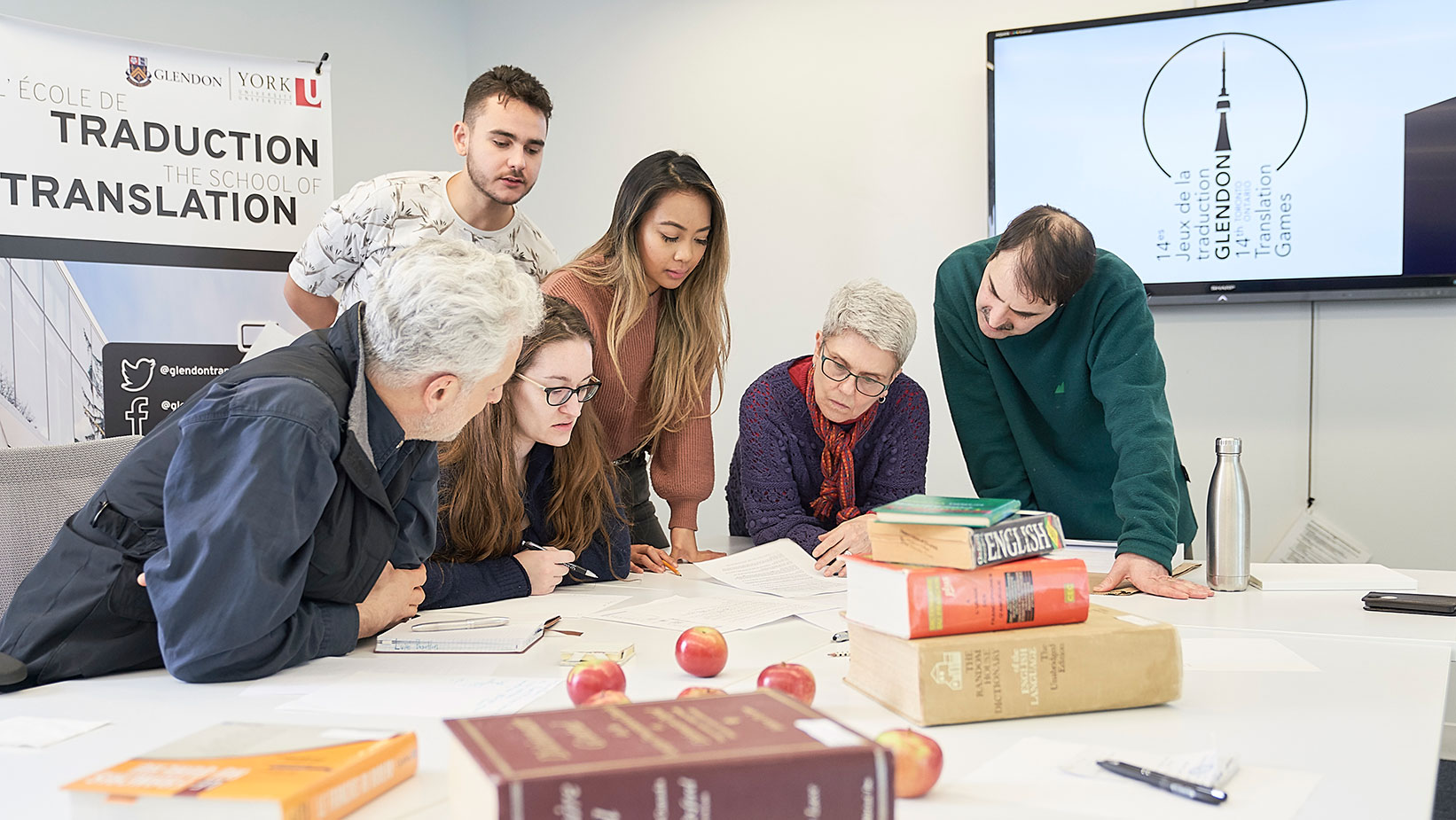
Undertake a learning journey in translation that is key to the circulation of knowledge, literature and information across the planet. In our multicultural and multilingual academic community — ideally set in Toronto, the most diverse city in the world, — you’ll collaborate with dynamic professors who are experts in many languages and various research areas, including literary translation and reception, translation theories, political texts and ideology, crowd sourced translation, ethics in Translation and Interpreting studies, space and mobility, epistemologies of communication, visual arts, communication policy and surveillance. Whether you want to increase your specialization or pursue advanced studies in the growing academic field of translation studies, you will earn skills to set you apart in the workplace.
Skills You'll Learn
- Learning and improving research practices
- Working independently and collaboratively with people from different disciplines and cultures
- Becoming an independent thinker
- Applying research findings to translation practice and professional settings
- Developing the best practices of oral and written communications
Careers
As a Master in Translation Studies graduate, you are well-equipped to become a leader and changemaker. You can choose to pursue grad studies or obtain additional qualifications. Here are a few examples of possible career paths:
- Translation in the public and private sectors
- Management
- Teaching
- School or university administration
- Research
- Law
- Community interpreting
- Intercultural communication
Hands-On Experiences
Apply the concepts and theories you’re studying to real world challenges. Engage in guided practical experiences in the classroom, workplace, community and abroad. These are some opportunities for Master in Translation Studies students.
- Attend the School of Translation’s monthly conference series to hear about translation projects and research
- Volunteer at the annual Glendon Graduate Conference in Translation Studies
- Participate in research activities (writing workshops, research meetings, collaborative projects with the language industry, etc.)
Admission Requirements
The Master in Translation Studies is open to students who have completed an Honours Bachelor of Arts degree in Translation or another discipline who have some experience in translation and / or interpreting. All applicants except graduates from Canadian translation programs must write and pass an entrance examination in English.
Program Requirements
OPTION 1: 4 COURSE + THESIS
Candidates for the MA Degree by Thesis must complete four courses and write a thesis based on original research. The thesis must be successfully defended at an oral examination. Examples of MA theses defended in the program can be found in under Research.
OPTION 2: 6 COURSES + MAJOR RESEARCH PAPER
Candidates for the MA Degree by Research Paper must complete six courses and submit a Major Research Paper on a well-defined topic. The MRP is assessed and marked by the student’s Research Supervisor and by another member of the program.
OPTION 3: 8 COURSES
Candidates for the MA degree by coursework must successfully complete eight courses, or equivalent, chosen from those offered by the program.
NOTE: MA Thesis and Major Research Papers must conform to expectations for academic writing, academic integrity guidelines and FGS submission guidelines.
View full academic requirements for graduate programs
Student Supports & Programs
Glendon Campus prides itself on being a supportive community that goes the extra mile to ensure you get the help you need. See some of the resources Translation Studies students use the most.


Meet Your Professors
You’ll learn from and get to know approachable professors, who are prominent members of the international translation studies community and actively working and researching in the field.

York Hall C233
416-736-2100 x 88306
maubin@glendon.yorku.ca

York Hall 121
736-2100 x 88339
aclifford@glendon.yorku.ca

York Hall 209
416-736-2100 x 88325
mguzman@yorku.ca

York Hall 135
416-736-2100x.88241
lhebert@glendon.yorku.ca
Vanier College, 228
416-736-2100 Ext: 77101
thyun@yorku.ca
Vanier College, 242
416-736-2100 Ext: 77023
singram@yorku.ca
Nelida Chan
Miriam Compagnoni
Valérie Florentin
Lorraine Janelle
Brian Mossop
Dominique Picouet
Salah Basalamah
Elena Basile
Hélène Buzelin
Marco Fiola
Marta Marín-Dòmine
Joshua Price
Sherry Simon
Adriana Şerban
Sehnaz Tahir Gürçaglar
Xiaoping Song
News & Events
Get involved on campus and in the community to meet fellow students and boost your Glendon experience.
The 13th Annual Glendon Graduate Conference in Translation Studies
Glendon Campus, York University, Toronto
April 14-15, 2023 (Hybrid format)
TRANSLATION AND UNHEARD VOICES
https://www.glendon.yorku.ca/transconf/