
Post
Published on October 7, 2024
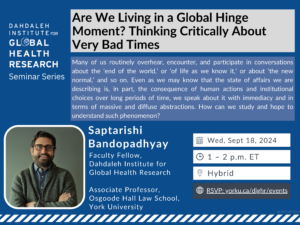
On September 18, 2024, Dahdaleh faculty fellow and Associate Professor at York University Saptarishi Bandopadhyay explored whether current global crises represent a pivotal moment in history. Professor Bandopadhyay was hesitant to answer definitively due to the complexity of the question. Accordingly, he surveyed possible answers to this question based on the works of prominent experts on the subject.
He introduced the concept of a "polycrisis," a term used increasingly in policy and academic circles. This term rooted in complexity theory which refers to multiple interconnected crises that are difficult to address in isolation because they overlap and amplify each other. Examples of polycrises discussed included climate change, economic instability, social inequality, geopolitical tensions and the COVID-19 pandemic. Bandopadhyay explained how these crises are not isolated but influence one another which leads to more significant, system-wide disruptions.
Professor Bandopadhyay discussed how institutions like the World Economic Forum and the United Nations Development Programme (UNDP) have embraced this term particularly in their assessment of global risks. He referenced the 2023 Global Risks Report which highlights the polycrisis threat, emphasizing risks emerging from natural resource shortages, climate change, and geopolitical instability. Professor Bandopadhyay noted that while the polycrisis framework is useful for understanding complexity, it tends towards oversimplification and detachment from the specific historical and cultural contexts of contemporary crises.
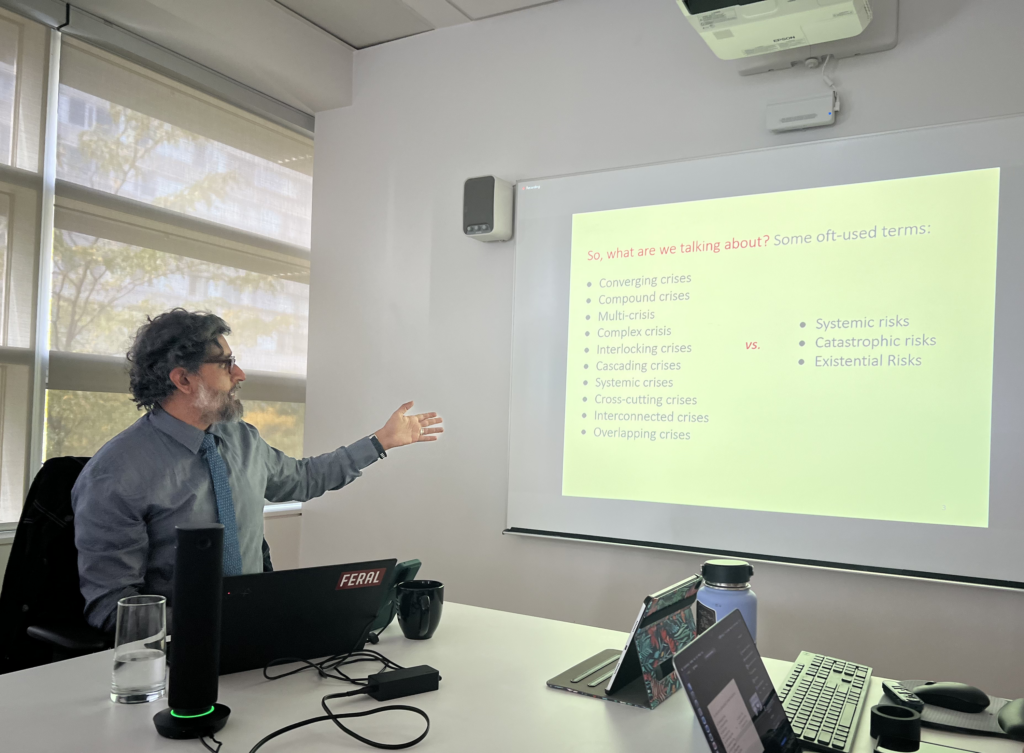
Professor Bandopadhyay noted how concepts like polycrisis often lead to a focus on systemic risks without adequately addressing the human dimension or the root causes of crises such as inequality or historical exploitation. He pointed out the tendency of global institutions and policymakers to prioritize technical solutions over deeper, structural change which often leads to conservative, status-quo affirming policies rather than transformative action.
Throughout the seminar Professor Bandopadhyay encouraged a more critical and nuanced approach to understanding global crises. He argued that while scientific models and data are essential, we should not overlook the political and moral dimensions of these issues. For example, he noted that polycrisis thinking has historical roots in Cold War-era concerns about resource scarcity and environmental security, and these ideas have been shaped by Western governments’ fears about the movement of peoples out of Africa and the Global South.
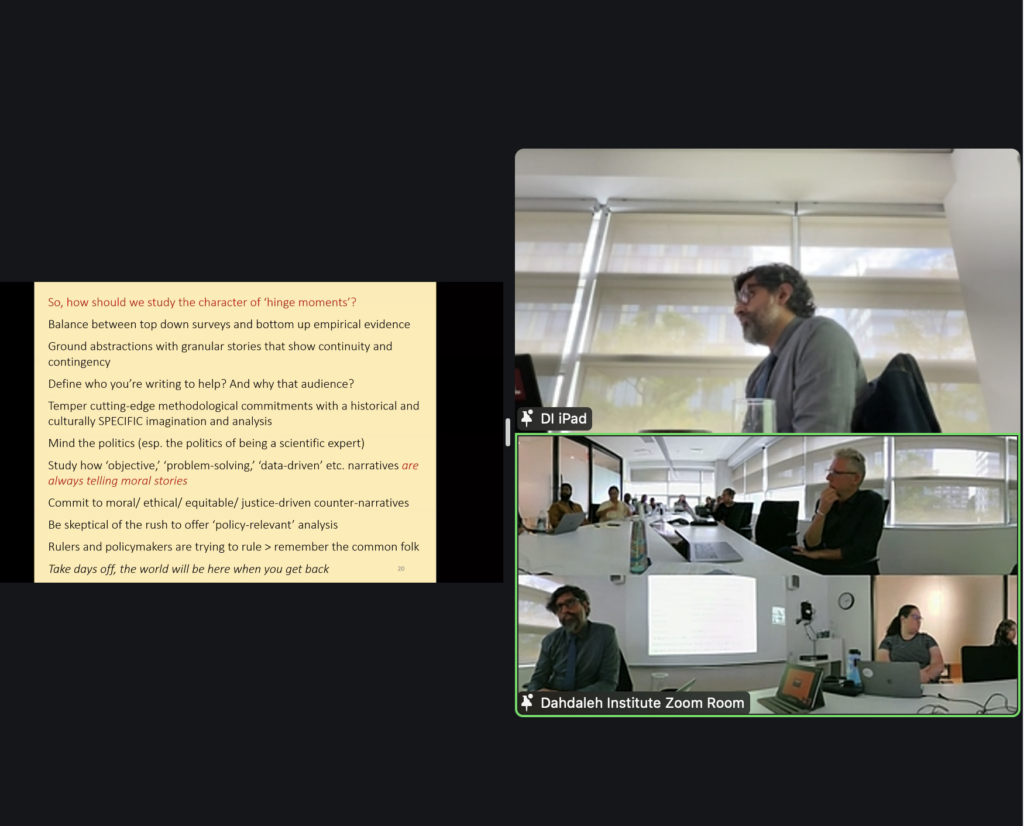
He concluded by urging scholars and policymakers to balance top-down analyses with detailed, empirical case studies that highlight the specific, localized impacts of global crises. Professor Bandopadhyay emphasized that addressing these crises requires acknowledging the limitations of existing frameworks and recognizing the importance of human agency, historical context, and power dynamics in shaping global outcomes.
In the question and answer session of the seminar, the participants discussed the implications of Professor Bandopadhyay’s critique including the challenges of navigating complex situations while maintaining a commitment to equity and justice. The conversation highlighted the need for interdisciplinary approaches that combine rigorous analysis with a deep understanding of social, cultural and political factors.
Overall, the seminar provided a thought-provoking examination of how we understand and respond to global crises and advocated for a more reflective, context-aware approach to addressing the challenges of our time.
Watch the seminar presentation below: https://youtu.be/O63sLlFopOU
Connect with Saptarishi Bandopadhyay
Themes | Global Health & Humanitarianism |
Status | Active |
Related Work |
N/A
|
Updates |
N/A
|
People |
You may also be interested in...
Recap – Science is Necessary But Not Sufficient for Positive Public Policy Impacts
On January 25, Dr. Jean-Jacques Rousseau used his broad experiences in government in Canada and abroad to comment on instances when scientific and technical advice fails to have a positive influence on public policy: "Science ...Read more about this Post
Recap – The Afterlives of the Clinic: AMR, Conflict, and the Future of Global Health, with Omar Dewachi
On February 4, 2026, Dr. Omar Dewachi, medical anthropologist, historian and former physician, Chair and Associate Professor of Anthropology at Rutgers University, led a lecture on antimicrobial resistance (AMR) and its implications on the afterlives ...Read more about this Post
Recap — Sensory Investigations in Global Health Practice: Critical Perspectives in Global Health Workshop
Kristina Baines What does it actually mean to be healthy? This is one of the questions that this year’s Critical Perspectives in Global Health Workshop sought to address and, more importantly, challenge. Anthropologist Kristina Baines ...Read more about this Post