
Post
Published on April 24, 2025
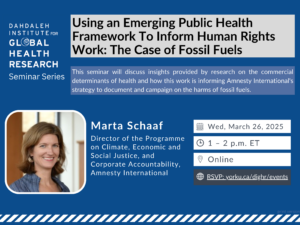
On March 26, 2025, Marta Schaaf, Director of the Programme on Climate, Economic and Social Justice and Corporate Accountability at Amnesty International, delivered a seminar exploring how a public health framework, specifically the commercial determinants of health (CDOH) can inform human rights work with a focus on fossil fuels.
Schaaf explained that corporate actors not only produce harmful commodities like tobacco, ultra processed foods and fossil fuels, but also actively shape the policy environment to protect their interests. Drawing from the CDOH framework she highlighted how corporations externalize health and environmental costs, influence scientific narratives and exploit policy tools such as trade agreements and cost benefit analysis to avoid regulation. These efforts often undermine state obligations to uphold the right to health.
Additionally, she detailed how fossil fuel companies evolved their tactics, from denial of climate change to promoting themselves as problem solvers through “solutions” like carbon capture, while continuing harmful extraction practices. Importantly she revealed that the widely recognized “carbon footprint” concept was developed by a Public Relations firm for British Petroleum, shifting responsibility to individuals instead of systems.


Schaaf emphasized the role of civil and political rights in safeguarding the civic space for environmental defenders particularly Indigenous communities and frontline populations. She outlined Amnesty’s strategy of using mixed methods research including satellite data and testimonies to document the human rights impacts of fossil fuel extraction. These findings aim to support transnational solidarity and challenge corporate power structures.
She concluded by encouraging public health professionals to critically engage with the growing influence of corporate actors and recognize the structural and discursive tools they employ. The seminar underscored the urgency of integrating public health and human rights approaches to confront the harms perpetuated by commercial interests and to protect vulnerable communities and ecosystems.
Connect With Marta Schaaf.
Themes | Global Health Foresighting |
Status | Active |
Related Work |
N/A
|
Updates |
N/A
|
People |
N/A
|
You may also be interested in...
York University funds $4.05M to support interdisciplinary research for the UN SDGs
The research projects advance knowledge in areas ranging from water remediation, management of infectious disease through technological innovation, the effects of climate change on ecosystems and human populations, visual neuroscience, and understanding the pathway from ...Read more about this Post
Hot Off The Press — How to Teach AI: Multi-Objective Water Quality Modelling for Emergencies
The Humanitarian Water Engineering Lab is happy to announce a new publication entitled “Training for the test: Using multi-objective training to improve ANN ensemble forecasts of household residual chlorine in emergencies” in the journal PLOS ...Read more about this Post
York University Presents 15 York Research Chairs
Fifteen York University researchers have been named new York Research Chairs (YRC), an internal program that mirrors the national Canada Research Chairs (CRC) program which recognizes world-leading researchers in a variety of fields. “The York ...Read more about this Post