
Post
Published on October 10, 2025

On September 17, 2025, Benjamin Ewert, a political scientist and Professor of Health Policy and Health Professions at Fulda University of Applied Sciences in Germany, presented his work on health system resilience and political determinants of health.
Ewert began by introducing his two hypotheses. First, that political determinates remain underexplored in current literature on health system resilience. Second, that current health system resilience policies in Germany reinforce the existing political and governance structures rather than changing them.
Guiding Ewert’s research was the question, how political is health system resilience? When examining frameworks for health system resilience Ewert described two distinct frames, a global health frame and a health system frame.
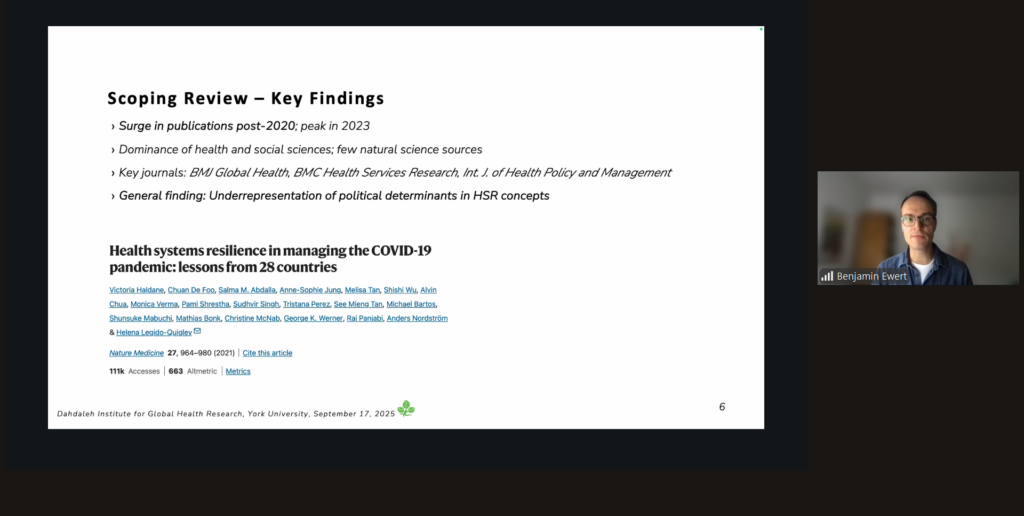
For his research, Ewert conducted a scoping review guided by his hypotheses. He found that there was a modest increase in political determinates of health in health system resilience literature after 2020, with a peak in 2023. Many of these were written by health and social scientists. Overall, Ewert found that there was an underrepresentation of political determinants in health system resilience concepts.

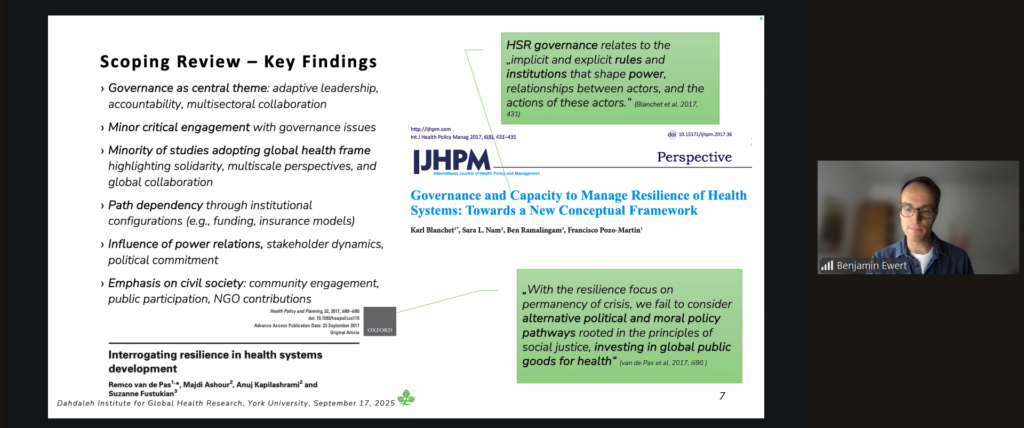
Next, Ewert highlighted gaps in current research. He found that political determinants were often fragmented and isolated factors were the focus. Alongside this he found that political science theory was not integrated into research and issues were framed as managerial or technical. Lastly, Ewert highlighted resilience discourse and how this risks reinforcing the status quo. As a result of these gaps, Ewert proposes that more systematic political analysis is needed in literature on health system resilience.
Ewert provided an example from the German context based on a paper published by himself and colleagues in 2022. Prior to the COVID-19 pandemic the primary focus was on individuals in the healthcare system to cope on their own. However, since the pandemic, the focus has shifted towards organizational and economic resilience and calls to improve in order to ensure better response to the next crisis.
To conclude, Ewert stated that health system resilience is a political task and in order for it be effective in implementation, HSR must be re-politicized.
A publication has been released by Dr. Ewert related to this talk, and can be found here: https://doi.org/10.1017/S1744133126100437
Ewert, Benjamin. (2026). Depoliticising resilience? Uncovering the political theories of health system resilience. Health Economics, Policy and Law, 1–16. https://doi.org/10.1017/S1744133126100437
Watch the full seminar: https://youtu.be/UN_ce8qrn9o
Themes | Global Health Foresighting |
Status | Active |
Related Work |
N/A
|
Updates |
N/A
|
People |
You may also be interested in...
Recap — It is Time to Rescue the Decolonization of Global Health Movement: The Pressing Need for a Shift in Paradigm, with Luchuo Engelbert Bain
On January 8, Dahdaleh research fellow Luchuo Engelbert Bain emphasized the urgent need for a paradigm shift to save the decolonization of the global health movement from stagnation and superficiality. Bain underscored that decolonizing global ...Read more about this Post
Recap — Fifth Annual Dahdaleh Global Health Graduate Scholars Symposium
The Dahdaleh Institute proudly supports graduate research and scholarly and creative activities in line with the three themes of planetary health, humanitarianism, and foresighting at York University. We held our 5th Annual Global Health Graduate ...Read more about this Post
Recap – Shifting Perspectives on One Health Research and Policy
On May 1, 2024, Dr. John Amuasi (Kwame Nkrumah University of Science and Technology) delivered a seminar emphasizing the necessity of adapting goals within the One Health framework. Dr. Amuasi addressed the traditionally negative perceptions ...Read more about this Post