
Post
Published on July 5, 2023
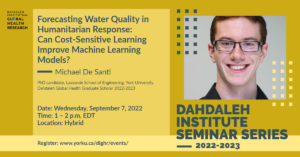
On September 7, 2022, Dahdaleh graduate student fellow in the Lassonde School of Engineering, Michael De Santi presented his work analyzing the technical aspects of machine learning used in the Safe Water Optimization Tool (SWOT)
The number of people being displaced has been rapidly growing in the last two due to armed conflict and natural disasters. These crises are often exacerbated as those displaced by conflict and disaster are then exposed to outbreaks of communicable disease in refugee and internally displaced person (IDP) settlements, often due to unsanitary conditions contaminating household stored drinking water. This phenomenon of waterborne illness spreading through previously safe drinking water has been identified in Uganda, Malawi, Kenya, Sudan, and South Sudan, among others.
Chlorine removes pathogens and prevents re-contamination. However, over time free residual chlorine (FRC) can lose its effectiveness and protection which can cause disease spread. There are many factors that contribute to chlorine decay, such as water handling, behavioural interaction, water environmental factors. SWOT aims to probabilistically model FRC decay to forecast the likelihood of having enough FRC to improve chlorination guidance in refugee and IDP settlements.
Michael explained that their use of probabilistic modelling captures a more accurate representation of FRC concentration and allows users to make decisions based on risk. This method of modelling prioritizes two behaviours: the ability to predict unsafe occurrences (i.e., FRC levels fall below 0.2 mg/ litre) and effectively reproduce underlying distribution of data. One of the challenges faced on the SWOT is that conventional machine learning training approaches do not meet these priorities for probabilistic models. Michael demonstrated how a novel cost-sensitive learning approach aligns the cost function used to train the models with these desired behaviours. This novel approach outperformed a conventional training approach to improve the forecasting abilities of the SWOT. These improvements to the SWOT can provide better FRC targets, lower the risk of recontamination during storage, and ultimately prevent the spread of waterborne illnesses.
Watch the seminar presentation here:
Connect with Michael De Santi
Themes | Global Health & Humanitarianism, Global Health Foresighting |
Status | Active |
Related Work | |
Updates |
N/A
|
People |
You may also be interested in...
SSHIFTB Workshop Drives Social Equity and Innovation in the Global Fight Against Tuberculosis
Originally published by Social Science & Health Innovation for Tuberculosis (SSHIFTB) Centre Initiative (1 February 2024) Tuberculosis (TB) prevails most in LMICs and socially marginalized groups in higher-income countries. Airborne transmission means that it most affects people ...Read more about this Post
Recap – Systematic Reviews and Meta-Analysis Workshop Enhance Interdisciplinary Research Skills
Professor Godfred O. Boateng and Professor Reginald Quansah (from the University of Ghana) led a hybrid four day-workshop on systematic reviews and meta-analysis from Tuesday, February 20th to Friday, February 23rd. With participants joining from ...Read more about this Post
Nineteen Exceptional Scholars Awarded 2024-2025 Dahdaleh Global Health Graduate Scholarships
The Dahdaleh Institute is delighted to announce this year's recipients of the 2024-2025 Dahdaleh Global Health Graduate Scholarships, and we extend our warmest congratulations to the following recipients: "We are proud and elated to support ...Read more about this Post