

An archeological student is standing at the foot of the Temple of Karnak in Egypt; but the building isn’t a tourist-packed ruin. Instead, they are seeing the temple as it was 3,000 years ago – with newly constructed columns and freshly painted hieroglyphics – an experience created using virtual reality (VR) and projection mapping.
“It’s a really interesting way to learn about an archeological site,” says Jack Hang-tat Leong, digital scholarship librarian at York University Libraries (YUL).
VR can create immersive narratives and encourages interactive, active participation, he says. It's just one of many applications of high-tech Meta Quest devices – headsets for gaming, socializing and exploring digital worlds – that YUL’s Making & Media Creation Lab is teaching York faculty, staff and students about.
Tim Tan Huynh, librarian, and Leong run the “VR for First Timers” workshop. They joke that the workshop goes beyond the safety tips of “how not to hit a wall” while wearing the headsets.
“Safety is absolutely so important,” says Huynh, “but we also want to stress accessible considerations. We don’t want people to just be consumers of tech. We want them to consider the barriers – who is included and excluded by this technology.”
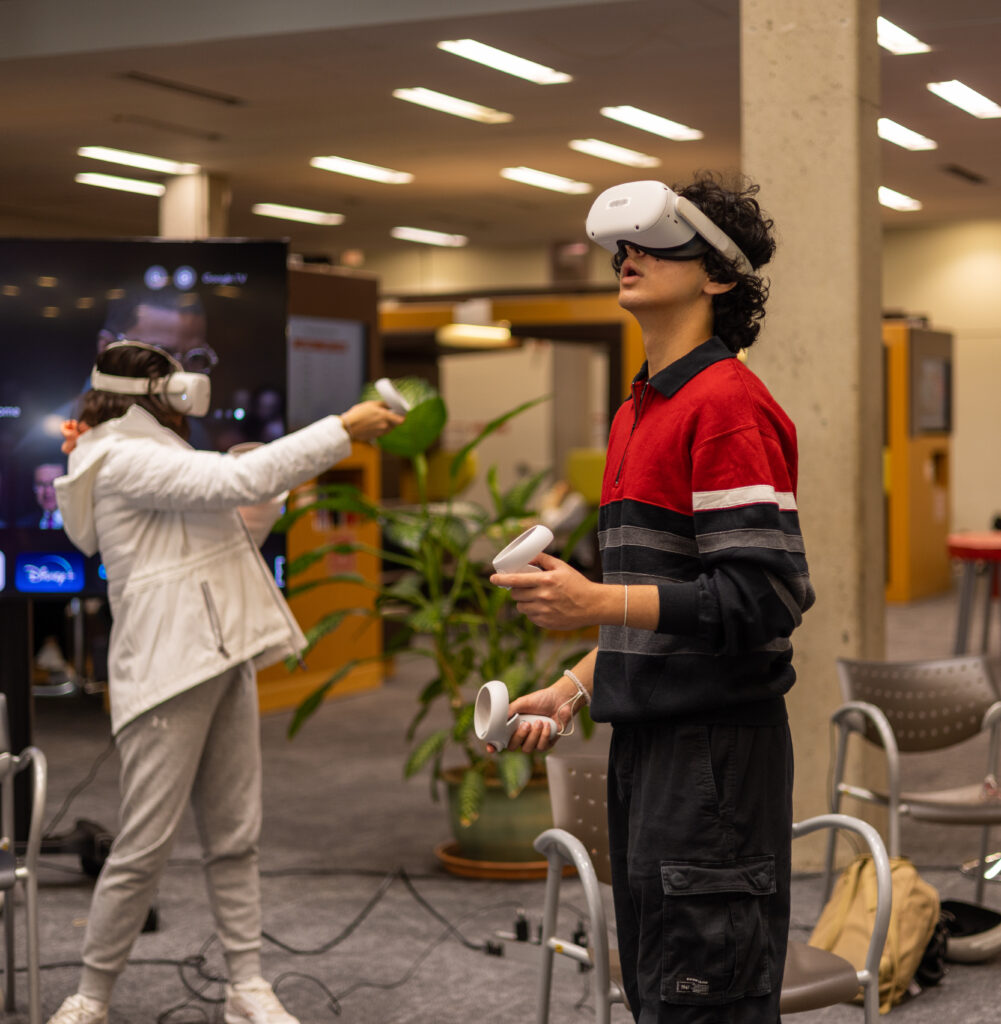
It is mainly students who take the workshop, which helps them build confidence in using immersive tools for academic projects; but faculty and staff also participate in the class to learn how to enhance their research and teaching.
Although VR headsets are recognized as a popular gaming device, Leong says the educational and research applications are abundant – and are already being applied across the University.
York U researcher Lora Appel from the School of Health Policy and Management, Faculty of Health, has been recognized for her work creating simulated universes using VR technology to help people cope with anxiety and health conditions.
In the Faculty of Liberal Arts & Professional Studies, Rich Shivener and Elizabeth Caravella, both scholars of communication in digital environments, published a peer-reviewed study in the journal Written Communication where they used headset recordings to document a range of writing tasks in virtual and hybrid environments.
Faculty are also actively developing content for teaching using immersive experiences. The Faculty of Science, for instance, announced this spring it was using VR to augment students’ understanding of concepts. It launched a fourth-year chemistry class, “Enzyme Design in Virtual Reality,” that teaches students about enzyme design by using VR technology to visualize and manipulate molecular structures.
And, the Lassonde School of Engineering conducted a pilot project last winter having students work on career readiness and developing “soft skills” using Bodyswaps, an AI and VR platform that promotes interpersonal skills.
“Everyone in the York U community can find an application or use for VR headsets,” says Leong.
The library workshop shows participants how to use Meta Quest headsets and controllers, navigate the interface, curate experiences and explore different applications. Huynh and Leong also demonstrate casting, the process of sharing what the person in a VR headset is seeing on an external screen, like a TV, computer or mobile phone.
“It’s very hands-on,” says Huynh. “We want people to walk away informed but also inspired.”
Participants learn about the Making & Media Creation Lab, which has a large inventory of devices that can be borrowed by York students, faculty and staff. The lab has video and editing equipment and suites along with gaming and visualization rooms, as well as software for various media creation. There are 3D printers, laser cutters, a CNC mill, soldering tools, prototyping kits and 3D scanners.
Along with the ability to borrow VR headsets, there are two stand-alone VR rooms that can be reserved. The rooms are equipped with HTC Vive Pro headsets – professional grade equipment that runs on high-powered computers.
“There is a common assumption that VR headsets are just used for gaming or entertainment,” Leong says. “While there are many apps you can use for fun, there is such a huge application for research or education.”
Faculty, staff and students can register for the workshop once a semester. The next one is scheduled for Feb. 11, 2026.
With files from Karen Martin-Robbins