
Post
Published on July 30, 2024
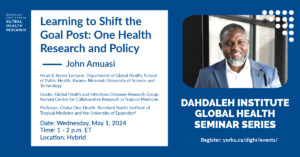
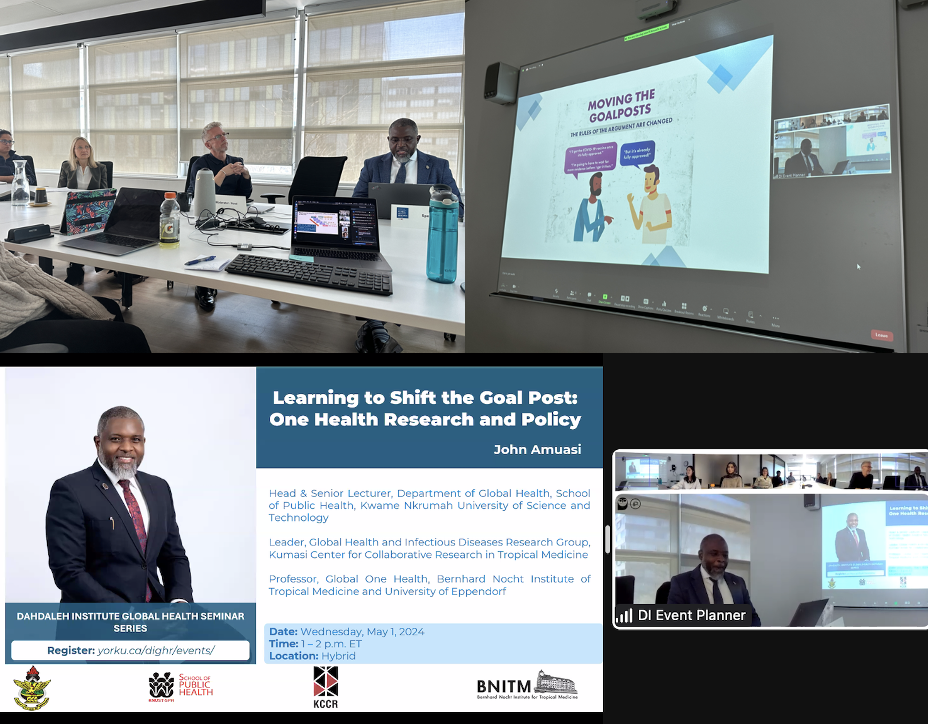
On May 1, 2024, Dr. John Amuasi (Kwame Nkrumah University of Science and Technology) delivered a seminar emphasizing the necessity of adapting goals within the One Health framework. Dr. Amuasi addressed the traditionally negative perceptions of shifting goalposts that are often seen as preventing positive outcomes, particularly evident during the COVID-19 pandemic. However, shifting goalposts can be crucial for scientific progress and public health. He provided a historical context by referencing Hippocrates' humoral theory, linking health to the balance of bodily fluids, and Ignaz Semmelweis' advocacy for handwashing to prevent puerperal fever. Both examples show that shifting goalposts are essential because scientific knowledge is dynamic and constantly evolving, requiring updates to maintain relevance and effectiveness.
Through exploring the complexity of One Health systems, which integrate human, animal, and environmental health, Dr. Amuasi argued that the dynamic nature of these systems necessitates shifting goalposts. He illustrated examples from recent clinical studies, where adaptive platform trials required changes in sample sizes and protocols to remain effective and relevant. In a complex and interconnected world, health interventions must be flexible and responsive to new data and changing conditions.
The seminar included a case study on anti-malarial drugs, demonstrating how health system factors influence treatment effectiveness in different regions. Dr. Amuasi emphasized health system factors, such as local practices and infrastructure, significantly impact treatment outcomes. This case study underscored the need for localized strategies and continuous adaptation to achieve optimal health outcomes. He stressed that recognizing and managing these trade-offs is essential for effective public health policy.
Dr. Amuasi concluded with a call for continuous improvement and adaptation in One Health, discussing that shifting goalposts based on evolving scientific knowledge is crucial for achieving sustainable health outcomes. This dynamic approach is essential for addressing the complex challenges faced by One Health and integrating new scientific insights into practice. The seminar underscored the importance of flexibility and a willingness to adapt in the pursuit of improved global health outcomes.
Watch the seminar presentation below:
Connect with Dr. John Amuasi
Themes | Global Health Foresighting |
Status | Active |
Related Work |
N/A
|
Updates |
N/A
|
People |
N/A
|
You may also be interested in...
GEHLab Research Intern Presents at the 16th Annual CUGH Conference in Atlanta
From February 20th to February 23rd, 2025, I had the incredible opportunity to attend the 16th Annual Consortium of Universities for Global Health (CUGH) Conference in Atlanta, United States. The Global & Environmental Health (GEH) ...Read more about this Post
Hot Off The Press — Challenges and Opportunities for Cervical Cancer Prevention Through HPV Vaccination in Ghana: A Public Health Policy Analysis
In October 2025, Ghana took a decisive step in women’s health by launching its first nationwide Human Papillomavirus (HPV) vaccination program. The moment is both historic and deeply symbolic, marking the country’s renewed commitment to ...Read more about this Post
Recap — Dahdaleh Global Health Trainee Symposium
The Dahdaleh Institute proudly support intern positions, graduate research, and scholarly and creative activities in line with the three themes of planetary health, humanitarianism, and foresighting at York University. We held this year's Global Health ...Read more about this Post