
Post
Published on January 3, 2025
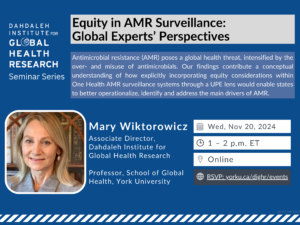
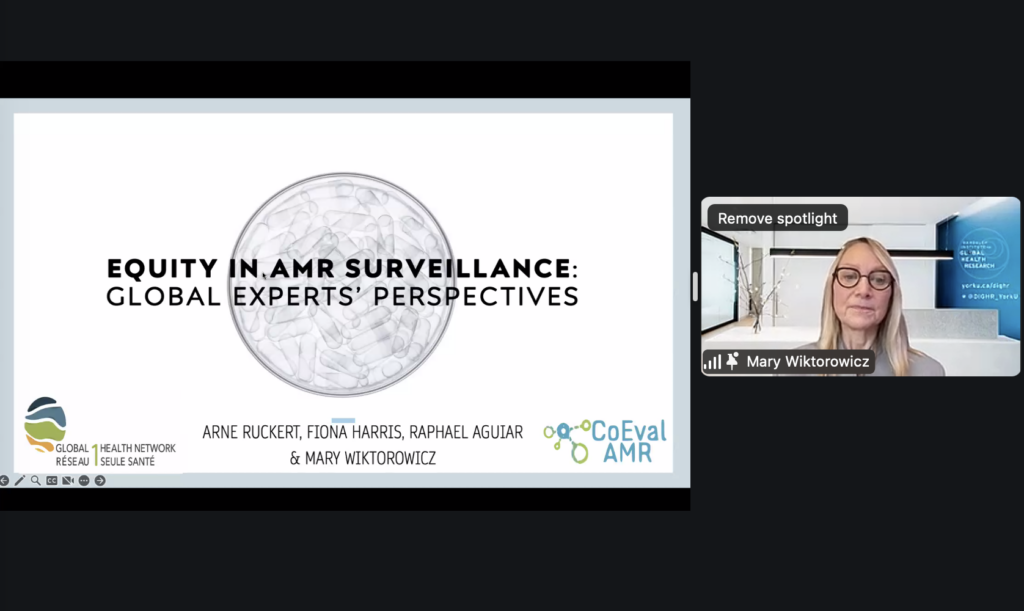
On November 20, Dahdaleh associate director Mary Wiktorowicz delved into the topic of equity in antimicrobial resistance (AMR) surveillance, offering insights into how equity can be embedded in global surveillance systems. The discussion emphasized equity as both a distinct domain and a critical component integrated across all domains. Using a Political Ecology lens, Dr. Wiktorowicz highlighted systemic threats and global inequalities that shape health outcomes, advocating for a collective structural responsibility approach to addressing AMR.
The presentation outlined governance as a reflexive and collaborative process where stakeholders share resources and dialogue to manage complex challenges. Current research identified key entry points for equity within AMR surveillance systems, including governance and evaluation frameworks. Interviews with 17 key informants from diverse sectors revealed themes such as the conceptualization of surveillance, global redistributive dimensions, data concerns and sectoral imbalances.
Challenges to achieving equity in AMR surveillance included issues of data access, ownership, interoperability and literacy. Disparities between the Global North and South were prominent, with resource limited countries often unable to implement recommended systems due to impractical guidelines. Sectoral imbalances further compounded the problem, with human health receiving more attention and funding than sectors like agriculture and environmental health.
A conceptual model of equity in AMR surveillance was introduced, addressing factors such as geographic disparities, social determinants of health and socioeconomic inequities. The model emphasized the importance of targeting root causes, supporting equity deserving groups and fostering intersectoral collaboration. Trust building and data sharing across sectors and disciplines were identified as critical to improving equity.
The presentation concluded by calling for systemic interventions including equitable resource distribution, improved collaboration and a shift toward addressing the structural determinants of AMR. This integrated approach aims to make equity a central focus in AMR surveillance systems worldwide.
Watch the seminar presentation below: https://www.youtube.com/watch?v=9D2Cu-fZcjs
Connect with Mary Wiktorowicz.
Themes | Global Health Foresighting |
Status | Active |
Related Work |
N/A
|
Updates |
N/A
|
People |
You may also be interested in...
Developing a Global Framework To Address Gender-Based Violence in Women Affected by TB
We are pleased to formally announce the initiation of a new partnership development grant funded by the Social Sciences and Humanities Research Council (SSHRC), under the leadership of Dr. Amrita Daftary of the School of ...Read more about this Post
Call for Applications – 2022 Seed Grants for Critical Social Science Perspectives in Global Health Research
The Dahdaleh Institute for Global Health Research is accepting applications for the 2022 Seed Grants for Critical Social Science Perspectives in Global Health Research. Five seed grants worth up to $5,000 CAD each will be awarded ...Read more about this Post
AI4PEP Showcases Climate-Resilient Health Innovations at V Global Conference on Health and Climate
The AI4PEP Network (Global South Artificial Intelligence for Pandemic and Epidemic Preparedness and Response) was spotlighted at the V Global Conference on Health and Climate, held from July 29–31, 2025 in Brasília, Brazil. Hosted by ...Read more about this Post