
Post
Published on March 27, 2025
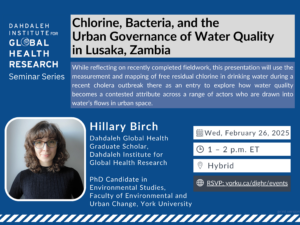
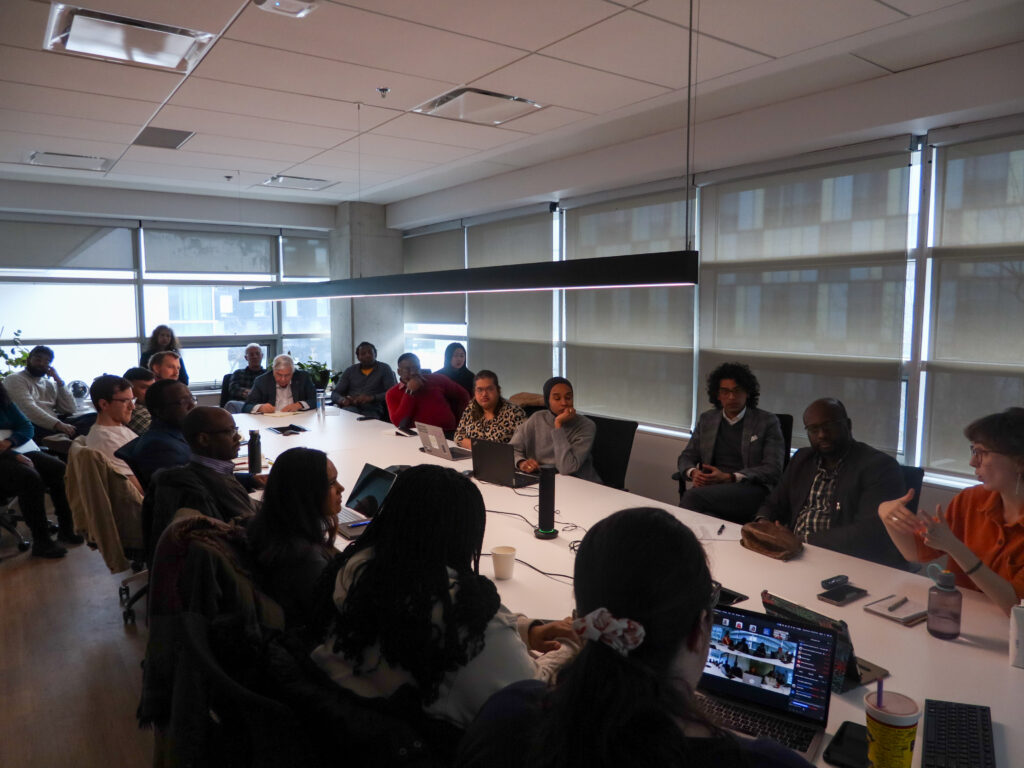
On February 26, 2025, Dahdaleh Graduate Student Scholar, Hillary Birch, explored the urban governance of water quality in Lusaka, Zambia. A PhD candidate in Environmental Studies at York University, Birch presented findings from her six-month fieldwork, examining how water quality is contested, measured and shaped by governance structures, particularly in response to recurrent cholera outbreaks.
Lusaka’s water infrastructure is highly fragmented. While 85% of the population has access to piped water, this often comes through communal kiosks with intermittent supply and only a small portion of the city is connected to a sewer system. The city’s reliance on groundwater, combined with seasonal flooding and inadequate sanitation, contributes to waterborne disease outbreaks such as the severe cholera outbreak from 2023 to 2024 which resulted in over 23,000 cases and hundreds of deaths.

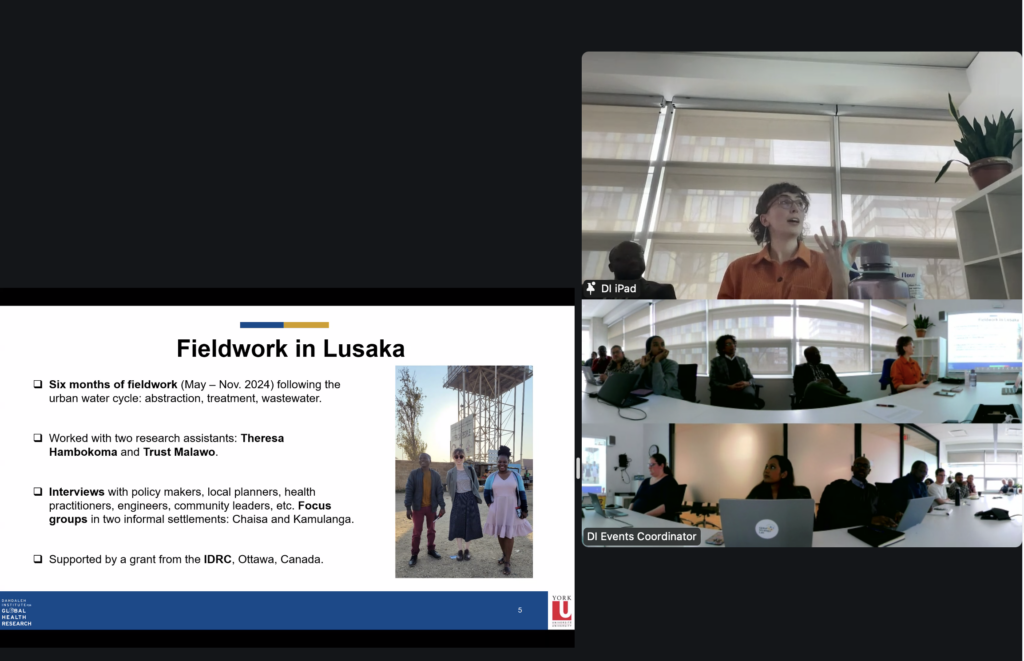
A major focus of Birch’s research was the role of free chlorine residual (FCR) testing in determining water safety. The Ministry of Health and UNICEF conducted extensive testing during the cholera outbreak, mapping water points across the city to assess whether chlorine levels met internationally recommended standards. The results highlighted widespread inconsistencies in water quality, revealing systemic governance gaps and tensions between public health agencies and commercial water providers over accountability and responsibility for water in the city.
Community members expressed deep distrust of their water sources, citing unpredictable changes in quality throughout the day and across locations. Many observed that leaks in pipes allowed contamination to occur, while others noted that official testing confirmed bacterial presence in water which they had previously trusted. Although chlorination is promoted as a key treatment method, affordability remains a challenge, leaving many residents unable to maintain safe water access as they are made responsible for water treatment at the household level. Birch concluded that chlorine, while a crucial public health tool, also exposes deeper structural issues in water governance and global health practice. She emphasized the need for systemic solutions that go beyond household interventions and instead advocate for sustainable policies to ensure equitable access to safe drinking water.
Connect with Hillary Birch.
Watch the seminar here: https://youtu.be/-hvQcTcGXoA
Themes | Global Health & Humanitarianism |
Status | Active |
Related Work |
N/A
|
Updates |
N/A
|
People |
Hillary Birch, Dahdaleh Global Health Graduate Scholar, Faculty of Environmental and Urban Change - Active
|
You may also be interested in...
Call for Applications – 2023 Seed Grants for Critical Social Science Perspectives in Global Health Research
The Dahdaleh Institute for Global Health Research is accepting applications for the 2023 Seed Grants for Critical Social Science Perspectives in Global Health Research. Five seed grants worth up to $5,000 CAD each will be awarded. ...Read more about this Post
Global Health: Wellness Impact Lab (WIL)
The Dahdaleh Institute has a bold vision for achieving global health for all. A new lab has been created – the Wellness Impact Lab (WIL) – led by Dr. Harvey Skinner, PhD (Senior Fellow) and ...Read more about this Project
[UPDATED] Call for Applications – 2024 Seed Grants for Critical Social Science Perspectives in Global Health Research
The Dahdaleh Institute for Global Health Research is accepting applications for the 2024 Seed Grants for Critical Social Science Perspectives in Global Health Research. York graduate students and research fellows are welcome to apply with the ...Read more about this Post