
Post
Published on November 20, 2025

Authored by Hanna Lum-Gerry¹ & Brian Ferrier¹
¹ School of Global Health, York University
On October 8, 2025, Dr. Madhukar Pai, MD, PhD, FCAHS, FRSC visited York University to deliver a lecture that highlights the importance of positionality in the global health industry and how Global North dominance has become so normative that we often cannot imagine it any other way. Using relevant case studies of contemporary politics, leadership, and global health organizations, Dr. Pai challenged the audience to reimagine a version of global health that is truly global, that is, how would leadership from the Global South change the field of global health as we know it.
Dr. Pai’s lecture was an amazing breath of fresh air. He offered thought-provoking critique of the academic and institutional structures shaping global health. He spoke with a deep understanding of how the current global health ecosystem operates, and challenged the audience to critically examine the assumptions, hierarchies, and power dynamics embedded within it.
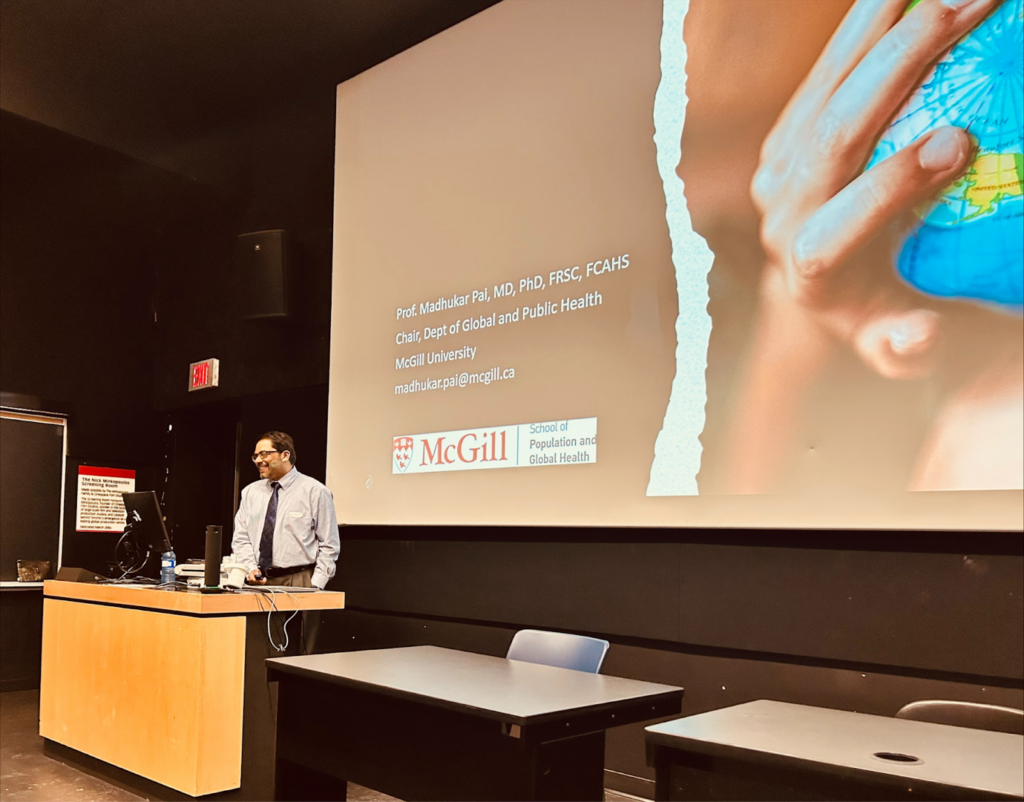
His presentation was filled with insightful moments that immediately resonated with the audience. In one example, Dr. Pai reminded us, “knowledge is the only thing that grows in value when it is shared.” This is particularly important for emerging global health students who will eventually be entering professional settings. As students, we need to remember that information is a source of power. It is a resource that can be hoarded unless we take active steps to assure equity in access.
Dr. Pai’s address targeted the audience, many of whom were at the beginning of their academic career. He outlined a sort of “best practices” for us to adopt at each stage of advancement within the context of the university; advice that contained, succinctly, the rationale for his professional approach to building a career in Global Health.
Dr. Pai’s engaging delivery brought clarity to his presentation. Dr. Frank Luntz, pollster and political strategist, said, “It is not what you say, but what people hear” that is critical.” Dr. Pai spoke at a rate that the audience could understand, absorb, and mobilize. He spoke with passion, clarity, and courage—his presentation was factual but also deeply thoughtful and provocative.
Dr. Pai finished his lecture with an important question for all students embarking in global health studies and research: “So, the next time we reimagine global health, write a paper, or plan a conference, we can all ask: is this our work to do?”
Dr. Pai’s presentation drew from a paper he recently wrote with collaborators across the world: “You can’t see what you’ve never had to live”— Cultivating imagination and solution spaces in global health and development. The publication can be accessed here.
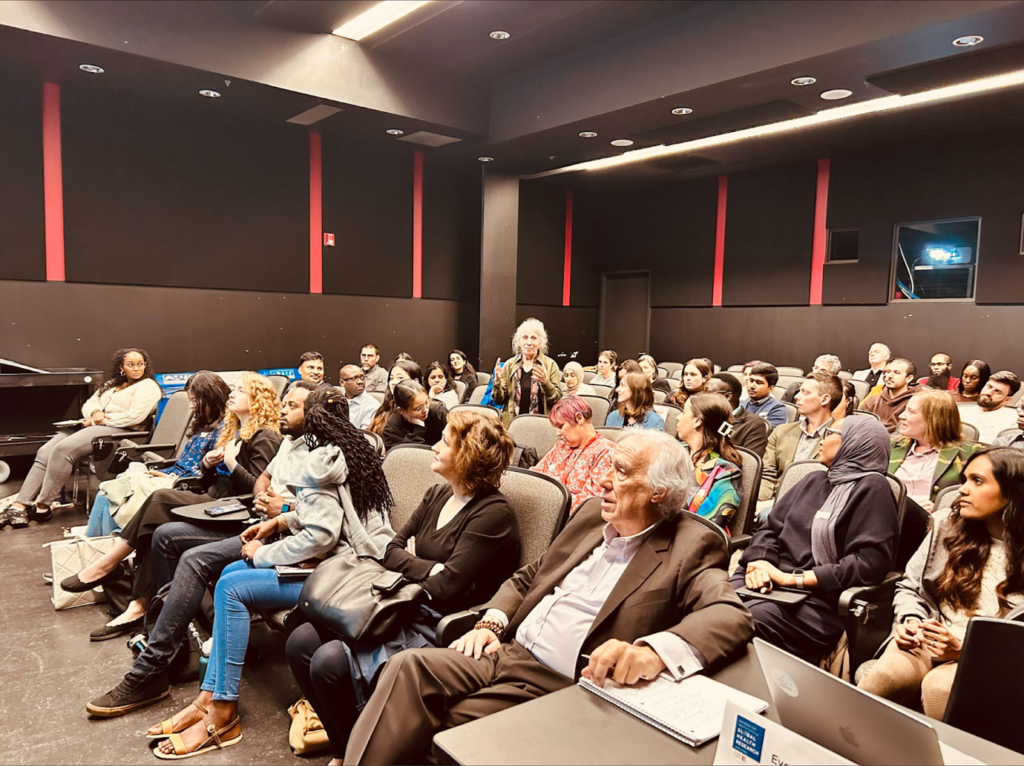
Attendees included graduate and undergraduate students from the School of Global Health and professors from the Faculty of Health, as well as community and visiting scholars. Reviews of the lecture described Dr. Pai as “engaging,” “knowledgeable,” and “refreshingly honest.”
Prof Madhukar Pai, MD, PhD, FCAHS, FRSC is the Inaugural Chair, Department of Global and Public Health at the McGill School of Population and Global Health. He holds a Tier 1 Canada Research Chair in Epidemiology & Global Health. He was previously Director of the McGill International TB Centre. He was the inaugural Editor-In-Chief of PLOS Global Public Health. He is an elected Fellow of the Royal Society of Canada, and a Fellow of the Canadian Academy of Health Sciences.
This event was possible thanks to funding from the The Dahdaleh Institute for Global Health Research, the Faculty of Health (Fund for Innovation in Teaching), Dr. David Peters (Dean of the Faculty of Health) and Dr. Amrita Daftary at the School of Global Health.
Watch the full seminar: https://www.youtube.com/watch?v=tFXaAmWE6wk
Themes | Global Health Foresighting |
Status | Active |
Related Work |
N/A
|
Updates |
N/A
|
People |
You may also be interested in...
Recap — Centering Palestinian Voices: Rethinking Global Health and Humanitarian Responsibility in Gaza
On Wednesday, November 19, the Dahdaleh Institute was joined by experts in food systems, WASH, and health, Dr. Ahmad Abu Shaban, Dr. Reem Abu Shomar and Dr. Mohammed Al Barayka, for a session entitled “The Limits and Responsibilities ...Read more about this Post
Hot off the Press — Can Systems Analysis Help Avoid Potential Policy Failure for Emerging Zoonoses and Pandemic Prevention?
Dahdaleh Institute research fellows Chloe Clifford Astbury and Kirsten Lee, faculty fellows Shital Desai, Tarra Penney, and Cary Wu, and interim director Mary Wiktorowicz recently published a paper in BMJ Global Health titled, "Wildlife policy, the ...Read more about this Post
New Research Show Mpox Outbreak Lead to Stigma and Blame Toward 2SLGBTQIAP+ Community
Originally published by YFile (30 May 2023) York University researchers have furthered their study of the global mpox virus by publishing a new paper on the dangerous stigmas the 2SLGBTQIAP+ community face as the outbreak continues. Since ...Read more about this Post