
Post
Published on November 26, 2025

On October 22, 2025, Benedict Weobong, Dahdaleh faculty fellow and Global Mental Health epidemiologist and academic, presented his and his team’s research on reaching adolescents with health services, specifically in select communities in a secondary city in Ghana.
Benedict began by recognizing his team from Ghana and WHO. He also recognized the funding organization, Botnar Foundation.
Benedict and his team’s research seek to address the challenge that adolescents pass through adolescence without any preventive or promotive contacts without a health worker, which represents missed opportunity for early detection of health problems and overall health promotion.
Guiding Benedict’s research was the question; Would health check-ups during adolescence be effective and cost-effective to improve adolescent health and wellbeing? The research took place in five communities across the city of Cape Coast, with specific schools selected from each community.
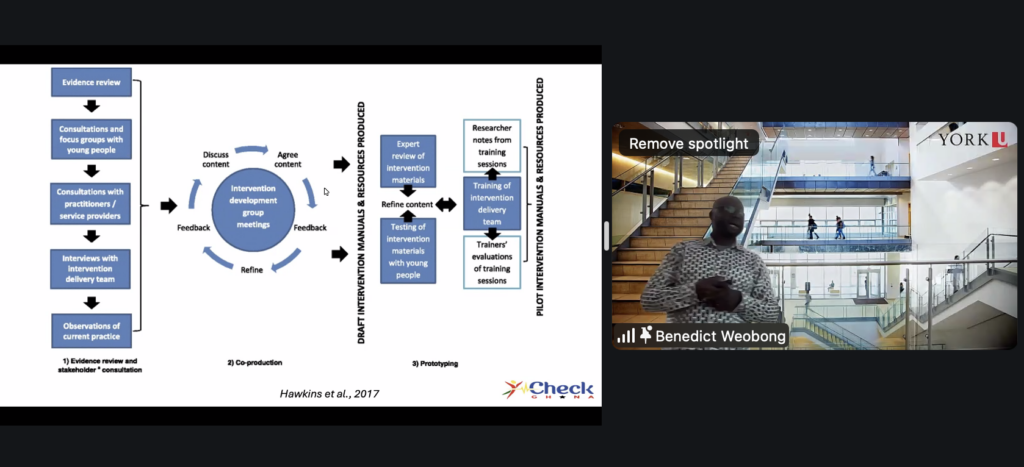
A bottom-up approach was taken by Benedict and his team with several stages. The first step consisted of co-production workshops, between adolescents and parents. The second co-production workshops included the discussion of health and education. The final validation workshop consisted of presenting results from previous workshops, alongside validating the intervention architecture. Lastly, national level meetings were conducted between health and education stakeholders in Ghana.
The results consisted of a list of thirty-three health conditions that are consistent with the research performed. Then, the screening process, which consisted of Y-Check stations, began. This included screening, physical assessment, clinical review/treatment and referrals (with the assistance of a Y-Check counsellor).
The health check-ups picked up a number of conditions that would otherwise not have been detected – these were particularly high for psychosocial issues (including mental health), Epilepsy, STI symptoms, and Anaemia.
To conclude, Benedict addressed further steps for his and his team’s research, including rethinking an approach appropriate for a community setting, and emphasizing the importance of a multisectoral approach, specifically in between the health and education teams.
Watch the full seminar: https://www.youtube.com/watch?v=OhyNsncKW5w
Themes | Global Health Foresighting |
Status | Active |
Related Work |
N/A
|
Updates |
N/A
|
People |
You may also be interested in...
Recap — Repoliticizing Health System Resilience: Unpacking the Political Determinants of Health with Benjamin Ewert
On September 17, 2025, Benjamin Ewert, a political scientist and Professor of Health Policy and Health Professions at Fulda University of Applied Sciences in Germany, presented his work on health system resilience and political determinants ...Read more about this Post
Dahdaleh Researchers Receive $5.9M From New Frontiers Research Fund to Support Climate Change Adaptation and Mitigation Efforts
On June 3, 2024, the New Frontiers Research Fund (NFRF) announced $92 million funding to support 165 new and groundbreaking Canadian-led initiatives: the 2023 International Joint Initiative for Research in Climate Change Adaptation and Mitigation ...Read more about this Post
Recap — Sensory Investigations in Global Health Practice: Critical Perspectives in Global Health Workshop
Kristina Baines What does it actually mean to be healthy? This is one of the questions that this year’s Critical Perspectives in Global Health Workshop sought to address and, more importantly, challenge. Anthropologist Kristina Baines ...Read more about this Post