
Post
Published on December 1, 2025
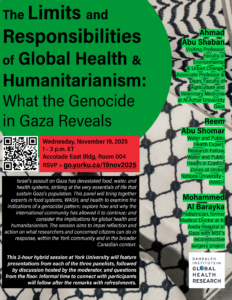
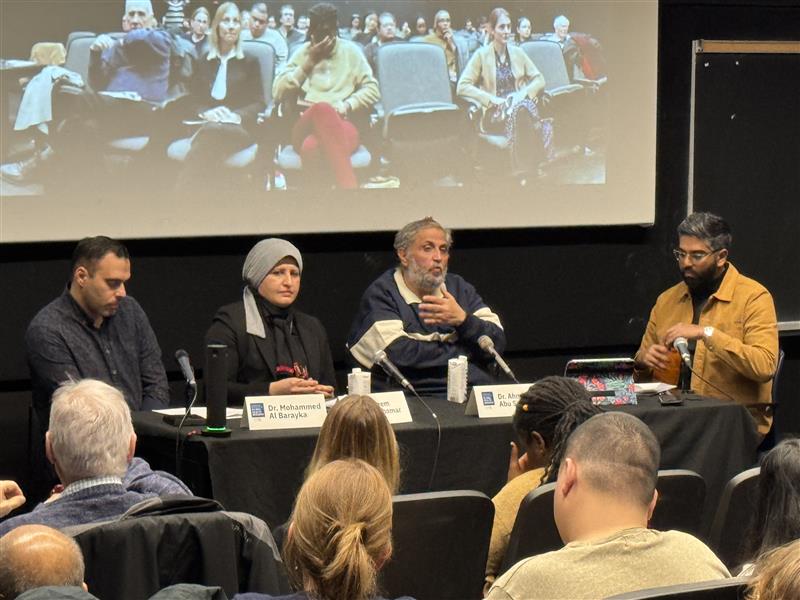
On Wednesday, November 19, the Dahdaleh Institute was joined by experts in food systems, WASH, and health, Dr. Ahmad Abu Shaban, Dr. Reem Abu Shomar and Dr. Mohammed Al Barayka, for a session entitled “The Limits and Responsibilities of Global Health & Humanitarianism: What the Genocide in Gaza Reveals.” The panel event sought to present the perspectives of Palestinians who are surviving, enduring, and standing against Israel’s genocide in Gaza on the role of global health and humanitarianism in this moment.
Dr. Ahmad Abu Shaban, Visiting Professor in the Faculty of Environmental & Urban Change and the Faculty of Liberal Arts & Professional Studies (LAPS) at York, and Associate Professor & Dean of the Faculty of Agriculture and Veterinary Medicine at Al Azhar University in Gaza, began his presentation by sharing the historical context of Palestinians’ dispossession from their land from 1947 to present-day. Dr. Abu Shaban stressed the importance of challenging the narrative that this genocide began in October 2023. Rather, generations of Palestinians have faced the targeted aggression of Israel.
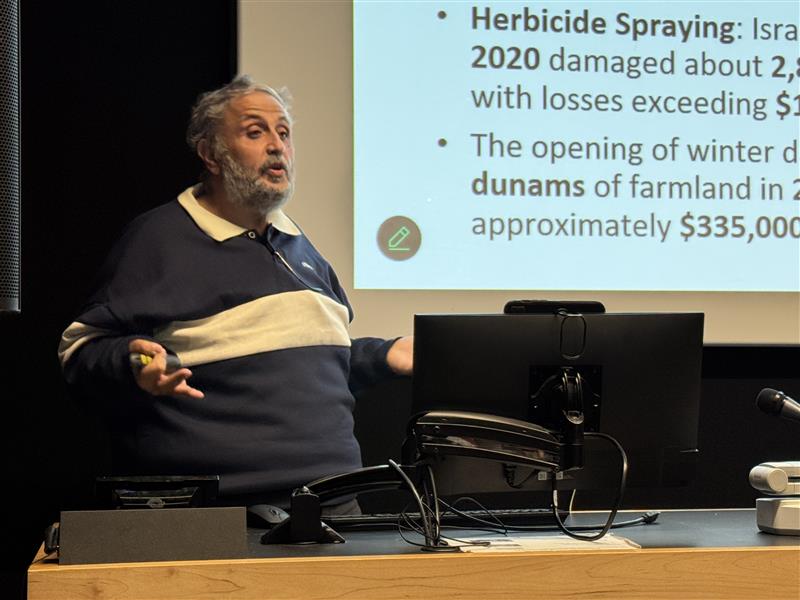
Dr. Abu Shaban shared the pre-war food system vulnerabilities imposed by Israel, including access restrictions placed on the land and sea. Resource restrictions made Gaza’s food system fragile, driving up costs and contributing to food insecurity, well before Israel’s current genocide of Gaza.
Post-October 2023, Israel shifted from controlling Gaza’s food system to complete annihilation of the food system by weaponizing starvation. Dr. Abu Shaban shared countless stories of Palestinians who died from hunger, like the story of Zaina, a little girl who died in the line to receive food aid.
Dr. Abu Shaban also shared a story of one of his students, Yousif Abu Rabee, who started a project, “We will Cultivate It” to rehabilitate his destroyed farm in Northern Gaza. His initiative focused on producing seedlings to feed his community, despite the ongoing violence. Tragically, Yousif was killed by an Israeli airstrike while working on his land.
Despite Israel’s annihilation of Gaza’s food system, Palestinians continue to show resilience through community resilience models, such as community kitchens and collective care, seed bank and seed multiplication, and a community-led solidarity marketing initiative.
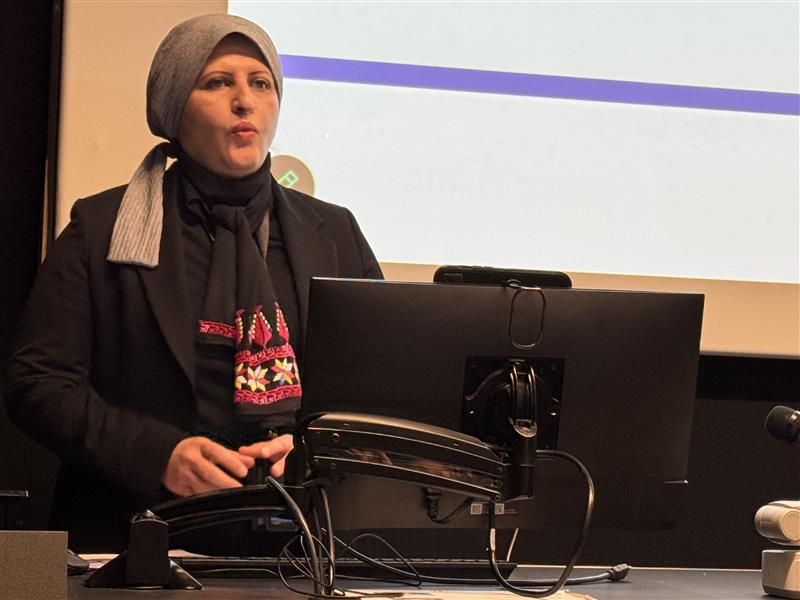
Next, Dr. Reem Abu Shomar, Research Fellow in Water and Public Health in Conflict Zones at United Nations University Institute for Water, Environment and Health (UNU–INWEH), discussed Israel’s weaponization of water, including cutting of water supplies, mass destruction of WASH infrastructure, and cut-off of fuel and electricity used to operate water desalination and wastewater facilities. WASH is foundational to the health, dignity, and survival of all humans, and it plays an integral role in preventing waterborne disease outbreaks. Under international humanitarian law, attacks on objects vital to civilian survival, such as water facilities, are prohibited.
Stemming from WASH-related mass destruction are disease outbreaks, anti-microbial resistance, menstrual and maternal hygiene issues, and a lack of washing facilities and privacy. The deliberate dismantling of civilian survival systems and collapse of WASH services in Gaza emerged from decades of occupation and control, limiting Palestinian autonomy and leading to fragmented water governance. Investments in WASH recovery are critical to mitigate further public health emergencies and prevent escalating risks of waterborne diseases.
Lastly, Dr. Mohammed Al Barayka, pediatrician and former medical doctor with Médecins Sans Frontières reconstructive surgery project at Al Awda Hospital in Gaza, shared the horrifying impacts of Israel’s systemic destruction of Gaza’s healthcare system. Gaza’s health system had thirty-six pre-conflict hospitals, but as of late 2025, only a fraction remain partially functional due to mass destruction of the healthcare system in the strip.
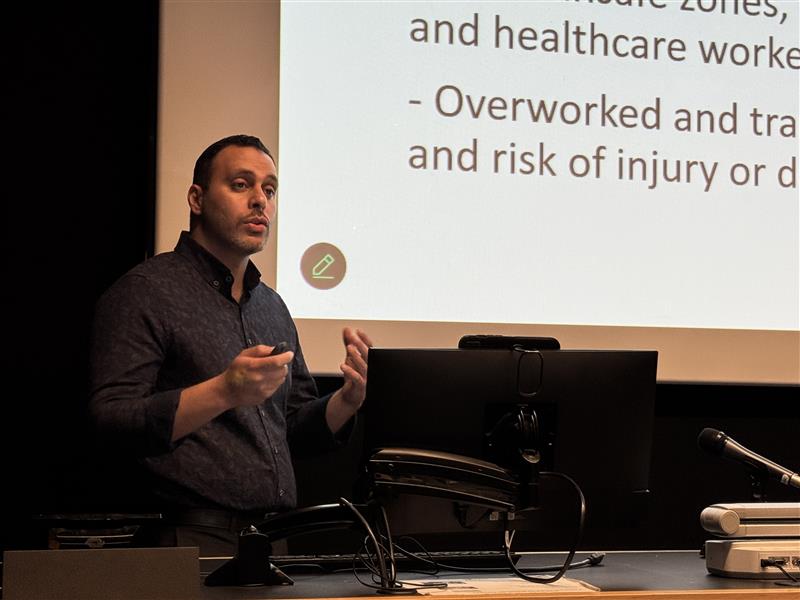
The destruction of hospitals has had widespread impacts on the people of Gaza, including but not limited to, the collapse of healthcare systems, shortages of critical supplies, destruction of specialized care, and an immense mental and psychological toll, all leading to increased mortality and morbidity across all health indicators. Healthcare workers also face widespread challenges, including high casualty rates, deaths and injuries among health workers, severe shortage of medical supplies, drugs and equipment, overwhelming workload and burnout, displacement and loss of staff and psychological trauma.
He shared a story of Dr. Hani Bsiso, an orthopedic surgeon, who made a below-knee amputation for his 17-year-old niece in his home kitchen, using a sewing needle. A few days later, on January 16, 2024, she was taken to Shifa hospital where Dr. Almaqadma was able to close the stump. Dr. Almaqadma was killed by Israeli forces during the invasion of Shifa Hospital in April 2024.
Dr. Al Barayka also shared the effects on current and future generations, including the breakdown of maternal and newborn healthcare, increased risk of premature and low-weight births, higher newborn mortality, acute and chronic malnutrition in children, long-term physical growth impacts, developmental effects on children and educational setbacks.
Following the panelist’s presentations, a panel discussion began around the band-aid of humanitarian aid, and how we, as researchers, scholars and concerned citizens, can go beyond it.
The panelists highlighted that the international community needs to stand in solidarity with the people of Palestine and stand against the injustices perpetrated by Israel against the Palestinian people. Investments to rebuild Palestinian institutions and essential systems that sustain Gaza’s population are a primary avenue to keep aid aligned with the priorities of the Palestinian people.
Moreover, the panelists stressed that researchers and scholars in universities in Canada have an ethical responsibility to challenge misinformation around Israel’s genocide in Gaza by supporting Palestinian knowledge production efforts. This includes documentation of war crimes and the destruction of the essential life-sustaining food, water, and healthcare systems in Gaza. Partnering with Palestinian academics and experts, empowering them, and amplifying their voices are essential, as are efforts to help Palestinians rebuild their institutions.
Watch the full seminar here: https://www.youtube.com/watch?v=QGt5oObR7-Q
Themes | Global Health Foresighting |
Status | Active |
Related Work |
N/A
|
Updates |
N/A
|
People |
You may also be interested in...
Recap — Letting the Fox Build the Hen House: Private Sector Influence at the WHO
On Wednesday, September 24, Dr. Tracey Wagner-Rizvi, a Research Associate from the Global Strategy Lab discussed the private sector influence of substantive initiatives at the WHO (World Health Organization) and the development of the WHO’s ...Read more about this Post
Recap – Gender as a Dimension of Inclusive Innovation
On April 24, 2024, Dahdaleh adjunct faculty fellow Dr. Jean-Jacques Rousseau and development practitioner Devina Srivastava (Global Fellow, Center for Human Rights and Humanitarian Studies, Brown University) discussed the importance of inclusive innovation as an ...Read more about this Post
Congratulations – Dr. Chiara Camponeschi receives 2023 Banting Postdoctoral Fellowship
The Banting Postdoctoral Fellowships program provides funding to the very best postdoctoral applicants, both nationally and internationally, who will positively contribute to the country's economic, social, and research-based growth. The objective of the Banting Postdoctoral Fellowships program ...Read more about this Post