
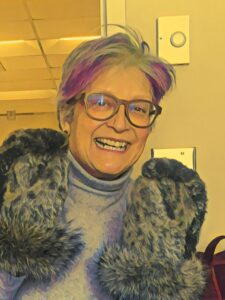
Dawn Bazely is a biology professor in York University's Faculty of Science. Beginning in 2006, she directed York’s Institute for Research and Innovation in Sustainability for seven years, receiving the university’s Sustainability Leadership Award, and in 2017, the title of University Professor.
Dawn has worn many academic hats since joining York in 1990 as an assistant professor, and she has developed diverse research expertise since beginning her field ecology career as a grass biologist. She maintains active research into toxic fungal endophytes of grasses. Dawn has studied plant-herbivore interactions for over forty years, including snow geese on Hudson Bay's salt-marshes and St Kilda’s Soay sheep in Scotland. Her Zoology doctorate from Oxford University applied economic optimality models to sheep grazing behaviour.
Dawn's many scholarly publications include the edited volume, Environmental Change and Human Security in the Arctic (Routledge, 2014). From 2006 to 2011, She led the Canadian section of the International Polar Year project, Gas, Arctic Peoples and Security. Dawn advocates for open access, excellent science communication, and Equity, Diversity, and Inclusivity in STEM, and beyond higher education. Her chapter, with York History department's, Prof. Kate McPherson, on the under-appreciated contributions of women to Ontario horticulture features in Ann Shteir’s McGill-Queen’s edited volume about Canadian botany in the nineteenth century: Flora’s Fieldworkers (2022).
Dawn has received many accolades over the decades, both within and outside of York University, including being named the Globe and Mail’s 2014 Universities Report "Hotshot Professor", and in 2022, receiving the Ontario Minister of Colleges and Universities’ Award of Excellence for Future-Proofing Students, by leading the way in virtual teaching during the COVID-19 pandemic in 2020 and 2021. In 2022, she was the recipient of the Royal Canadian Institute for Science’s Sandford Fleming Medal for Excellence in Science Communication.
Research keywords:
Ecology; Plant-Herbivore Interactions; Invasive Species; Science Policy; Open Access; Climate Change; Sustainability; Human Security
Themes | Planetary Health |
Status | Alum |
Related Work | |
Updates |
You may also be interested in...
No Health Without Water: Wrapping Up a Year of Fieldwork in Freetown
Brian Waters, a PhD candidate in Geography at York University and a Dahdaleh Global Health Scholar since 2023, has successfully completed the final round of his twelve-month survey on household water insecurity in Freetown, Sierra ...Read more about this Post
Recap — Equitable Green Homes? Housing, Health and Energy in a Changing Climate
What are the barriers to providing equitable and climate-resilient housing for all, and how can we begin to address these barriers? This event, chaired by Lina Brand Correa, a Faculty Fellow at the Dahdaleh Institute for Global ...Read more about this Post
BioCAM4: Biodiversity Integration in Climate Adaptation and Mitigation Actions for Planet, People, and Human Health
BioCAM4 is an interdisciplinary and trans-sectoral research partnership dedicated to: Developing methodologies for mapping NBCA trends worldwide and assessing local opportunities and challenges for NBCAs with dedicated deep-dive studies in two world regions: East Africa ...Read more about this Project