
Post
Published on May 10, 2023
In the final seminar of the 2022-2023 Dahdaleh Seminar Series, Eduardo Gallo-Cajiao and associate director Mary Wiktorowicz presented their recently published research on global governance for pandemic prevention and the wildlife trade.
Wildlife trade is a concern to public health and biodiversity conservation. However, a total ban on wildlife trade is neither feasible nor desirable, as many people depend on it for their livelihoods. As such, it is pivotal to consider conservation goals, trade, and livelihood objectives. The researchers posit that global health, food security, trade, and biodiversity conservation should be better coordinated as a strategy to prevent zoonotic spillover events. Further, as pandemic prevention often focuses more efforts on response after a zoonotic spillovers, rather than avoiding them in the first place, their research proposes to focus on prevention at source through governance macro-structures building on the Pandemic Treaty currently being negotiated under the World Health Organization.
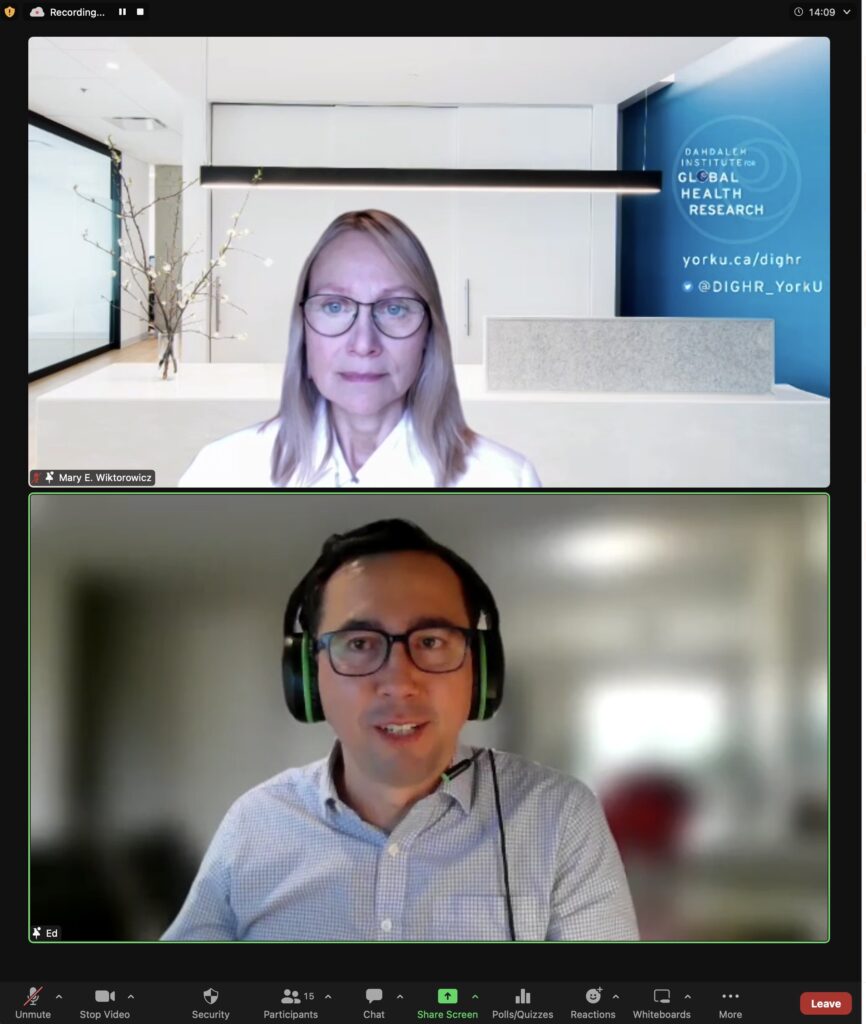


Eduardo highlighted a few silo symptoms, which include lack of legally binding international agreements that prioritize both human health and biodiversity conservation. There are also governance gaps from institutions like CITES, OIE, and FAO, because they do not have a mandate to address zoonotic disease outbreak. Lastly, Eduardo mentioned the lack of cross-sectoral coordination between institutions, for example, WHO and CITES.
The Pandemic Treaty was proposed by Chile in April 2020. It has since garnered the support of 61 nations and moved into negotiations with the WHO. Accordingly, Eduardo and the research team propose four goals to include in the Pandemic Treaty. First, there is an imperative to improve risk understanding through the development of a policy-science platform, including the development of a framework for risk evaluation and monitoring. Second, such a framework should be adopted to evaluate zoonotic risk across the globe. Third, the assessment of zoonotic risk should be used to guide risk reduction accordingly. Fourth, a global pandemic financing facility should be established to support the previous three goals. The authors hope the WHO process will enshrine these goals in the Pandemic Treaty to prevent future pandemics by stopping zoonotic spillovers at their source.
Watch the seminar presentation below:
Connect with Mary Wiktorowicz
Themes | Global Health & Humanitarianism, Global Health Foresighting |
Status | Active |
Related Work |
N/A
|
Updates |
N/A
|
People |
You may also be interested in...
Israel Uses Water as a Weapon Against the People of Gaza: New MSF Report
Authored by Dahdaleh Research Fellow and Director, Humanitarian Water Engineering Lab, Syed Imran Ali A critical new report from Médecins Sans Frontières (MSF/Doctors Without Borders)—drawing on its extensive operational data and medical evidence in Gaza, ...Read more about this Post
Recap – Beyond Divestment: Toxic Legacies of the Oil and Gas Industry from the Niger Delta to North America, with Anna Zalik and Isaac Osuoka
On November 26, 2025, Dahdaleh Institute Faculty Fellow Anna Zalik and Isaac Osuoka, Coordinator at Social Action International, delivered a presentation examining the toxic legacies of the oil and gas industry. Their discussion drew upon ...Read more about this Post
Dahdaleh Institute Researchers Awarded Over $1.4M from New Frontiers in Research Fund
Originally published by Yfile (4 May 2023). Written by Corey Allen, senior manager, research communications Seven projects led by York University researchers were awarded a combined $2.4 million from the New Frontiers in Research Fund (NFRF) in ...Read more about this Post