
Post
Published on October 19, 2023
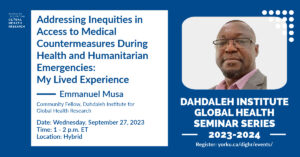
On September 27, 2023, Dahdaleh community fellow Emmanuel Musa illustrated the consequences when countries do not have access to medical countermeasures (MCMs) – strategies and tools that can be implemented during a wide range of emergencies. Examples of MCMs include vaccination programs, medicine and medical, diagnostic tools, personal protective equipment, enacting public health measures, and decontamination techniques.
During his time as an epidemiologist team lead in Beira, Mozambique, Dr. Musa witnessed the disastrous effects of the 2019 Tropical Cyclone Idai. The cyclone resulted in over 100,000 homes destroyed leaving hundreds of thousands displaced and even more without food, electricity, and access to clean water. According to the UN, it caused an estimated $773 million in buildings, crops, and infrastructure damages. In just two weeks, cholera and diarrhoeal diseases began to spread. Under these circumstances several MCMs were deployed, temporary shelters, medical teams, mental health and psychosocial support, logistics support, an emergency operations centre was established to coordinate resources, expertise, and equipment.


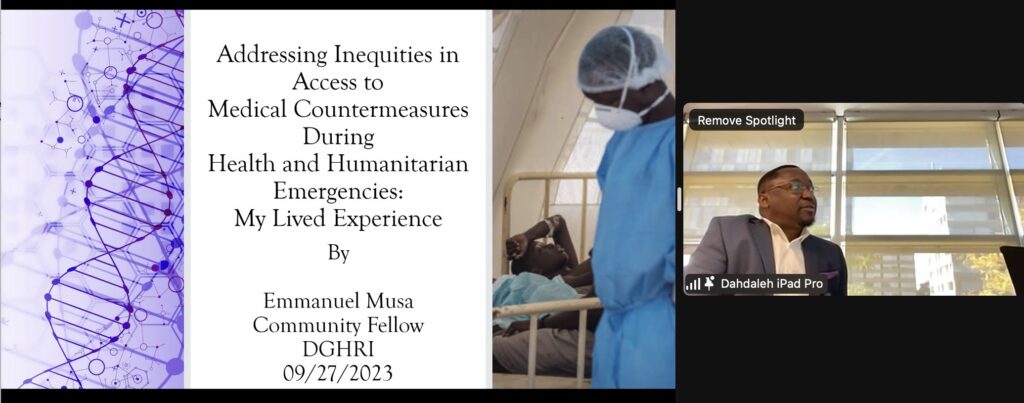
Despite these efforts, not all areas and all citizens were able to access all the resources. Women, children, and the elderly felt overlooked by responding teams. Dr. Musa stated that inequities had to be addressed though integrated approaches that targeted more vulnerable areas. Organizations collaborated with the local governments, NGOs, civil society, and other influential persons to find solutions and spread word about plans to reach everyone. Dr. Musa emphasized the importance of a MCMs communication phased approach and to involve policymakers as much as possible.
Lastly, he shared the key principles of humanitarianism (humanity and impartiality) and the need to build local capacity to improve emergency preparedness. Dr. Musa advocated for the importance of global advocacy and solidarity with a multi-prong approach to equitable access to MCMs. This would require more investment towards affordable MCMs and resource allocation that prioritizes underserved, at-risk areas.
Watch the seminar presentation below:
Connect with Emmanuel Musa
Themes | Global Health & Humanitarianism |
Status | Active |
Related Work |
N/A
|
Updates |
N/A
|
People |
You may also be interested in...
Civilians trapped by massacres in Sudan
Sudan is experiencing “the biggest and worst humanitarian crisis in the world,” Hanin Ahmed told Dahdaleh Community Fellow Chris Houston on November 2. Ahmed is a communication officer for Sudan’s grassroots network known as Emergency ...Read more about this Post
Advanced Disaster, Emergency and Rapid Response Simulation
The Victor Phillip Dahdaleh Advanced Disaster, Emergency and Rapid Response Simulation (ADERSIM) Lab, is a cutting-edge, multi-function infrastructure that serves as a research and training hub and an advanced Emergency Operations Centre (EOC). Officially opened in ...Read more about this Project
Recap – The Protection Gaps that Venezuelan LGBTQI+ Asylum Seekers Face in Brazil
On October 19, the Dahdaleh Institute for Global Health Research and the Centre for Research in Latin America and the Caribbean co-sponsored a seminar with Yvonne Su (faculty fellow) and Gerson Scheidweiler (postdoctoral fellow). Yvonne and ...Read more about this Post