
Post
Published on March 26, 2024
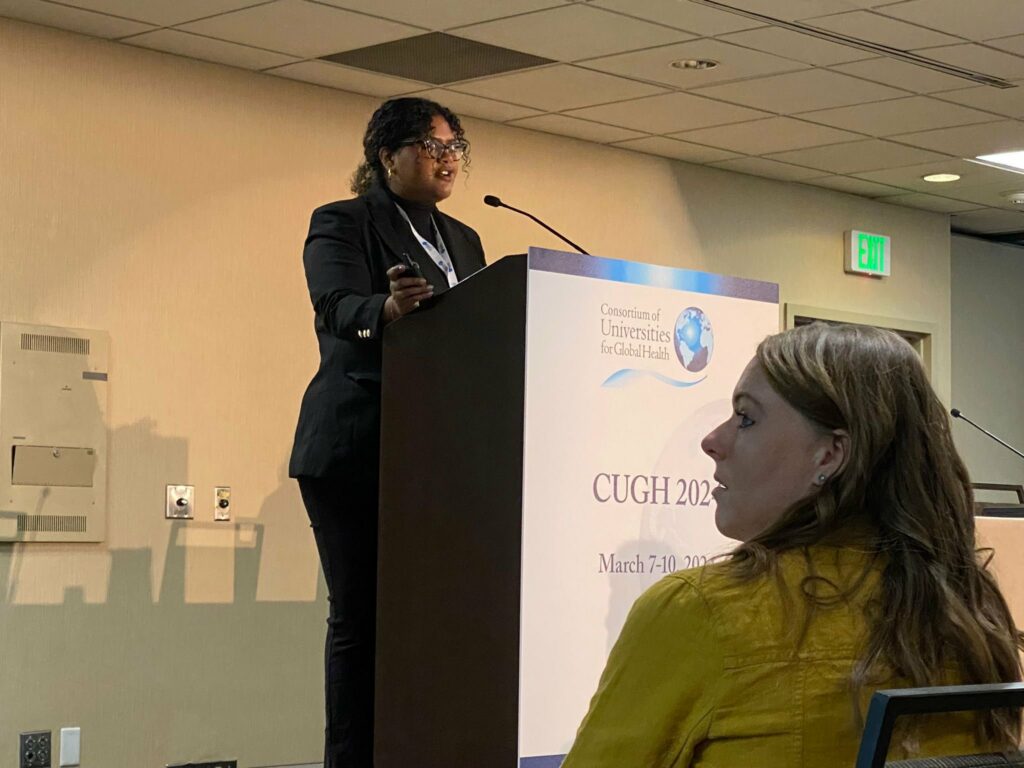
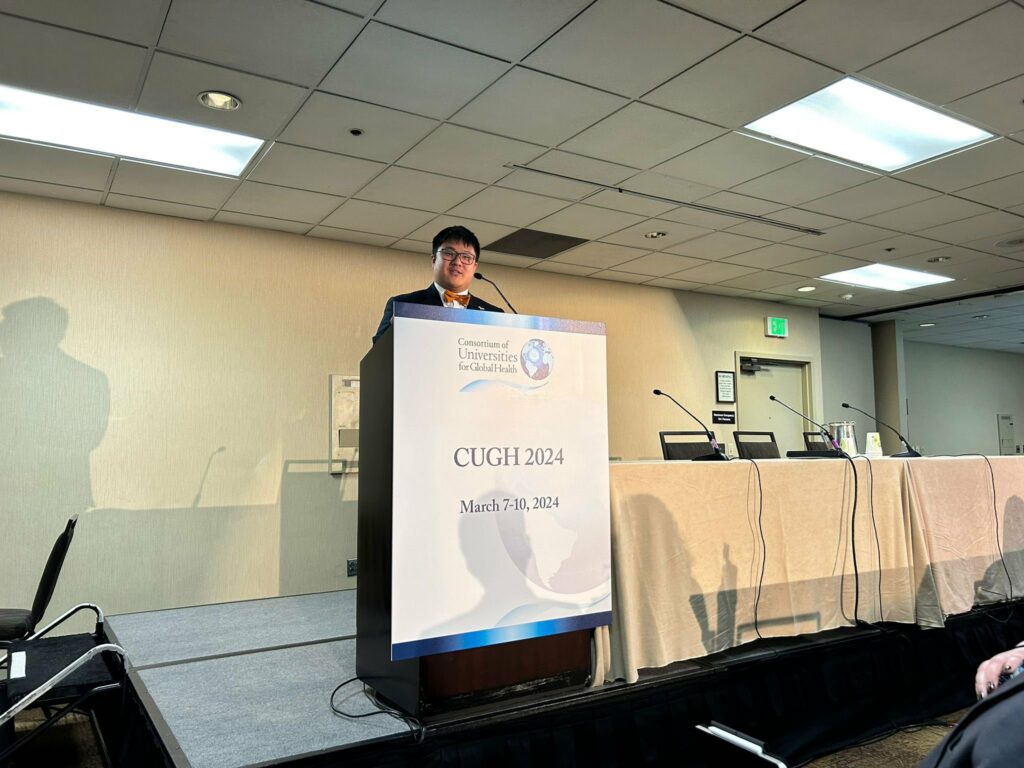
From March 7th to March 10th, 2024, two Global and Environmental Health Lab members attended the 15th annual Consortium of Universities for Global Health (CUGH) Conference held in Los Angeles, California. Dahdaleh global health alumna Mirianna Georges and Dahdaleh global health intern Richard Wu were selected to deliver 2 of 63 oral abstract presentations from a pool of over 1000 applicants after a highly competitive process. Mirianna was also chosen to present a poster presentation, while Richard served as a non-author presenter on behalf of two other members of the GEH Lab.
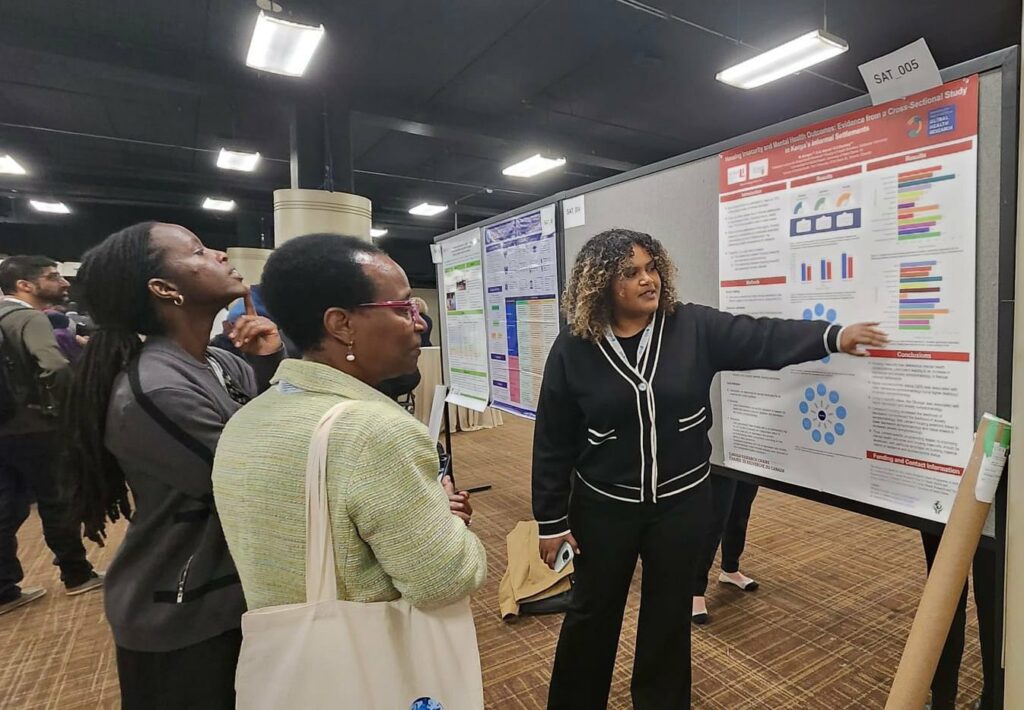
Mirianna Georges gave an oral presentation on the gendered differences in the relationship between housing insecurity and diarrheal infections in Kenyan informal settlements, as well as a poster presentation on the association between housing insecurity and mental health in Kenyan Informal Settlements.
Following the presentation, Mirianna Georges received questions about the project's methodology, specifically regarding how the multivariate models were built and how certain variables were chosen for the study. Additionally, there were questions surrounding the role of food insecurity and how that might influence findings – this was addressed by explaining the scope of the project and that food insecurity is a dimension of informal settlements that is an area of further research for the GEH lab.
During the poster presentation on mental health and housing insecurity, there was a lot of interest in how mental health was measured. Mirianna explained how the Generalized Anxiety Disorder-7 and the World Health Organization Wellbeing Index were used to measure depression and anxiety symptomatology in participants.
During a session entitled “The Social Determinants of Health”, Richard presented on the effects of housing and energy insecurity on psychosocial health outcomes amongst those living in informal settlements in Ghana. According to the results of his analysis, there was indeed a correlation between housing and energy insecurity and poor mental health outcomes. Though his results additionally indicate potential associations between living in community-oriented settings and lower odds of depression, more qualitative research is needed to better understand how these interactions work. During the Q&A session following his presentation, Richard fielded a number of questions and comments from CUGH attendees related to interventions and programs for alleviating some of the negative mental health effects arising from housing and energy insecurity.
More generally, attending the conference provided Richard and Mirianna with the opportunity to participate in sessions and lectures spanning the multidisciplinary field of Global Health. One session, “Responding to Conflict to Impact Public Health,” explored the gap between research in refugee and crisis settings and action and how timing is often a critical factor to consider in these situations. Doctors and professors from the Yale School of Public Health and the International Medical Corps talked about the use of non-traditional data collection in areas of conflict for humanitarian decision-making.
Another fascinating session was a talk called, “Advancing Quality Health Information - What Works?” In this session, editors from the Journal of Health Communication and senior researchers from the CUNY School of Public Health spoke about the landscape of health communication, and how the rise in misinformation has given rise to many challenges.
“I am deeply grateful to have been given the chance to meet and learn from some of the most accomplished minds in Global Health, let alone present an oral abstract,” said Richard. “This has been one of the most enriching experiences of my academic career and has reaffirmed my goal to one day work in global health.”
“Attending CUGH was incredibly rewarding, giving me experience in presenting research, engaging with scholars from multidisciplinary fields, and networking with students and scholars alike,” said Mirianna. “I look forward to using the skills gained from this conference and being able to integrate them into future projects and research.”
Themes | Global Health & Humanitarianism |
Status | Active |
Related Work | |
Updates |
N/A
|
People |
Richard Wu, Global & Environmental Health Lab, Global Health Intern [W23;S23;FW23-24;S24] - Alum
Mirianna Georges, Global and Environmental Health Lab, Global Health Intern [SU23] - Alum |
You may also be interested in...
Recap – Health Disparities Across Gender and Life Stages in India
On May 8, 2024, Dahdaleh community scholar Dr. Rajnish Ranjan Prasad presented an in-depth analysis of gender health inequities in India and its root causes. He began with an overview of gender health disparities that ...Read more about this Post
Civilians trapped by massacres in Sudan
Sudan is experiencing “the biggest and worst humanitarian crisis in the world,” Hanin Ahmed told Dahdaleh Community Fellow Chris Houston on November 2. Ahmed is a communication officer for Sudan’s grassroots network known as Emergency ...Read more about this Post
Water Safety Research in Cambridge Bay, Nunavut is Off to a Successful Start
In mid-April, Dahdaleh graduate scholar Caroline Duncan, Dahdaleh faculty fellow Professor Stephanie Gora, and Audrey Tam from the Safe and Sustainable Water Research Group at York University arrived in Cambridge Bay to hold the first ...Read more about this Post