
Post
Published on February 13, 2025
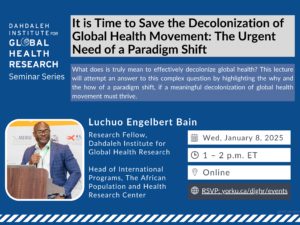
On January 8, Dahdaleh research fellow Luchuo Engelbert Bain emphasized the urgent need for a paradigm shift to save the decolonization of the global health movement from stagnation and superficiality. Bain underscored that decolonizing global health must go beyond performative gestures to dismantle inequities perpetuated by Global North power and epistemic dominance.
He drew attention to the structural barriers impeding progress, such as epistemic violence, elite capture and inequitable partnerships. Citing data, Bain explained that two thirds of global health agencies are headquartered in high income countries, with their leadership overwhelmingly male and Western educated. Such dynamics perpetuate epistemicide, marginalizing Indigenous knowledge and local expertise, while privileging Western frameworks the guide global public health practice and scholarship.
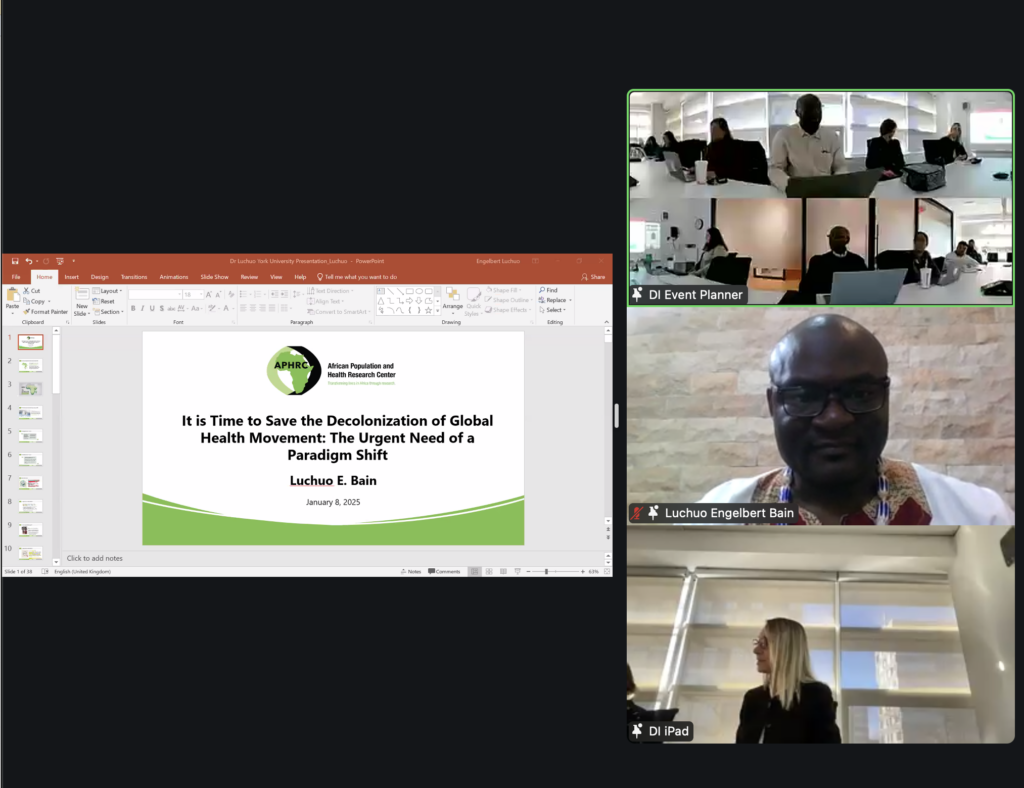
Bain critiqued the tokenistic approach to decolonization, which risks becoming co-opted by Global North institutions. Without genuine structural change, including equitable funding and governance, the movement may serve existing power structures rather than challenge them. He advocates for a shift from paternalistic models to approaches grounded in local leadership, true and transparent community engagement and meaningful co-creation. Referring to frameworks like the Research Fairness Initiative (RFI), he showcased how institutions could foster equitable research practices. He acknowledged the progress already made by some funders in localizing funding agendas that are locally driven.
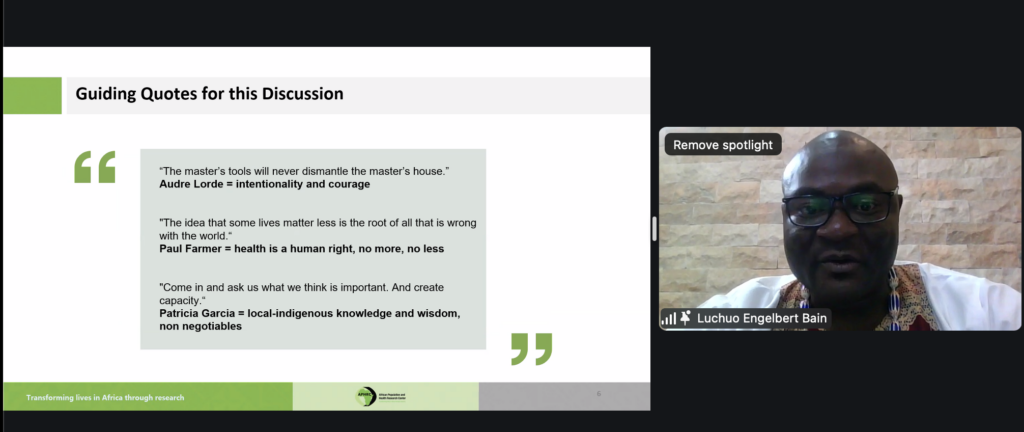
Bain also emphasized the role of inclusive language and inter – trans disciplinary approaches in thinking through the decolonization agenda He advocated for increased involvement of social sciences (history of medicine, political science, international relations) , local knowledge and linguistic diversity to redefine expertise and scholarship in global health. Bain echoed Audre Lorde’s sentiment that “the master’s tools will never dismantle the master’s house,” urging intentionality and courage in disrupting well established systems. He insisted on the true global north – global south allyship, equitable south – south partnerships, and the need to rethink expertise and knowledge in global health as key dimensions of true decolonization of global health.
In closing, Bain called for solidarity, equity and justice as guiding principles, asserting that the decolonization of global health must be driven by those directly affected. This transformative agenda demands structural reimagination, where power and resources shift decisively to the Global South.
He concluded with a quote: To decolonize global health effectively, we must continuously question: knowledge, expertise, methods, power, agenda. For whom, by whom, with whom!!!
Watch the seminar presentation below: https://youtu.be/wyXOlmWVow4
Connect with Luchuo Engelbert Bain.
Themes | Global Health Foresighting |
Status | Active |
Related Work |
N/A
|
Updates |
N/A
|
People |
You may also be interested in...
Pandemic Prevention and Global Policy in Geneva
In late May, Dahdaleh faculty fellow Tarra Penney and Dahdaleh research fellow Chloe Clifford Astbury travelled to Geneva to attend the Geneva Health Forum and Geneva Health Week, which ran in parallel with the 77th ...Read more about this Post
Call for Presentations – 2024 Critical Social Science Perspectives in Global Health Workshop
Returning for a fifth year, the Critical Social Science Perspectives in Global Health (CPGH) Research workshop will be held on Friday, March 1 from 9:30 a.m. to 1:30 p.m. ET. Join us to gain novel ...Read more about this Post
New Research Show Mpox Outbreak Lead to Stigma and Blame Toward 2SLGBTQIAP+ Community
Originally published by YFile (30 May 2023) York University researchers have furthered their study of the global mpox virus by publishing a new paper on the dangerous stigmas the 2SLGBTQIAP+ community face as the outbreak continues. Since ...Read more about this Post