
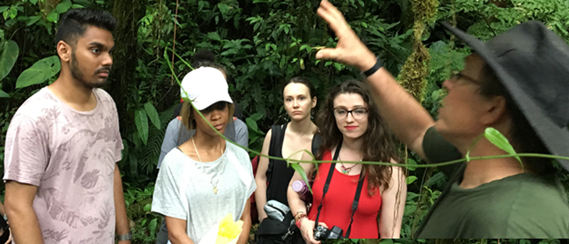
Taking place within the forests of the Alexander Skutch Biological Corridor in Southern Costa Rica, York University’s Las Nubes Study Abroad Program offers an incredible, hands-on education opportunity surrounded by rich local biodiversity. Under the direction of Dr. Felipe Montoya-Greenheck, Chair in Neo-Tropical Conservation and Las Nubes Project Director, and Ana Maria Martinez, Associate Director, the program operates from the Las Nubes EcoCampus, which features the landmark Lillian Meighen Wright Centre.

The program’s mission is rooted deeply in environmental conservation, social justice, and the UN Sustainable Development Goals. These 9- to 10-day, 3-credit courses are open as elective credits to 3rd- and 4th-year undergraduate or graduate students with no prerequisites. Past students have shared profound, memorable experiences in this multicultural environment, noting how the program’s focus on local environmentalism and social activism completely shifts how they view their own academic focus. It gives students a chance to open their options, connect with scholars from different backgrounds, and immerse themselves in local Costa Rican culture and meaningful homestays with local families.
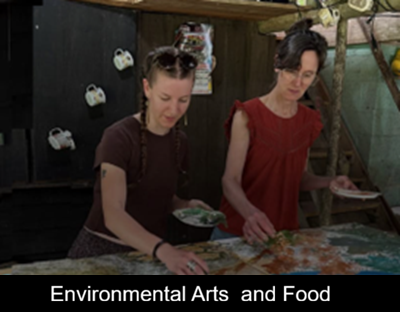
The curriculum leverages this unique setting by connecting theory and community impact through unforgettable field experiences. In a course on Environmental Arts and Food Sovereignty in Costa Rica (EU/ENVS 4810B), EUC Professor Martha Stiegman offers students the opportunity to experience local struggles for food sovereignty in Costa Rica through environmental arts. The course explores environmental arts principles and practices at the Las Nubes Eco Campus, visit surrounding small farmers, agro-cooperatives, Indigenous communities, farmers' markets, and ecological features. Students produce a variety of creative projects including short cellfilms and collaborate with local environmental artist Raquel Bolaños to create mobile murals proclaiming small farmers’ rights.
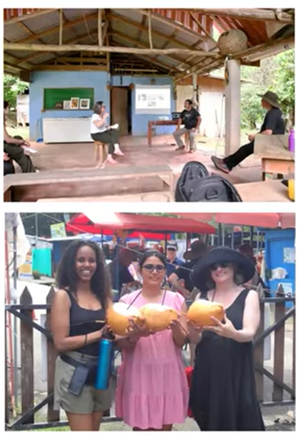
with students at the Las Nubes EcoCampus in Costa Rica.
In another course on Nature, Neoliberalism, Political Ecology: The Politics of Water in Costa Rica and Latin America (EU/GEOG 4050) with EUC ADR Carlota McAllister as Course Director, students critically examine and experientially engage with the water line as it has taken shape in Costa Rica and Latin America to understand how such coalitions work to counter climate crisis and its disproportionate effects on poor, Indigenous, and Black peoples.
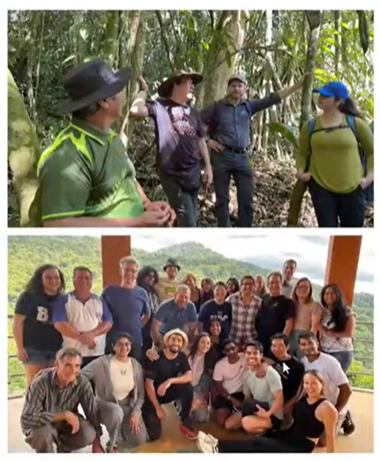
Students survey the problems that humans and other living beings increasingly face in accessing water, identify the structures and processes that limit access, explore new ways of relating to water, and imagine how people might act on and through these relations. The course involves site visits to bodies of water near the campus and conversations with activists and communities engaged in water politics.
The study program also offers courses in the winter, bringing a field-based lens to human behaviour and health. Environmental Psychology (HH/PSYC 3450) dives into the bidirectional interaction between people and their environments, examining how natural and built spaces impact our well-being and exploring how to encourage pro-environmental behaviour.
Meanwhile, Advanced Topics in Environment and Health: Ecosystem Approaches in the Field (EU/ENVS 4800A/5182) with Course Director, Martin Bunch, offers a 10-day excursion centered around principles of systems thinking, transdisciplinarity, and social equity. This course is built around hands-on themes like EcoHealth and Watersheds or EcoHealth and Food, using the Alexander Skutch Biological Corridor as a living case study to link health, environment, and community.
All courses from the Las Nubes Study Abroad Program give students a chance to apply skills outside of the classroom and challenge them to take this global-minded activism and apply it directly to their own lives and future careers. More information can be found on the official Las Nubes EcoCampus website and attending information sessions throughout the school year.