
Post
Published on October 31, 2022
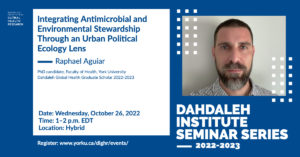
On October 26, Raphael Aguiar presented a guiding framework that focuses on rescaling socio-ecological governance approaches to addressing AMR by considering societal relations with nature that affect AMR at the human-animal-environmental interface. Antimicrobial resistance, pandemics, biodiversity loss, and climate change pose simultaneous existential threats, yet coordinated responses that jointly address them through a One Health approach do not exist. An urban political ecology (UPE) lens informs a critical analysis of the governance of antimicrobial stewardship (AMR) by situating AMR risks in relation to global governance and economic forces that shape the social and political co-determinants of antimicrobial and other systemic existential threats already confronted in broader commitments to pandemic prevention and environmental stewardship.
Watch the seminar presentation below:
Themes | Global Health Foresighting |
Status | Active |
Related Work |
N/A
|
Updates |
N/A
|
People |
You may also be interested in...
New Digital Platform Supporting Online Well-Being Launches This Spring
A first-of-its kind digital wellness platform, created at York University’s Young Lives Research Lab, will launch this spring to help Canadians navigate the challenges and complexities of the internet and social media. Originally published in YFile, ...Read more about this Post
York University to train next generation of climate ambassadors
Originally published by Yfile (16 May 2025). Edited by Ashley Goodfellow Craig York University will offer funding from the highly competitive Canadian Queen Elizabeth II Diamond Jubilee Scholarships (QES) program to students and researchers from York, as ...Read more about this Post
Recap — Pandemic Urbanism: Looking at Past Infectious Diseases and Preparing for a Post-Pandemic World
On March 8, over 35 participants attended the launch of Pandemic Urbanism: Infectious Diseases on a Planet of Cities (Polity Press, 2022), co-authored by S.Harris Ali, Creighton Connolly and Roger Keil. Prof. Syed Harris Ali ...Read more about this Post