
Post
Published on June 29, 2023
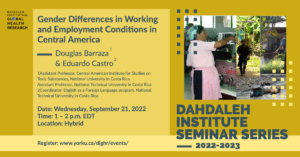
On September 21, 2022, Douglas Barraza and Eduardo Castro examined structural gender inequality in Central America. Douglas introduced survey results about the labour conditions across various countries in Central America and how these circumstances have resulted in higher rates of unemployment among women. Some countries such as Panama and Costa Rica fare better comparatively (e.g., better employee benefits such as two weeks of paid vacation, pensions, resting or sick days, and maternity and paternity leave) however, much improvement is still required.
Between 2015 to 2019, the employment rate of women has increased slightly, but the employment rate for men is still nearly double that of woman. Eduardo added that not only is there a disparity between employment opportunities between men and women, but there is also a division between citizens and migrant workers where immigrant workers often work in unsafe conditions with fewer benefits.
Douglas and his research team found that regardless of gender and status, all workers are working longer hours. To earn a minimum wage of $400 USD per month, many are working around 40 to 60 hours a week. These workers risk compromising their health working overtime in dangerous work conditions. His research measured the safety of work environments with a criterion that included items like exposure to elevated noise, exposure to toxic chemicals, continuous repetitive movement, requirement to work fast, union health and safety offices at work, risk-prevention services, and the workers perceived level of health. Despite the efforts, more progress needs to be made towards improving the working conditions for all citizens regardless of gender and immigration status.
Watch the seminar presentation below:
Connect with Douglas Barraza and Eduardo Castro
Themes | Global Health & Humanitarianism |
Status | Active |
Related Work |
N/A
|
Updates |
N/A
|
People |
N/A
|
You may also be interested in...
Announcing the Winners of the 2023 Seed Grants in Critical Perspectives in Global Health Research
Following the fourth annual Critical Perspective for Global Health Research (CPGH) workshop in March, the CPGH Steering Committee is delighted to announce that the following York researchers have been awarded this year’s $5,000 seed grants ...Read more about this Post
GEHLab welcomes International Visiting Research Trainee
This fall, Ann Codjoe will join the Global and Environmental Health Lab for a four-month period as an International Visiting Research Trainee (IVRT). The IVRT program enables highly qualified students from academic institutions around the world ...Read more about this Post
Dahdaleh Graduate Scholar Presents Research in Rome and Calgary
17th World Congress on Public Health in Rome Director of the Dahdaleh Institute, Dr. James Orbinski, and Dahdaleh graduate scholar Nilanjana Ganguli participated at the 17th World Congress on Public Health (WCPH) held in Rome ...Read more about this Post