
Post
Published on May 25, 2023
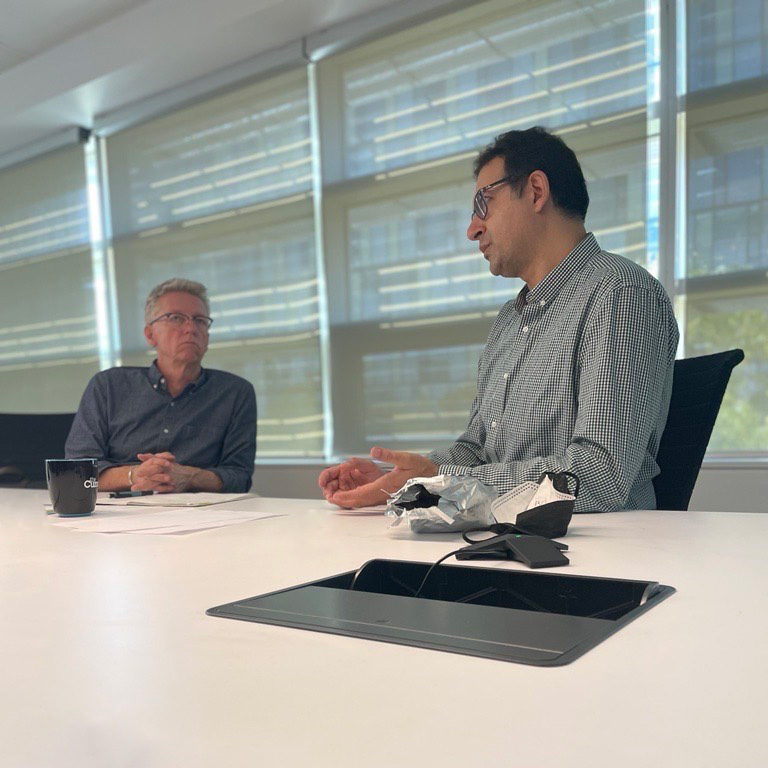
On October 5, Dahdaleh postdoctoral research fellow Mohammadali Tofighi introduced computer modelling approaches and applications for modelling health impacts caused by climate change in Malawi.
The modelling process can be abstract. Mohammadali discussed a few modelling approaches that can be used based on the level of abstraction and the information available. For example, dynamic systems modelling works best for low abstraction data because it is numerical with analysis of physical state variables and algebraic differential equations. Whereas system dynamics modelling can work well with high-abstraction ideas and uses feedback loops to gather data. Next, agent-based modelling can account for and measure individual behaviour, direct and indirect interaction, and a wide range of abstractions.
The research team were able to map out their data to find patterns, and correlations, and apply real-world solutions that address the spread of disease or food insecurity caused by climate change. They used a combination of these modelling techniques, but he especially highlighted agent-based modelling, which allows for flexible, expandable, and sharable data collection. It can depict how environments and agents interact. For instance, the level of rainfall can inform the rate of malaria being spread. Ultimately, these models can simulate rapidly changing weather patterns and prepare local communities for these challenges.
Watch the seminar presentation below:
Connect with Mohammadali Tofighi
Themes | Global Health & Humanitarianism, Global Health Foresighting, Planetary Health |
Status | Active |
Related Work | |
Updates |
N/A
|
People |
You may also be interested in...
Partnership for Youth and Planetary Wellbeing Present Results at the Society for Applied Anthropology Conference
Dahdaleh research fellow James Stinson and research assistant Lee Mcloughlin recently presented at the Society for Applied Anthropology annual conference in Santa Fe, New Mexico on a panel titled "Decolonizing Alliances for the Post-Carbon Transition." ...Read more about this Post
Recap — Utilizing Academic Research to Support Real-Time Decision-Making in Health and Humanitarian Crises
On November 30th, Dr. Ahmad Firas Khalid delivered an interactive seminar about how the Canadian Red Cross makes decisions using scientific, real-time evidence amidst health and humanitarian crises. Twenty-six participants discussed the Red Cross' involvement ...Read more about this Post
Hot off the Press — Antimicrobial Resistance (AMR) and Its Associated Inequities Do Not Occur in Isolation; Solutions Must Also Be Interconnected
Dahdaleh Institute research fellow Raphael Aguiar, faculty fellow Roger Keil, research associate Ryan Gray, and associate director Mary Wiktorowicz recently published a paper in Taylor & Francis Online titled, "One health governance of antimicrobial resistance seen ...Read more about this Post