
Post
Published on May 13, 2024
Dahdaleh research fellow James Stinson and research assistant Lee Mcloughlin recently presented at the Society for Applied Anthropology annual conference in Santa Fe, New Mexico on a panel titled "Decolonizing Alliances for the Post-Carbon Transition." The panel explored how Indigenous/non-Indigenous alliances contribute to the cultivation of sustainable and just post-carbon ways of life, and reflected on the possibilities and complications associated with diverse approaches to alliance formation and on the roles that engaged anthropologists might play.
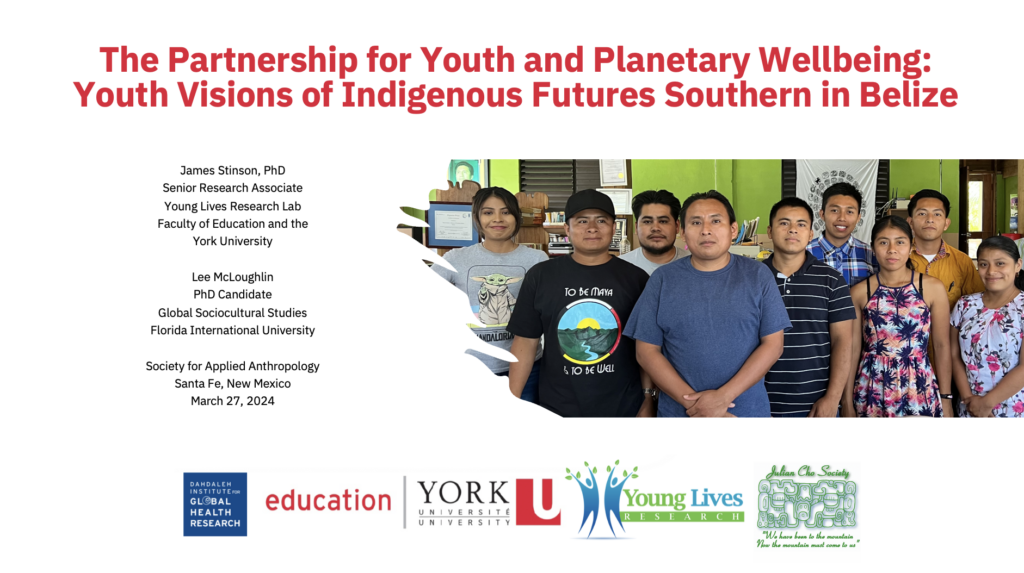
James and Lee presented results from the Partnership for Youth and Planetary Wellbeing project in Belize. Led by Professor Kate Tilleczek, the project is a collaboration between researchers from York University and the Julian Cho Society (JCS) in Belize. JCS is an Indigenous NGO based in southern Belize committed to supporting and promoting sustainable development and the rights of Indigenous Maya communities through research, education and advocacy. The project responds to calls for new decolonial partnerships that aim to harness, support, and foreground Indigenous and youth-centred research, education and action for planetary health.
Throughout 2023, James and Lee worked with staff from JCS to train and mobilize a team of 10 Maya youth as "young anthropologists" to conduct interviews in their communities on issues related to planetary health. They also collaborated Dahdaleh research fellow Mark Terry and the Planetary Health Film Lab to train youth in documentary film production. This partnership facilitated innovative youth-led research on the impacts of climate change, the importance of food sovereignty, traditional ecological knowledge, and the struggle to secure Indigenous land rights in Maya communities, that was mobilized for both global policymakers at the UN and local audiences in Belize. Perhaps more importantly, youth participants noted the benefits of the project on their own wellbeing through the training and skills they received, the social connections made with with other youth and community members, and the development of leadership skills and confidence building.
Themes | Planetary Health |
Status | Active |
Related Work | |
Updates |
N/A
|
People |
Kate Tilleczek, Faculty Fellow, Faculty of Education - Active
Mark Terry, Research Fellow, Documentary Film & Global Health - Alum James Stinson, Postdoctoral Fellow, Planetary Health & Education - Active Lee Mcloughlin, Research Assistant, SMART Conservation - Alum |
You may also be interested in...
Dahdaleh Postdoctoral Fellow Discusses Digitalization and Predictive Policing in Conservation
Written by Aiden Smith, Research Fellow at the Center for Law, Energy, & the Environment Originally published by Legal Planet (2 June 2023). Does technology shift focus toward “green policing” and away from integrated conservation and development? ...Read more about this Post
United Nations Climate Negotiations in Bonn, Germany
In June 2024, Dahdaleh Global Health Graduate Scholar Ana Carolina Cardoso travelled to Bonn, Germany to attend the 60th session of the Subsidiary Bodies (SB60) of the United Nations Framework Convention on Climate Change (UNFCCC). ...Read more about this Post
Five York Researchers Awarded Seed Grants for Critical Perspectives in Global Health Research
Five York researchers have been awarded seed grants to carry out critical global health research and develop fuller grant proposals and research programs. Following a two-day workshop on critical perspectives in global health research in ...Read more about this Post