
Post
Published on June 27, 2024
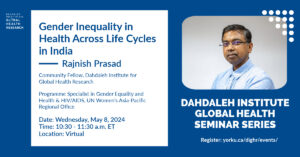
On May 8, 2024, Dahdaleh community scholar Dr. Rajnish Ranjan Prasad presented an in-depth analysis of gender health inequities in India and its root causes. He began with an overview of gender health disparities that starts even before birth, highlighting the practice of sex-selective abortions and the resulting imbalance in the sex ratio at birth.
Dr. Prasad noted that infant mortality rates have declined overall. Yet, significant health disparities remain between males and females. Beginning from birth, there are biases in post-birth care and nutrition, with female infants receiving less medical attention. This issue is particularly more pronounced in rural areas and among less educated mothers. Later in life, poor nutrition and social norms that deprioritize female health, results in higher prevalence of anemia among adolescent girls and women, in the age-group of 15 to 49 years. Anemia significantly impacts educational outcomes as well as maternal health, being a leading cause of maternal mortality due to postpartum hemorrhage.


Following, Dr. Prasad discussed the taboo surrounding menstruation in India. Specifically, he elaborated upon the significant variation in menstrual hygiene management practices between urban and rural areas and the impact of inadequate menstrual facilities on girls' education. Lack of clean water and sanitation in schools often leads to absenteeism among menstruating girls. Additionally, early marriages can result in educational dropouts, early pregnancies, and associated health risks for young mothers and their children. Education was identified as a critical factor in delaying marriage and improving health outcomes.
The seminar concluded with a discussion on broader social determinants of health, such as women's employment, financial independence, and access to resources like mobile phones. Dr. Prasad emphasized the need for holistic approaches to address gender norms and empower women to make informed health decisions. He provided examples of successful initiatives, such as conditional cash transfer schemes and community participation programs, which have improved health outcomes for women and girls. However, he stressed that significant challenges remain, particularly in addressing deeply rooted gender norms and ensuring equitable access to health services across diverse regions in India.
Watch the seminar presentation below:
Connect with Dr. Rajnish Ranjan Prasad
Themes | Global Health & Humanitarianism |
Status | Active |
Related Work |
N/A
|
Updates |
N/A
|
People |
You may also be interested in...
Updates – New Website for the 2023 World Health Assembly Simulation at York University
The World Health Assembly Simulation (WHA SIM), led by Dahdaleh faculty fellow, Dr. Ahmad Firas Khalid, announces a new website in preparation for the upcoming Global Health WHA SIM, taking place from April 30 to ...Read more about this Post
The Global Health Class of 2025 Celebration
On June 18, 2025, the School of Global Health proudly hosted the Global Health Class of 2025 Celebration—a special post-convocation event that brought together graduating students, their families, and faculty for a joyful and memorable ...Read more about this Post
Check out the SWOT at the UNC Water and Health Conference
The Safe Water Optimization Tool (SWOT) team will be at the upcoming UNC Chapel Hill Water and Health Conference, October 24 to 28, at the University of North Carolina Chapel Hill. James Brown, our field technical ...Read more about this Post