
Post
Published on February 16, 2023
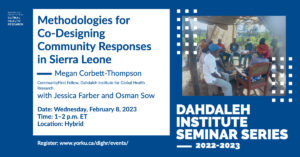
On February 8, in a collaborative seminar with the Dahdaleh Institute and the SeeChange Initiative, Megan Corbett-Thompson (Community Fellow, Dahdaleh Institute) along with Jessica Farber and Osman Sow delivered an insightful seminar.
Megan began by introducing the CommunityFirst approach and framework when addressing critical humanitarian health crises; it is crucial to cultivate relationships with local community members and co-design solutions that can further the understanding of ongoing health issues within communities.
Osman then presented examples using the participatory methodology in Sierra Leone. He shares the COVID-19 action plan in Rowalla, Tonkolili where a health committee was established to promote the dissemination of health information and vaccine advocacy.
Finally, Jessica elaborated on the co-designing method with local communities through her experience working on the Médecins Sans Frontières’ (MSF) CommunityFirst TIC Pilot Project. MSF and local communities in Mile 91 and Magburaka, Tonkolili District, co-designed strategies to strengthen adolescent sexual and reproductive health and rights.
The speakers demonstrate that this community-driven response to health crises can build effective, long-term solutions to health challenges and provide health education beginning at a grassroots level.


Watch the presentation below:
Themes | Global Health & Humanitarianism |
Status | Active |
Related Work | |
Updates |
N/A
|
People |
You may also be interested in...
2025 Year in Review
Thank you for your continued support, engagement, and invaluable contributions to our global health research community here at the Dahdaleh Institute. Happy holidays and cheers to a new year! 1. Centering Palestinian Voices: Rethinking Global ...Read more about this Post
Recap – The Importance of Planetary Health and Indigenous Wellbeing Showcased Through Film
On October 24, 2023, Dahdaleh research fellow Mark Terry presented the films created at the fourth annual Planetary Health Film Lab by Indigenous youth in Belize. Dr. Terry and the participants created six films within ...Read more about this Post
Highlighting the SWOT’s Risk-Based Approach at the 2022 Emergency Environmental Health Forum
Dahdaleh Institute member Michael DeSanti is presenting on the innovative Safe Water Optimization Tool (SWOT) at the 2022 Emergency Environmental Health Forum. He will discuss SWOT’s risk-based approach to generating chlorination guidance to ensure safe ...Read more about this Post