
Post
Published on April 3, 2023
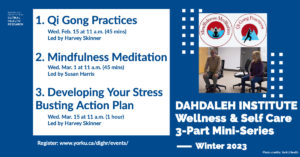
On March 1, the Dahdaleh Institute welcomed Susan Harris to lead members of the community in a Mindfulness Meditation session, the second instalment to a three-part Wellness & Self-Care mini-series.
After a half-hour long guided meditation that encouraged participants to be present in the moment and reflect deeply, individuals were invited to engage in a candid Q&A session. Susan stated that although it is important to put mindfulness in its Buddhist context to derive the most benefit, a religious connection is not required to derive the significant mental, emotional, and physical health benefits of meditation.
Susan also explained that group practice sessions like this one can provide powerful motivation and learning that is not available in solo practice. However, individual practice allows for a daily routine that is key to integrating mindfulness skills.
For example, Susan distinguished skillful versus non-skillful responses, noting that mindfulness can increase the former. She described a skillful response as one that is non-harming, and following the intentions for how we want to be in the world. After all, as a participant said: “accepting” does not mean that all things are acceptable.
The mindfulness session with Susan was an excellent beginning to a more mindful March.
Watch the seminar presentation below:
Themes | Global Health & Humanitarianism |
Status | Active |
Related Work | |
Updates |
N/A
|
People |
You may also be interested in...
Recap — Storytelling and Epistemic Humility as Critical Interventions in Global Health
Recap written by Dahdaleh Global Health Graduate Scholar Alexandra Frankel. Dr. Nancy Edwards’ one-woman performance Rethinking Good Intentions (1 hour 3 minutes) opens with two lines she meticulously deconstructs throughout her play: “There is not ...Read more about this Post
Hot off the Press – Protecting the Safe Water Chain in Refugee Camps: An Exploratory Study of Water Handling Practices, Chlorine Decay, and Household Water Safety in South Sudan, Jordan, and Rwanda
A new article has been authored by experts from the Dahdaleh Institute for Global Health Research and Médecins Sans Frontières in the American Journal of Tropical Medicine and Hygiene, exploring factors that protect or compromise ...Read more about this Post
York U researchers’ revamped AI tool makes water dramatically safer in refugee camps
As the world’s refugee crisis intensifies and climate change linked natural disasters become more frequent, unique machine-learning enabled tool helps aid workers deliver safe water in displaced-population settlements Woman and children gather at a tapstand ...Read more about this Post