
Post
Published on October 31, 2022
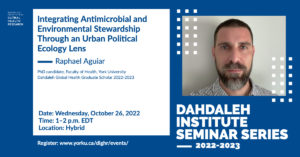
On October 26, Raphael Aguiar presented a guiding framework that focuses on rescaling socio-ecological governance approaches to addressing AMR by considering societal relations with nature that affect AMR at the human-animal-environmental interface. Antimicrobial resistance, pandemics, biodiversity loss, and climate change pose simultaneous existential threats, yet coordinated responses that jointly address them through a One Health approach do not exist. An urban political ecology (UPE) lens informs a critical analysis of the governance of antimicrobial stewardship (AMR) by situating AMR risks in relation to global governance and economic forces that shape the social and political co-determinants of antimicrobial and other systemic existential threats already confronted in broader commitments to pandemic prevention and environmental stewardship.
Watch the seminar presentation below:
Themes | Global Health Foresighting |
Status | Active |
Related Work |
N/A
|
Updates |
N/A
|
People |
You may also be interested in...
Recap – Gender as a Dimension of Inclusive Innovation
On April 24, 2024, Dahdaleh adjunct faculty fellow Dr. Jean-Jacques Rousseau and development practitioner Devina Srivastava (Global Fellow, Center for Human Rights and Humanitarian Studies, Brown University) discussed the importance of inclusive innovation as an ...Read more about this Post
Discover York Academics: Laptop and Learn
Discover York Academics (DYA) is a dynamic eCV platform that enables faculty to showcase their work, connect with peers, indicate availability for graduate supervision, and enhance visibility to industry and community partners. With automatic updates ...Read more about this Post
2022-2023 Dahdaleh Global Health Graduate Scholarships Awarded to Eight Outstanding Scholars
The Dahdaleh Institute for Global Health Research is delighted to announce and congratulate the recipients of the 2022-2023 Dahdaleh Global Health Graduate Scholarships. DI associate director and committee Chair, Mary Wiktorowicz, says, “We are impressed ...Read more about this Post