
Post
Published on April 3, 2023
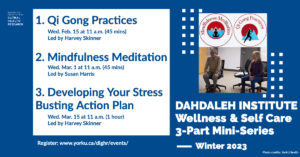
On March 1, the Dahdaleh Institute welcomed Susan Harris to lead members of the community in a Mindfulness Meditation session, the second instalment to a three-part Wellness & Self-Care mini-series.
After a half-hour long guided meditation that encouraged participants to be present in the moment and reflect deeply, individuals were invited to engage in a candid Q&A session. Susan stated that although it is important to put mindfulness in its Buddhist context to derive the most benefit, a religious connection is not required to derive the significant mental, emotional, and physical health benefits of meditation.
Susan also explained that group practice sessions like this one can provide powerful motivation and learning that is not available in solo practice. However, individual practice allows for a daily routine that is key to integrating mindfulness skills.
For example, Susan distinguished skillful versus non-skillful responses, noting that mindfulness can increase the former. She described a skillful response as one that is non-harming, and following the intentions for how we want to be in the world. After all, as a participant said: “accepting” does not mean that all things are acceptable.
The mindfulness session with Susan was an excellent beginning to a more mindful March.
Watch the seminar presentation below:
Themes | Global Health & Humanitarianism |
Status | Active |
Related Work | |
Updates |
N/A
|
People |
You may also be interested in...
New Research Presented at EGU and EEHF
This past month, Dahdaleh Global Health Graduate Scholar, Michael De Santi, presented his newest research “ML-QMRA: A novel machine learning tool for linking water quality to health risk in humanitarian contexts” at the European Geosciences ...Read more about this Post
Film Screening and Panel Discussion – In Search of a Better World with Payam Akhavan
On June 17, Massey College will screen the film In Search of a Better World at a special event as the film is launched on CBC Gem. The screening will begin at 7 p.m., followed ...Read more about this Post
Recap — Addressing HIV/AIDS Among Women in Asia Pacific: Challenges, Progress and Strategies, with Rajnish Prasad
On February 5, 2025, Dahdaleh community scholar Rajnish Prasad delivered an insightful seminar on Human immunodeficiency virus infection and acquired immune deficiency syndrome (HIV/AIDS) among Women in Asia Pacific. He provided a regional overview of ...Read more about this Post