
Post
Published on March 13, 2023
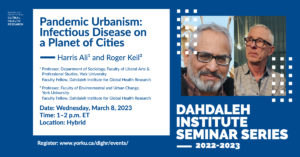
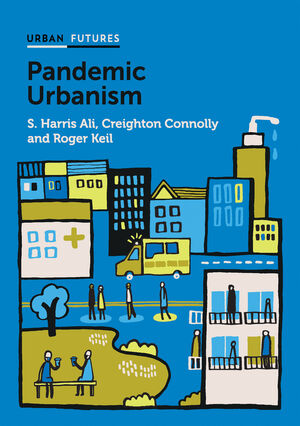
On March 8, over 35 participants attended the launch of Pandemic Urbanism: Infectious Diseases on a Planet of Cities (Polity Press, 2022), co-authored by S.Harris Ali, Creighton Connolly and Roger Keil.
Prof. Syed Harris Ali began the presentation by defining microbial traffic and the various mechanisms that infectious diseases can spread e.g., cross-species transfer, spatial diffusion, pathogenic evolution, and changes in human environment. Further, he drew our attention to extended urbanization. Many people live and work outside the urban city core. This includes classical suburban residential areas as well as informal settlements, First Nation reserves, or migrant labourers camps
In the 21st century, we have witnessed how urbanization affects the transfer of viruses when people live in proximity to each other. For example, in West Africa from 2014 to 2016, Ebola spread from people who lived in poorer informal settlement communities to more affluent neighbourhoods where many poorer individuals would travel to work; whereas the spread of COVID-19 in 2020 had the reverse effect where people in rich households would return from international travel with the virus and then spread it to their staff who would then spread it into their informal settlement communities. Similar differential impacts on groups were found in the region of Peel where many residents were employed in essential service positions such as taxi drivers, slaughterhouses, factory employees, truck drivers, while living in multi-generational households that also inadvertently increased their risk to COVID-19 infection. Though such marginalized individuals performed the important and necessary services required to support life for the larger population through the pandemic, they were often unjustly blamed for the spread of the disease.
Prof. Roger Keil added that despite this area being hit the hardest by COVID-19, it was also one of the most successful areas at implementing community-based programs to combat COVID-19. Vaccination accessibility was a concern in Brampton since most vaccine clinics and resources were located downtown Toronto. Brampton community members organized pop-up vaccination clinics and provided essential health care information to protect their communities.
In the 21st century, we have witnessed how urbanization affects the transfer of viruses when people live in proximity to each other. For example, in West Africa, Ebola spread from people who lived in poor neighbourhoods to rich neighbourhoods where many individuals would travel to work; whereas the spread of COVID-19 had the reverse effect where rich households would return from international travel with the virus and then spread it to their staff who would then spread it into their neighbourhoods. For example, in the region of Peel, many residents were employed in essential services such as taxi drivers, slaughterhouses, factory employees, truck drivers, and also lived in multi-generational households, which furthered the spread of COVID-19.
Taking the upstream preventative measure requires everyone to address the needs of those who bore the brunt of COVID-19 and assess the systems we currently have in place from a social, political, and economic perspective. Prof. Keil cited "racism, not race is a risk factor (Helmuth, 2020)." There are many areas that should be reviewed including housing, transportation, the job market, the environment, public health, and the government. Prof. Keil reiterated that urban democracy holds power below, power that is not linked to the state, but organizes itself bottom-up to create change.
Watch the seminar presentation below:
Connect with Harris Ali and Roger Keil.
Themes | Global Health Foresighting |
Status | Active |
Related Work |
N/A
|
Updates |
N/A
|
People |
Roger Keil, Faculty Fellow, Faculty of Environmental and Urban Change - Active
Harris Ali, Faculty Fellow, Faculty of Liberal Arts & Professional Studies - Active |
You may also be interested in...
Ten Exceptional Scholars Awarded 2023-2024 Dahdaleh Global Health Graduate Scholarships
The Dahdaleh Institute is delighted to announce this year's recipients of the 2023-2024 Dahdaleh Global Health Graduate Scholarships. We would like to extend a warm congratulations to the following recipients: Master's level Eyram Agbe Digital ...Read more about this Post
Dahdaleh Institute researchers contribute to York's achievements towards the United Nation’s 17 Sustainable Development Goals
In June 2020, York University launched its new University Academic Plan 2020-2025 (UAP), which included a university-wide challenge to elevate York’s contributions to the United Nation’s 17 Sustainable Development Goals (SDGs). The new UAP serves as ...Read more about this Post
Exciting New Events Scheduled for the Winter 2024!
The Dahdaleh Institute for Global Health Research has prepared an invigorating line-up of seminars for the start of the 2024 Winter semester. The events will feature a variety of topics covering the effects of climate ...Read more about this Post