
Members of this research cluster engage in research that: examines sex workers’ experiences of labour, management, migration, advocacy, regulation and criminalization, stigma, and discrimination; problematizes the conflation of sex work, labour exploitation, trafficking, and migration; and supports, consults or is co-produced with sex workers and other people harmed by campaigns against sex trafficking. It is premised on the argument that efforts to combat human trafficking and prostitution are informed by assumptions about individual vulnerability to exploitation rather than analyses of complex socioeconomic dynamics and problems. In particular, the research conducted by members of this cluster is aimed at disrupting common misconceptions about sex work and human trafficking from intersectional, critical feminist, and inter-disciplinary perspectives while also situating the Canadian experience and evolving legal and policy frameworks within racialized and geopolitical hierarchies that structure contemporary labour policies and practices.
Faculty and students in the group come from York University, but also share affiliation with other institutions and organizations in Canada and abroad. They represent a variety of related fields such as: women’s studies, social science, socio-legal studies, geography, public health, and political science.
Members of the research cluster espouse the following goals and principles:
- Conducting critical empirical research that centres the agency, experiences and understandings of people working in diverse sectors and locales of the adult entertainment and sex industries.
- Critically examining discourses of “modern-day slavery” in the context of globalization and human rights.
- Advancing research and policy development and providing tools and resources to communities concerned with and/or directly affected by anti-prostitution and anti-trafficking interventions.
- Disseminating research outputs and hosting events that educate policymakers, researchers, service providers, students and members of the broader community about the impacts and implications of regulations and discourses that portray people involved in the sex industry as risky/victims.
Follow Us
Under the direction of Professor Kamala Kempadoo--whose research about migration, sex work, and discourses of trafficking has garnered international acclaim including the Distinguished Scientific Award of the Society for the Scientific Study of Sexuality (2017) and the Lifetime Achievement Award of the Caribbean Studies Association (2018)--the Critical Trafficking and Sex Work Studies Research Cluster began in 2011. The cluster’s inaugural event, supported by the Centre for Feminist Research, was the international symposium, “Migration, Sex Work, Trafficking: Master Narratives and Critical Perspectives,” which featured emerging research from graduate students and problematized mainstream understandings of “sex trafficking.” The following year, Professor Kempadoo brought together graduate and undergraduate students, professors, and sex work activists for a conference entitled “From Bleeding Hearts to Critical Thinking: Exploring the Issue of Human Trafficking,” and subsequently collaborated with contributors to publish the conference proceedings. The 2016 cluster symposium brought together activists, graduate students, and academics to examine Sexual Economies, Politics and Positionality in Sex Work Research. Again, conference participants collaborated to publish a journal article examining positionality in sex work research. In 2017, Prof Kempadoo and graduate student cluster members put together Challenging Trafficking in Canada, a publication they launched at an event featuring sex work and migrant rights activists as guest speakers.

Although Professor Kempadoo is now retired, the courses she taught, from which many symposium and publication ideas and contributors emanated, are still being taught at York University. They include:
- AP/SOSC 3544 3.00 Deconstructing Human Trafficking
- AP/SOSC 3242 3.00 Sex Work/Sexual Labour
- GS/GFWS 6211/ GS/DVST 5124 The Global Sex Trade: Sex Work and Sex Trafficking in International Perspective
The cluster continues as a site for collaboration, scholarly discussion, critical research, graduate student networking, and activism.
Resisting Displacement: Sex Worker Activism and Anti-Trafficking Policing in Olympic Cities
Rooted in collaborative, community-led research, we are releasing two new outputs: (i) a policy brief analyzing the carceral logic of prostitution diversion programs, and (ii) a spatial analysis of LAPD prostitution arrest data (2010–2025), which reveals patterns of racialized policing in neighborhoods targeted by Olympic-driven development. These publications build on our Resisting Olympic Displacement event held in February, organized in partnership with sex workers, activists, and community members in Los Angeles. Together, they shed light on how intensified policing and redevelopment tied to the 2028 Olympics disproportionately impact Black, Brown, and low-income communities. We remain deeply committed to this work, to our collaborators, and to collectively reimagining safety, solidarity, and resistance beyond state violence.

Open Letter to York University from the Critical Trafficking and Sex Work Research Cluster
We at the Critical Trafficking and Sex Work Studies Research Cluster are writing to express our concern over York University’s decision to halt new admissions to 20 degree programs. This decision is an affront to the University’s reputation as a progressive Liberal Arts institution. York University’s mission asserts its adherence to the “pursuit, preservation, and dissemination of knowledge,” testing the boundaries of knowledge, and the cultivation of crucial intellect. The halting of new admissions to these programs breaches the values and educational commitments outlined in York’s mission that inform the University and its reputation. Many areas in York University’s own Strategic Research Plan (2023-2028), which include the pursuit of justice and equity, creating healthy communities, and Indigenous futurities, are also directly weakened by this decision.

PREVIOUS PROJECT: Erobotic Futures
About the Project: Erobotic Futures is a unique study which will examine the socio-economic impacts of AI erobotics, virtual reality (VR), and global sextech, on human sex industries in Canada. This study will lay the groundwork to open feminist discussions about the regulatory frameworks of commodified sex while supporting alternative sexualities; digisexual intimacy and pleasure; human, sexual and labour rights; commerce and the economy; technology; health and safety; privacy and security.
Please note that this project has now ended. If you would like more information, please email kcherri@yorku.ca.
About the Researcher: Kathleen Cherrington is a fourth-year PhD student in Gender, Feminist, and Women's Studies at York University. With 15 years of community-based outreach experience, she focuses on marginalized communities, including chronically homeless individuals struggling with mental health and addictions, HIV+ prisoners, and sex workers. Her research explores critical trafficking and sex work studies, sexual rights, and feminist sex tech theories. Passionate about sexuality studies, sex-positive feminism, and the societal impacts of sex tech, she investigates the ethical, legal, and socioeconomic implications. She is committed to bridging academia with real-world issues and strives for inclusive societal change through engaged scholarship and knowledge mobilization.


Peer Review: Play Naked by Cluster Co-Director, Amanda De Lisio
A peer review session for Play Naked: Puta Economies Against Olympic Dispossession (Spring/Summer 2026) brought together collaborators and project partners to discuss the manuscript in its final stages. The conversation took place in Portuguese, with English interpretation available for participants.

Candlelight Vigil for the International Day to End Violence Against Sex Workers
Date: Wednesday, December 17, 2025
We gathered for a Candlelight Vigil marking the International Day to End Violence Against Sex Workers, founded in 2003 by Annie Sprinkle and Robyn Few after the Green River Killer murders. The vigil honoured lives lost, acknowledged ongoing violence, and included candle-lighting, silence, and collective reflection in solidarity under the red umbrella.
Race & Gender in Sex Work & Critical Trafficking Studies:
A Tribute to Kamala Kempadoo
Date: Thursday, October 23, 2025
Time: 4:00-6:00pm
Location: Online & Kaneff Tower, Rm. 519
The symposium celebrated the career and scholarship of Kamala Kempadoo, marking her 2023 retirement. Bringing together scholars and activists from around the world, it honoured her transformative contributions to feminist anthropology, sex work studies, and critical trafficking research. The event also launched a Special Issue of Feminist Anthropology dedicated to her work, offering a resource that bridges critical scholarship, community perspectives, and activist interventions, and highlights her enduring global influence.

Rejecting the Romance of Police Reform
Date: Tuesday, October 28, 2025
Time: 6:00-8:45 p.m.
Location: York University, Ross Building S801/S802
Register: Online (Seats are limited!)
Drawing from years of scholarship, activism, and experience, this panel challenged the belief that policing could be reformed to deliver justice or safety. It revealed how reform often expanded criminalization, colonialism, and state violence, undermining Black, Indigenous, and migrant justice movements. It centred abolitionist and transformative frameworks, and stories of alternatives to policing. The panel called for rejecting carceral and colonial logics and envisioning collective paths toward real safety and justice beyond policing.

Candlelight Vigil for the International Day to End Violence Against Sex Workers
Date: December 17, 2024
We gathered for a Candlelight Vigil marking the International Day to End Violence Against Sex Workers, founded in 2003 by Annie Sprinkle and Robyn Few after the Green River Killer murders. The vigil honoured lives lost, acknowledged ongoing violence, and included candle-lighting, silence, and collective reflection in solidarity under the red umbrella.
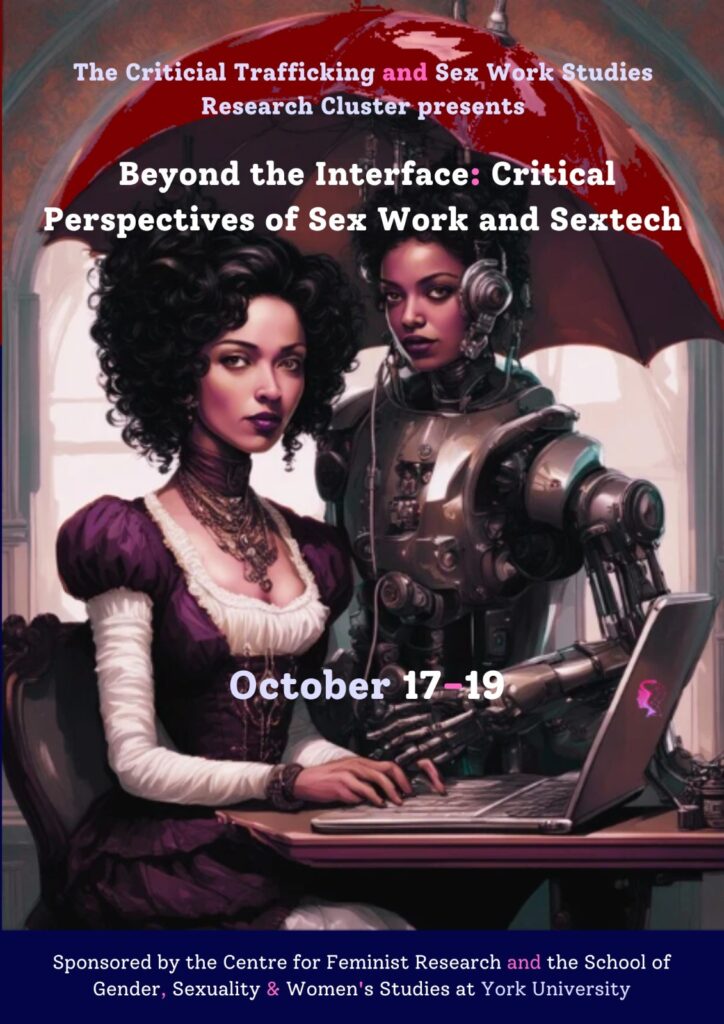
Beyond the Interface: Critical Perspectives on Sex Work and Sextech
Date: October 17-19, 2024
Program: https://www.yorku.ca/cfr/wp-content/uploads/sites/255/2024/10/Final-Conference-Program_Beyond-the-Interface-Oct-17-19-2024-.pdf
Our three-day inaugural virtual conference, Beyond the Interface, featured nearly 40 presentations and 11 panels exploring sex, technology, law, ethics, inclusivity, global power, wellness, and innovation. With speakers from across the globe, the conference fostered critical dialogue and advanced more equitable, inclusive futures in sex work and sextech.
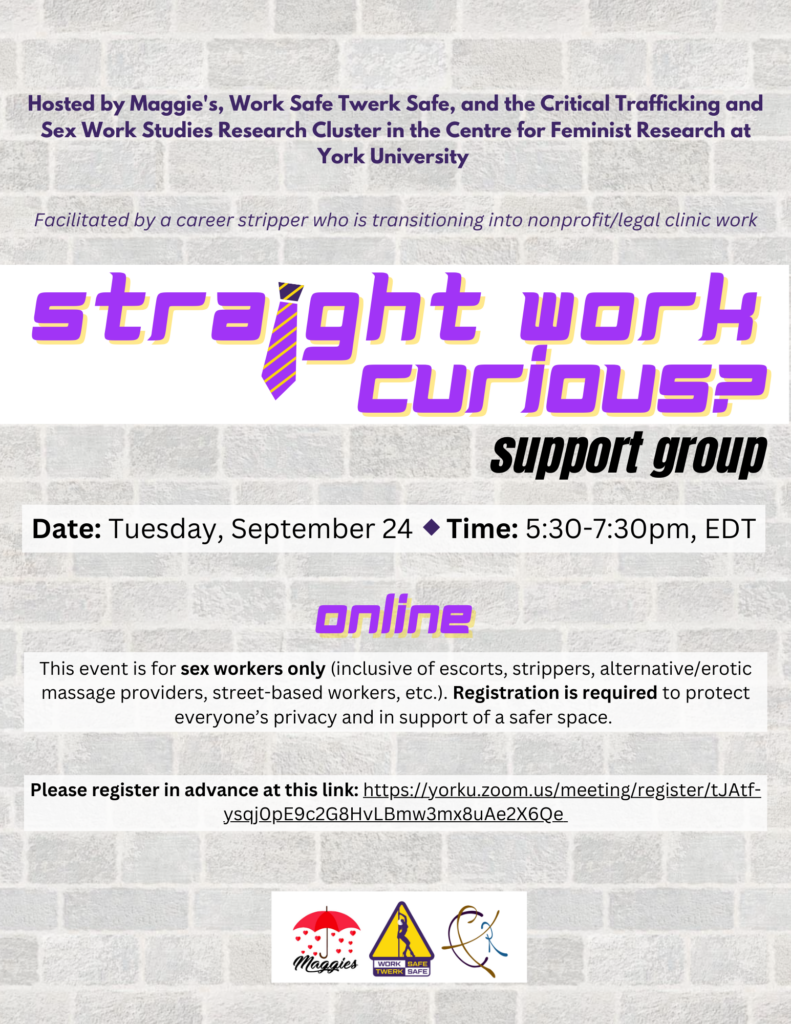
Straight Work Curious Support Group
Date: Tuesday, September 24, 2024
Time: 5:30pm - 7:30pm ET
Location: Virtual
Registration: https://yorku.zoom.us/meeting/register/tJAtf-ysqj0pE9c2G8HvLBmw3mx8uAe2X6Qe#/registration
This event was for sex workers only (inclusive of escorts, strippers, alternative/erotic massage providers, street-based workers, etc.). Registration was required to protect everyone’s privacy and support a safer space. It was hosted by Maggie's, Work Safe Twerk Safe, and the Critical Trafficking and Sex Work Studies Research Cluster in the Centre for Feminist Research at York University, and facilitated by a career stripper who was transitioning into nonprofit/legal clinic work.
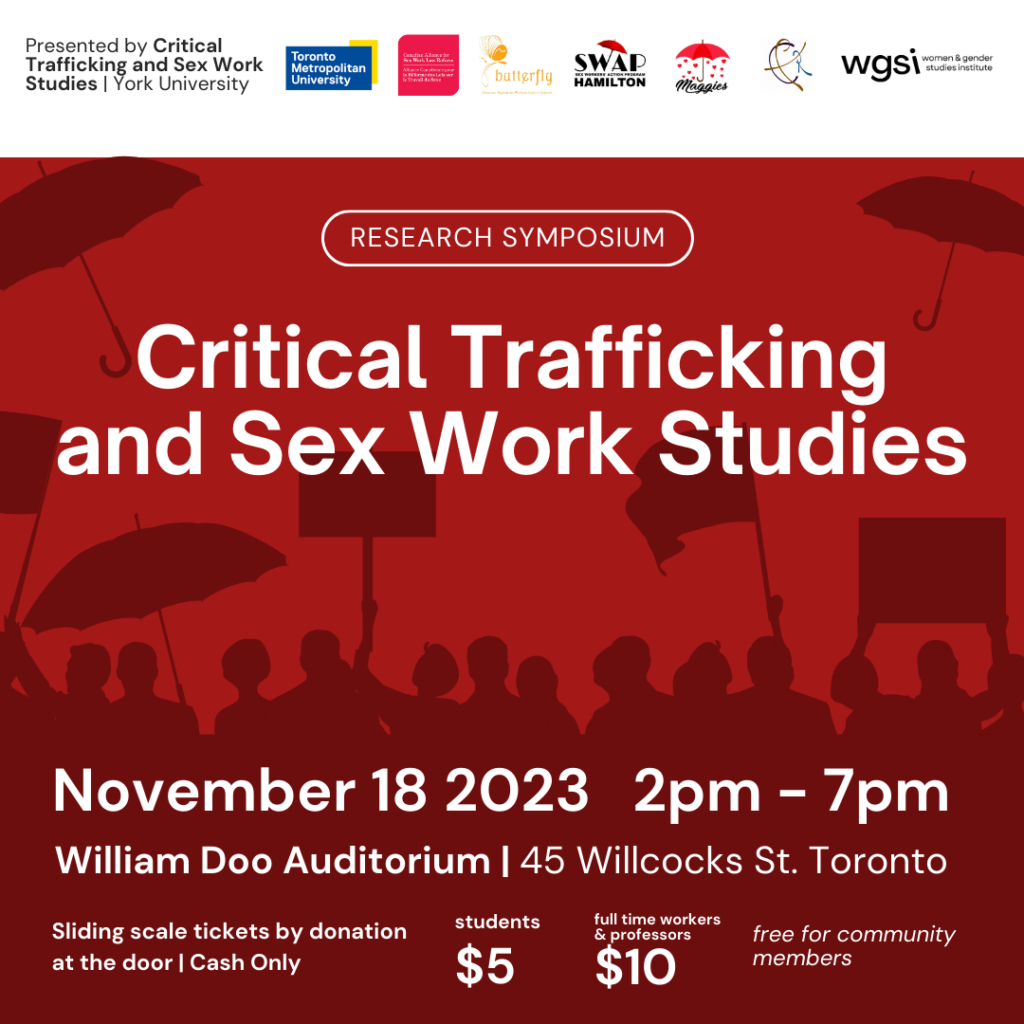
Critical Trafficking and Sex Work Studies Research Symposium
On November 18, 2023, we hosted the Critical Trafficking and Sex Work Studies symposium, bringing together sex workers, academics, activists and allies to discuss recent books, research activities, and mobilizing efforts in Canada and abroad. The event featured recently published academic works by Lyndsey Beutin (McMaster University/Princeton University), Kamala Kempadoo (York University), Elena Shih (Brown University), Juana María Rodrígues (Berkeley, University of California), Tuulia Law (York University), and Katrin Roots (Wilfrid Laurier University) in conversation with workers, activists, legal experts, and organizers.
The Critical Trafficking & Sex Work Research Cluster Meet and Greet
On May 1, 2023, we hosted an informal coffee chat with sex workers, activists, artists, and academics that work in the realm of Critical Trafficking and Sex Work Studies. The afternoon allowed us to facilitate needed connections for research and other forms of straight work as well as more non-academic creative projects. We are incredibly thankful for the dedicated folks at York University and beyond that attended and were so generous with their expertise, experiences, and insights. With their support, we submitted a brief for the for the Study on Human Trafficking of Women, Girls, and Gender-Diverse People in Canada as commissioned by the Standing Committee on the Status of Women. Soon, our brief will be available in English and French on the Parliament of Canada website.
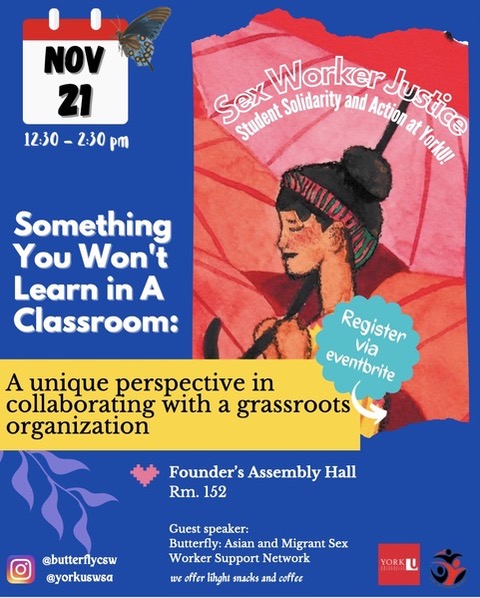
Sex Worker Justice: Student Solidarity and Action at YorkU
On November 21, 2022, the Social Work Student Association (SWSA) at York University, in collaboration with Butterfly: Asian and Migrant Sex Workers Support Network, hosted an event at Founder's Assembly Hall (Rm. 152, Keele Campus). The event welcomed members of the York University student population, staff, and faculty to listen to and learn from migrant and Asian women detrimentally impacted by the criminalization of sex work. Often portrayed as trafficked victim, migrant and Asian women spoke directly to their realities of stigmatization, discrimination, and state violence in the GTA. The event was well-attended with more than 50 students, predominantly from the Faculties of LAPS (Liberal Arts and Professional Studies) and Health.
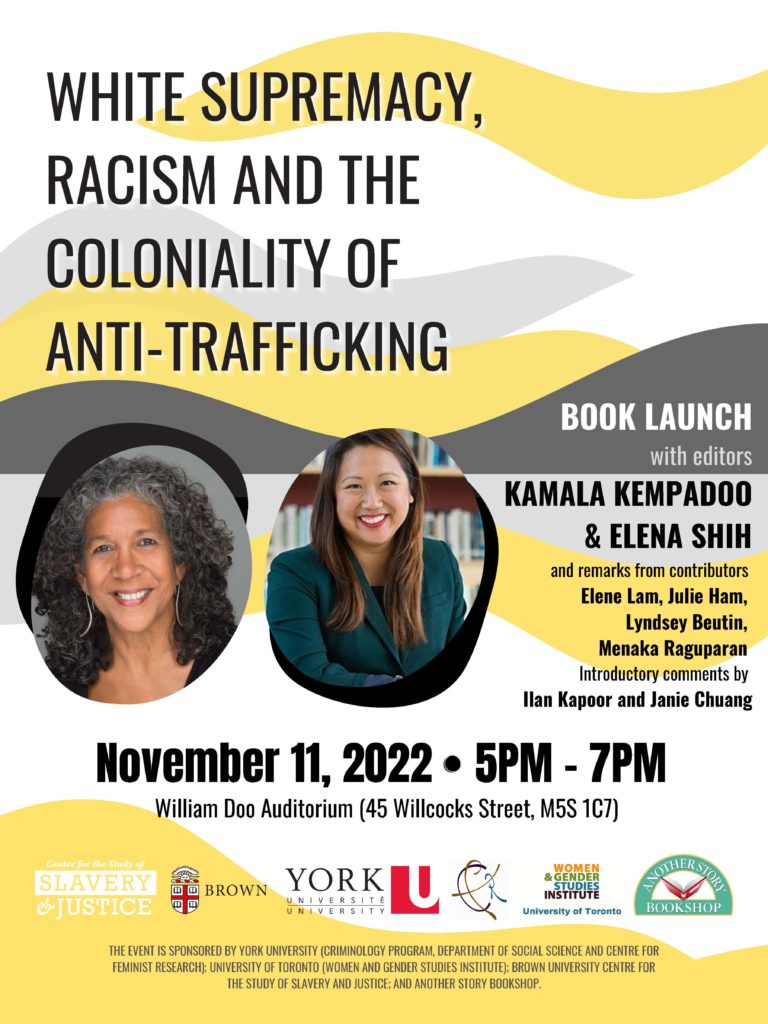
Book Launch: White Supremacy, Racism, and the Coloniality of Anti-Trafficking
On November 11, 2022, we proudly hosted the launch of White Supremacy, Racism and the Coloniality of Anti-Trafficking (edited by Kamala Kempadoo and Elena Shih) at the William Doo Auditorium (45 Willcocks Street, M5S 1C7). The book is available to purchase now at Another Story Book Shop.
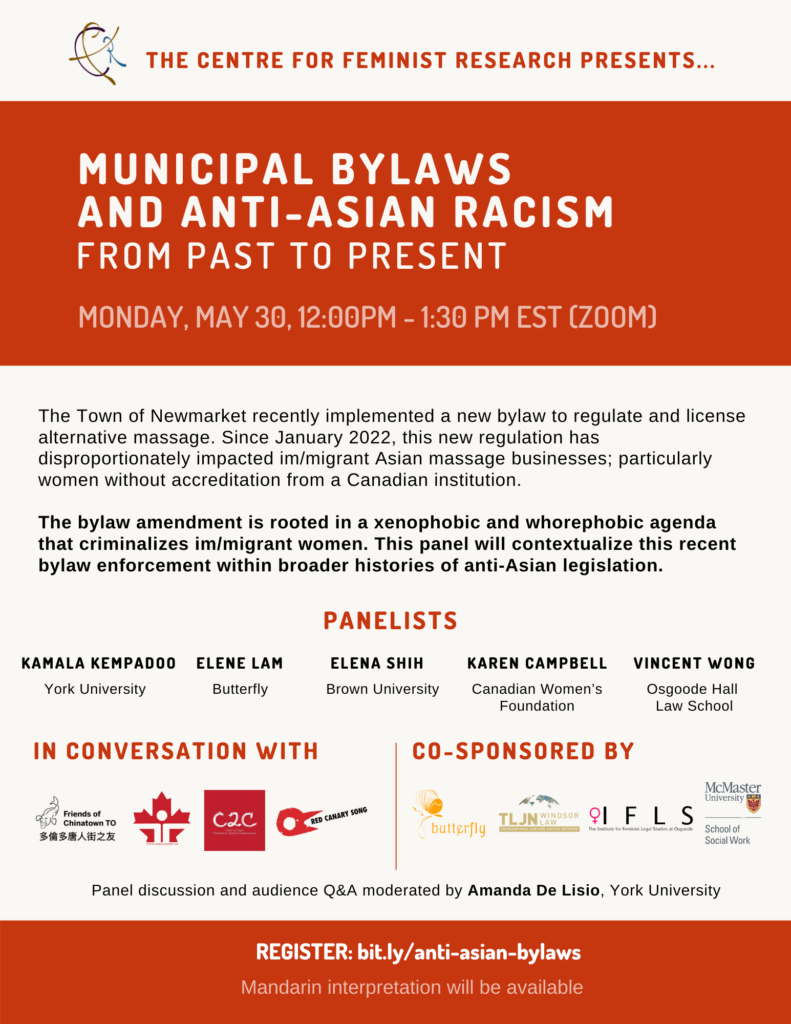
Municipal Bylaws and Anti-Asian Racism from Past to Present
On May 30, 2022, the Critical Trafficking and Sex Work Studies Research Cluster at the Centre for Feminist Research hosted an event to share insight and provide context to the recent implementation of a new accreditation process in the Town of Newmarket for people in alternative massage. To view the recorded panel and/or read a summary of the event, see Feminist Dispatch: Municipal Bylaws and Anti-Asian Racism From Past to Present.
Beutin, L.P. (2024). "Beyond Carceral Humanitarianism: Antiblackness as the Structure of Anti-trafficking Discourse" In Trafficking Harms: Critical Politics, Perspectives, Experiences, edited by Katrin Roots, Ann De Shalit, and Emily van der Meulen, pp. 34–53. Halifax: Fernwood.
De Lisio, A. (2026). Play naked: Puta economies against Olympic dispossession. McGill-Queen's University Press.
Cherrington, K. (2026a). Digital Beings or Mere Tools? Animist and Posthumanist Approaches to AI Companion Rights. In C. El Morr, R. da Silveira Gorman, E. Dolatabadi, & L. Seyyed-Kalantari (Eds.), AI for a Just World: Power, Liberation, and the People Left Behind (pp. 272–282). Chapman and Hall/CRC. https://doi.org/10.1201/9781003737810-30
Cherrington, K. (2026b). Flesh Meets Machine: Barbiecore Cyborg Fantasies in Pop-Art. In J. Grenzfurthner, G. Friesinger, & J. Hagendorfer (Eds.), Arse Elektronika: Plug & Play (pp. 239–250). Stadt Wien. https://shop.monochrom.at/?product=plug-play
Gallant, C., & Lam, E. (2024). Not your rescue project: Migrant sex workers fighting for justice. Haymarket Books.
Ham, J. (2024). Hypersexualisation and racialised erotic capital in sex work. Culture, Health & Sexuality, 1-15.
Jezrawi R., Zahorka Derka S., Warnick E., Foley J., Patel V., Pavithran N., Bernier T., Wagner N., Barr N.G., Maccio V., Leyland M., Lokker C. (2024). Partnering with students to develop a capstone for a graduate health informatics program. Appl Clin Inform, 15 (5): 1080-1092.
Kempadoo, K. (2023, January 13). “Critical perspectives on human trafficking” Podcast. Center for Security Studies, Wilfrid Laurier University.
Lam, E., Wong, V.W.S, Chu S.K.H., Chan T.C., De Lisio, A. (2024). Weaponized Licensure: Asian Migrant Sex Workers’ Struggle Against Discriminatory Licensing in Newmarket, Ontario. Journal of Critical Race Inquiry 11 (2), 24-39.
Moira, A. (2024). Neca: romance em bajubá. São Paulo/SP: Companhia das Letras.
Moira. (2025). So what if I’m a puta: Diaries of transness, sex work, desire (A. De Lisio & B. D. Lobato, Trans.). The Feminist Press at CUNY.
Murray, L.R. (2024). "Puta Politics: The Innovative Political Theories and Protest Praxis of Putas." In P. Amar (Ed.), Rio as method: Collective resistance for a new generation, (pp. 323-333). Duke University Press.
Murray, L.R. (2023). "Justice through the erotic: Puta politics, knowledge and feminism as guides for how to move beyond binaries and destabilise contradictions." In P. Aggleton, R. Cover, C.H. Logie, C.E. Newman & Richard Parker (Eds.), Routledge Handbook of Sexuality, Gender, Health and Rights, Second Edition (pp. 459-446). New York: Routledge.
Muray, L.R. (2023)."Gestando vitimas e politizando proteção: notas etnográficas sobre um Estado que faz "direitinho" em contextos de prostituição." In A. Piscitelli & L. Lowenkron (Eds.), Tráfico de pessoas e contrabando de migrantes: entre leis, políticas e experiências, First Edition (pp. 163-194). Campinas: Cadernos Pagu.
O’Doherty, T., & Cherrington, K. (2023). Commodified BDSM Services: Professional Dominatrices’ Views on Their Work and Its Criminalization. Archives of Sexual Behavior, 52(3), 1285–1298. https://doi.org/10.1007/s10508-022-02490-6
Pietrangelo-Porco, E. (2024). "The Sex Work Historian." New Sociology: Journal of Critical Praxis, 5, 1-10.
Pietrangelo-Porco, E. (2024, November 19). Why Canada’s sex work legislation hasn’t changed (but should). Active History.
Prada, M. (2025). Putafeminista: A manifesto of sex worker feminism (A. De Lisio, Ed. & trans.). The Feminist Press at CUNY.
Schwartz, A., & Cherrington, K. (2026). Fast femme-inism and the femme phallus: femme erotic artforms as gender and sexuality theory. Porn Studies, 1–16. https://doi.org/10.1080/23268743.2026.2676285
Püffel, M., Orbay, I., Salo, I., Burga, E.R., Bernier, T. (2024). “Sex workers can say no, too”: A systematic review on sexual violence in association with health in sex workers. DPK, 3rd German Psychotherapy Congress, Berlin, Germany.
Roots, K., De Shalit, A., & van der Meulen, E. (Eds.). (2024). Trafficking harms: Critical politics, perspectives, and experiences. Fernwood Publishing.
Ustundag, E. & Rose, D. (2024). Feminist methodologies for critical urban research: interrogating and reimaging epistemic justice. In Peake et al. (eds) Elgar International Handbook on Gender and Cities. Cheltenham: United Kingdom.
Zen, K., & Gallant, C. (2025, July 12). Sex workers are being abducted by ICE — and abandoned by respectability politics. Truthout.