
Post
Published on November 14, 2025
Three York University students from the Wellness Impact Lab (WIL) recently represented York at the Climate, Health & Sustainable Care Symposium 2025 hosted by the University of Toronto’s Institute of Health Policy Management and Evaluation. The event brought together leading scholars, practitioners, and community partners to explore innovative approaches to health and well-being in the face of the climate crisis.
Sarah Merghani and Sophia Bryan-Carbonell, both Lab Coordinators with the WIL, joined the panel “From Climate Distress to Collective Action: Participatory Approaches for Mental Health and Well-being,” moderated by Dr. Samantha Wells of the Centre for Addiction and Mental Health (CAMH). Their presentation, Scaling Climate Mental Health: Evaluating the Impact of University-Based Climate Cafés, highlighted findings from York’s WIL Climate Cafés and Nest Initiative; peer-led programs designed to help students process climate emotions, foster resilience, and transform distress into meaningful engagement and community action.
Merghani and Bryan-Carbonell also presented a research poster titled Evaluating University Climate Wellness Models: Lessons Learned and Future Directions, which shared preliminary evaluation data from The Nest, a student-driven project supported by the Agents of Change program at York University. Their findings emphasized the importance of creating inclusive, safe, and student-led spaces that empower young people to engage constructively with climate emotions.
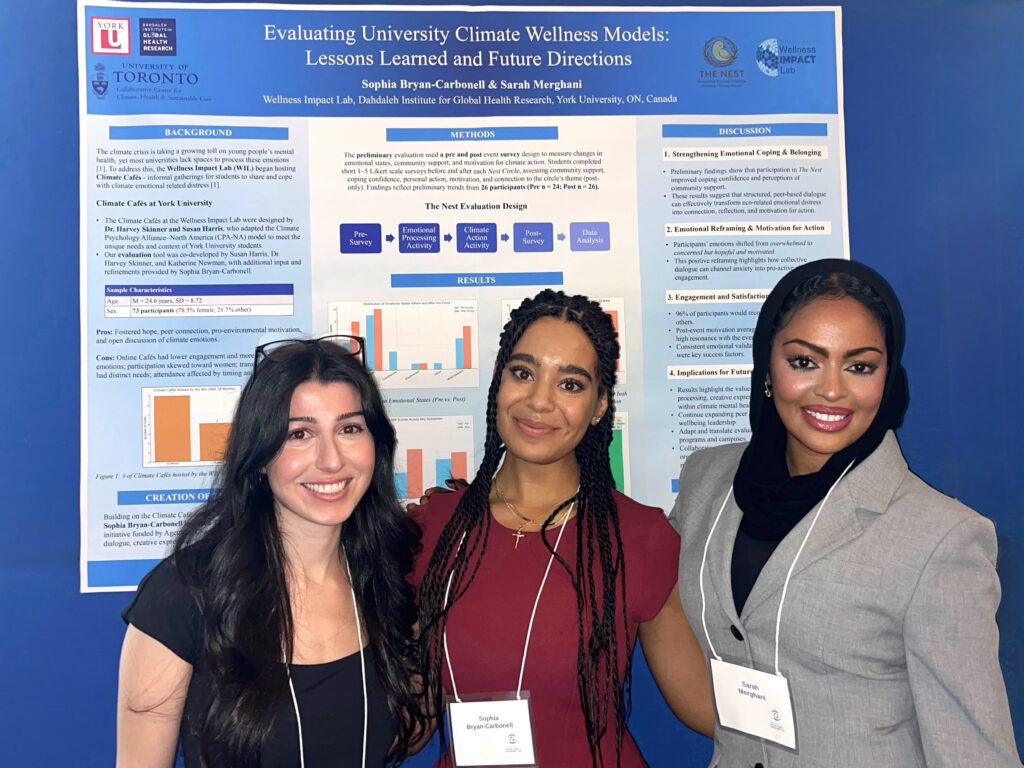
“Our work shows that when students are given the space to process climate emotions collectively, they not only feel less isolated but also more hopeful and empowered to act,” said Sarah Merghani, Co-Lead of The Nest. “We’re seeing that emotional connection and community care are key drivers of climate resilience.”
Lauren Corridore, a Research Assistant with the Wellness Impact Lab, also represented York by presenting her poster, Mindfulness-Based Approaches to Climate Distress: Fostering Inner Resilience and Environmental Engagement. Her research explored how mindfulness can help people cope with the emotional impacts of climate change and stay engaged in climate action. The review looked at programs using mindfulness practices like meditation, reflection, and group discussion to support emotional well-being, build confidence in taking climate action, and strengthen people’s connection to nature. Overall, mindfulness was found to reduce stress, promote compassion, and inspire more sustainable behaviours.
Together, these presentations showcased York University’s growing leadership in climate mental health research and experiential education.
“This symposium was an incredible opportunity to share our student-led innovations and connect with other researchers and practitioners who care deeply about climate well-being,” said Sophia Bryan-Carbonell. “It was inspiring to see how our work at York contributes to the larger conversation on mental health and climate resilience in higher education.”
The Wellness Impact Lab, co-led by Dr. Harvey Skinner and Susan Harris, continues to pioneer cutting-edge research and action on student wellness and climate action. Through partnerships with initiatives like The Nest, the Lab is advancing a holistic model of well-being that bridges research, compassion, and community engagement.
To learn more or get involved, follow The Nest Initiative on Instagram at @thenestyu and visit the Wellness Impact Lab website at www.wellnessimpactlab.com
Themes | Planetary Health |
Status | Active |
Related Work | |
Updates |
N/A
|
People |
Susan Harris, Community Scholar, Meditation, Wellness, and Selfcare - Active
Sophia Bryan-Carbonell, Wellness Impact Lab, Lab Coordinator, Global Health Intern [FW24-25; S25; FW25-26 - Alum Sarah Merghani, Global Health Intern, Lab Coordinator and Research Assistant - Active Lauren Corridore, Global Health Intern, Research Assistant, Wellness Impact Lab - Active |
You may also be interested in...
Climate Change Research Month showcases York as community of changemakers
A month-long series of events hosted by York University Organized Research Units (ORU) and campus groups aim to generate awareness on climate change research and mobilize community action. March 1 marks the start of the second annual ...Read more about this Post
Publication: Digital technologies for biodiversity protection and climate action: Solution or COP out?
Dahdaleh Institute Research Fellow James Stinson and DI Graduate Research Assistant Lee Mcloughlin have recently published their recent work on the promotion of digital technologies, including artificial intelligence, as solutions to biodiversity and climate crises ...Read more about this Post
James Madhier’s Rainmaker Enterprise Collaborating with World Food Programme
A sure sign of its impact and promise for smallholder farmers impacted by climate change, the Rainmaker Enterprise is now receiving funding and technical assistance from the World Food Programme (WFP) to help build lasting ...Read more about this Post