
Post
Published on April 26, 2021
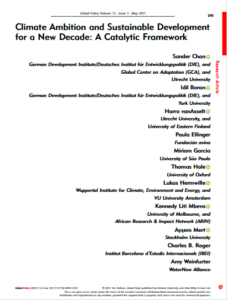
Dahdaleh Institute Faculty Member Idil Boran teamed up with a broad network of 26 leading experts to evaluate the Global Climate Action Agenda (GCAA) and discuss options to improve it to strengthen sub‐ & non‐state engagement in a new decade.
The transition from the pre‐2020 to a post‐2020 agenda provides a political opportunity to recalibrate the design of a catalytic multi-level governance framework. A more collaborative, comprehensive, evaluative and catalytic Action Agenda will exemplify a new avenue of cooperation between governments and sub‐ and non‐state actors and should help to accelerate implementation, raise #NDCs’ ambition and inform ambitious long-term strategies.
In this article, the authors encourage engagement at lower levels of governance through collaboration with regional & national processes in addition to strengthening linkages with sustainable development action can improve reflexivity and deliberativeness in climate governance.
Themes | Planetary Health |
Status | Active |
Related Work |
N/A
|
Updates |
N/A
|
People |
You may also be interested in...
Recap — Connecting Our Work to Movements for Social Justice: Critical Perspectives in Global Health Symposium
How should global health researchers understand the world, define their values, and act collectively in the face of profound inequity? These were amongst the questions that framed this year’s Critical Social Science Perspectives in Global ...Read more about this Post
Preparing for Healthy Futures in Bangladesh in a World of Climate Change
Originally published March 10, 2022 Biography Dr. Byomkesh Talukder is the inaugural Planetary Health Fellow at the Dahdaleh Institute for Global Health Research, where he works at the intersection of health, sustainable development, climate change and food and ...Read more about this Post
Internship Program: 2022-2023 Year In Review
Over the course of the 2022-2023 academic year, the Dahdaleh Institute worked with numerous exceptional students through an Internship Program. Our Global Health Interns benefited from the unique opportunity to participate in various of stages of ...Read more about this Post