
Project
Last Updated on October 9, 2025
Heat Exposure, Sleep, Cognition and MentAl Health: Mechanisms of Climate Change ImPacts on VulnErable Groups in Two Sub-Saharan Africa Countries
HEATSCAPE-Africa seeks to understand how the impact of heat exposure on depression and anxiety is due to sleep and cognitive functioning, in Ghana (lower middle-income) and Zimbabwe (other low-income).
Current evidence suggests that heat exposure disrupts sleep and impairs cognitive function—both of which are essential for mental health. However, research in low- and middle-income countries has been scarce, despite these populations being particularly vulnerable to climate-induced heat stress. 15% and 60% of primary healthcare attendees in Ghana and Zimbabwe respectively report depression symptoms. In both countries there is limited understanding of the mental health needs of vulnerable populations such as adolescents, women of reproductive age, and older adults.
The project will focus on three key themes:
- a) contextual understanding of heat and mental health;
- b) methodological advances to identify causal mechanisms through a two-year prospective cohort study;
- c) community/health system readiness.
The project has four deliverables:
- empirically-informed framework on mechanisms of heat exposure on depression/anxiety;
- a core mediator/moderator set for use in heat-mental health studies in LMICs;
- a community and health system readiness package of care;
- and a cohort of young researchers with lived experience.
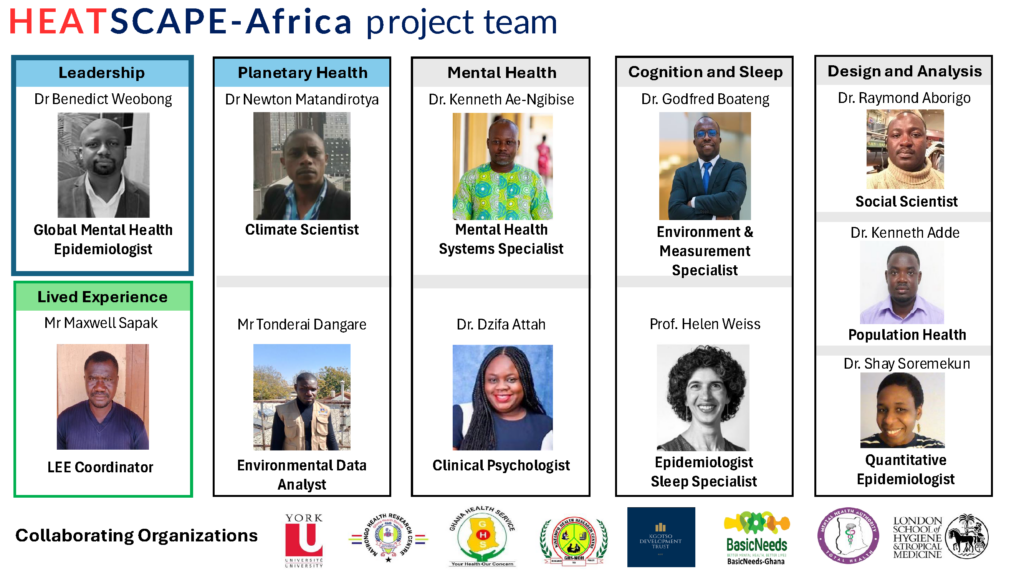
Project Team
- 1. Helen Weiss (Co-Investigator - LSHTM);
- 2. Seyi Soremekun (Co-Investigator - LSHTM);
- 3. Newton Matandirotya (Co-Investigator - Zimbabwe);
- 4. Raymond Aborigo (Co-Investigator - Navrongo Health Research Centre, Ghana)
- 5. Kenneth Ae-Ngibise (Co-Investigator - Kintampo Health Research Centre, Ghana)
- 6. Dzifa Atta (Co-Investigator - University of Ghana)
- 7. Kenneth Adde (Project manager - Ghana)
- 8. Peter Badimak Yaro (BasicNeeds - Ghana)
- 9. Maxwell Sapak (Lived Experience Expert - Ghana)
- 10. Tonderai Dangare (Environmental Analyst - Zimbabwe)
- 11. Nilanjana Ganguli (Program manager – York University)
- 12. Godfred Boateng (Co-Investigator – York University)
- 13. Benedict Weobong (Project lead – York University)
Supported by the Wellcome Trust, HEATSCAPE-Africa is a partnership based on expertise from Ghana (Navrongo Health Research Centre & Kintampo Health Research Centre), Zimbabwe (Kgotso Development Trust), United Kingdom (London School of Hygiene & Tropical Medicine), and Canada (York University & Dahdaleh Institute for Global Health Research).

Themes | Planetary Health |
Status | Active |
Related Work |
N/A
|
Updates |
World Mental Health Day 2026 | October 10, 2026
Student Opportunity FW26/27 - HEATSCAPE & Y-MIND RAY Student | July 14, 2026 World Environment Day 2026 | June 5, 2026 2025 Year in Review | December 18, 2025 HEATSCAPE-Africa Awarded Major Wellcome Trust Grant to Tackle Climate-Driven Mental Health Risks | October 9, 2025 York profs lead $5.5 million HEATSCAPE-Africa project | October 3, 2025 |
People |
Godfred Boateng, Faculty Fellow, Faculty of Health - Active
Benedict Weobong, Faculty Fellow, Faculty of Health - Active Takudzwa Mtisi, Research Associate - Program Manager, YMind Africa - Active Nilanjana Ganguli, Dahdaleh Global Health Graduate Scholar, Faculty of Environmental and Urban Change - Active Yasmin Husen, Global Health Intern, Planetary Health - Active Mahnoosh Jalilzadeh, Global Health Intern, Planetary Health - Active |
You may also be interested in...
Join Us This September for Our Global Health Research Seminar Series
We are kicking off the 2022-23 academic year at the Dahdaleh Institute with some wonderful global health research talks this September: disaster management, humanitarian response, occupational health, and planetary health. All events will be delivered in ...Read more about this Post
Dahdaleh Institute researchers contribute to York's achievements towards the United Nation’s 17 Sustainable Development Goals
In June 2020, York University launched its new University Academic Plan 2020-2025 (UAP), which included a university-wide challenge to elevate York’s contributions to the United Nation’s 17 Sustainable Development Goals (SDGs). The new UAP serves as ...Read more about this Post
World Water Day: A Solutions-Driven Workshop on Climate Impacts on Freshwater
Originally published April 27, 2022. Written by Elaine Coburn, Director of the Centre for Feminist Research. World Water Day: A Solutions-Driven Workshop on Climate Impacts on Freshwater was co-hosted by CIFAL York and the Office ...Read more about this Post