The goal of the Centre for Bee Ecology, Evolution and Conservation (BEEc)'s Speaker Series is to provide opportunities for BEEc associates and invited guests to learn from each other. We are pleased to announce that starting Fall 2025, this series will be open to the public. If you miss the live webinar, we often are able to record presentations for others to view - please see below for those recordings, or subscribe to our YouTube Channel to receive the most up-to-date notifications on new recordings!
At 11am Eastern Time, on the second or third Friday of every month, we will feature a different topic related to bees. These will be presented through the Zoom webinar platform, you will need to register individually for each webinar in the series.

Dr. Xin Zhou
Professor, Canada Research Chair in Eukaryote Biodiversity Genomics, Centre for Biodiversity Genomics and Department of Integrative Biology, University of Guelph
Friday, February 20th, 2026 @ 11AM EST
Probing adaptive traits in honey bees through an evolutionary lens
Honey bee traits that underpin both their ecological importance and value to the honey industry have been shaped by adaptive evolution in response to changing environmental pressures. My research investigates the molecular and genomic bases of these adaptive traits within an evolutionary framework, using the widespread Apis cerana and A. mellifera as model systems. Through an integrative approach combining genomics, functional genetics, metagenomics, and microbiology, we aim to uncover how these traits arise and evolve. In this presentation, I will highlight our recent discoveries on the molecular mechanisms underlying honey bee cold adaptation and food-intake regulation, and illustrate how natural selection repeatedly targets related genes to enhance survival under diverse environmental stressors.
Register: Zoom Link
Join our Public "Bees" ListServ!
Looking to stay informed on BEEc's public news, general, research activities and events? Send an email to LISTSERV@YORKU.CA with the following command in the body of the email:
SUBSCRIBE BEES YourFirstName YourLastName
Join our Internal "BEEc-Associates" ListServ!
Are you on our Internal BEEc Associates Listserv? This list is used for sharing our newsletters, upcoming events and opportunities. If you are not a Member of BEEc already, please contact beec@yorku.ca.
Scroll down for Past Presentations, Videos of Selected Presentations
Keep scrolling down the page to see the list of past presentations and recordings (where permissions were given for public posting). Or visit our YouTube Channel to see the recordings from all our speaker series, webinars, conferences.

Dr. Madeleine Ostwald
Lecturer in Ecology, Conservation, and Biodiversity, School of Biological and Behavioural Sciences, Queen Mary University of London
Friday, March 13th, 2026 @ 11AM EST
Functional Ecology and Climate Resilience: Wild Bee Biology in a Changing
Representing more than 20,000 species globally, wild bees exhibit striking variation in morphology, physiology, and behaviour, that enabled them to thrive in diverse climates across all major terrestrial ecosystems. Despite this diversity, our understanding of bee climate responses is drawn overwhelmingly from studies on a handful of managed species. My research combines behavioural ecology, experimental physiology, specimen-based research, and computer vision techniques to investigate bee functional ecology across different environmental contexts. Together, these studies highlight signatures of climate resilience and climate vulnerability in this functionally rich and ecologically important pollinator group.
Register: Zoom link

Nathalia Andrea Florez Gomez
PhD Candidate
Friday, April 17th, 2026 @ 11AM EST
Evolutionary history of bees in the tribe Emphorini (Hymenoptera: Apidae): Phylogeny, biogeography, and evolution of floral choices
Bees exhibit a wide spectrum of dietary preferences, from generalist species that collect pollen from many plant families to specialists with narrow pollen diets. Among these specialists, the tribe Emphorini (Hymenoptera: Apidae) stands out as one of the most remarkable groups. Emphorines are solitary ground-nesting bees restricted to the Western Hemisphere with an antitropical distribution, comprising over a hundred species in nine genera with their highest diversity in southern South America. In this study, I reconstructed the most comprehensive phylogeny of the group to date using ultra conserved elements (UCEs) from 85 species to understand their biogeographic history, the evolutionary patterns of their floral choices, and to test whether diversification and dispersal events are related to their specialized pollen diets.
Register: Zoom link
Past events:
2025-2026 Speaker Series Events
September 12th 2025: Impacts of environmental stressors across life stages of wild bees with Dr. Clara Stuligross.
November 14th 2025: Cooperation in Context: Nutritional, pheromonal, and hormonal regulation of honey bee social behaviour and longevity with Dr. Alexander Walton.
2024-2025 Speaker Series Events
September 13th 2024: Teasing apart stressor interactions in honey bee workers and queens: Nothing is ever easy with Dr. Adam Dolezal.
October 11th 2024: The fascinating world of bees: from novel monitoring tools to landscape-level stressors with Dr. Laura Figueroa.
November 8th 2024: The Calculus of Honey Bees with Dr. Matthew Betti.

December 13th 2024: Jan Dzierżon's Revolution in Honey-Bee Biology with Dr. Christopher Starr (No Recording Available)
January 10th 2025: Global change and pollinator conservation with Dr. Olivia Bernauer.
February 21st 2025: Quantitative Behavioural Analysis - lessons from 'big data' with Dr. Nadia Tsvetkov.
April 11th 2025: Agent-based modelling of social bees and its application with Dr. Matthias Becher.
March 21st 2025: How urban community gardens can support wild pollinators - from research to practice with Dr. Monika Egerer.
2023-2024 Speaker Series Events
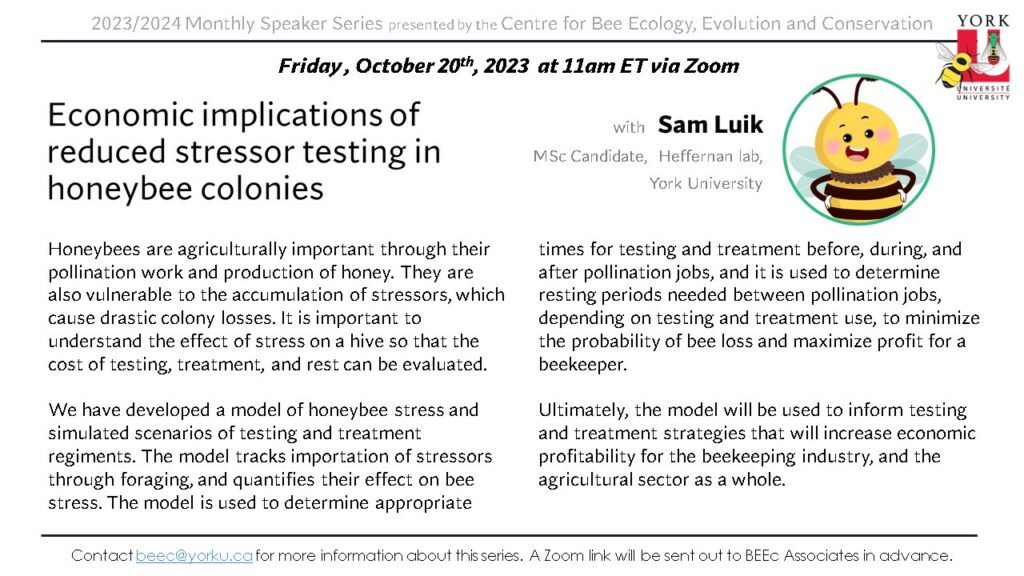
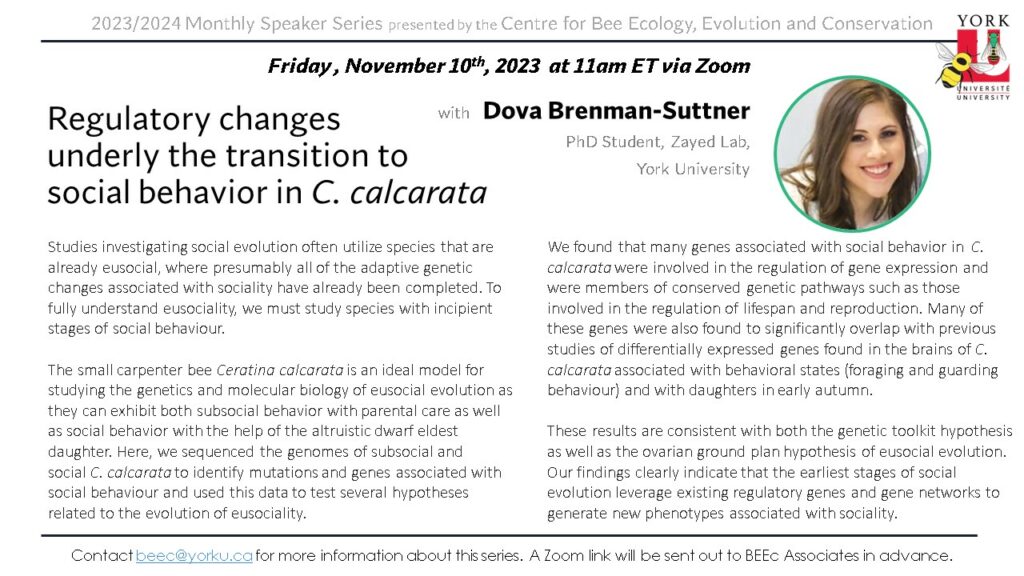
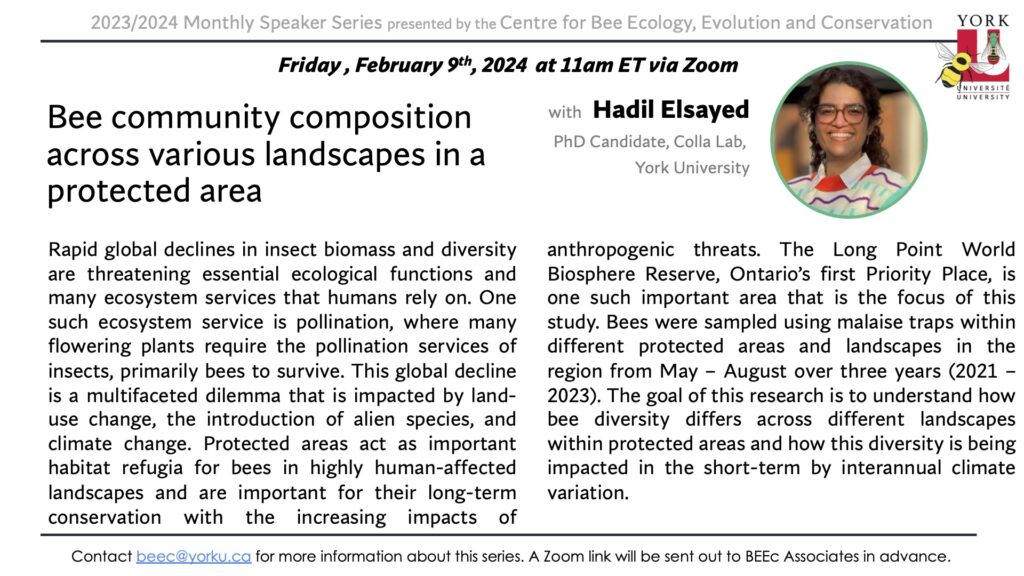
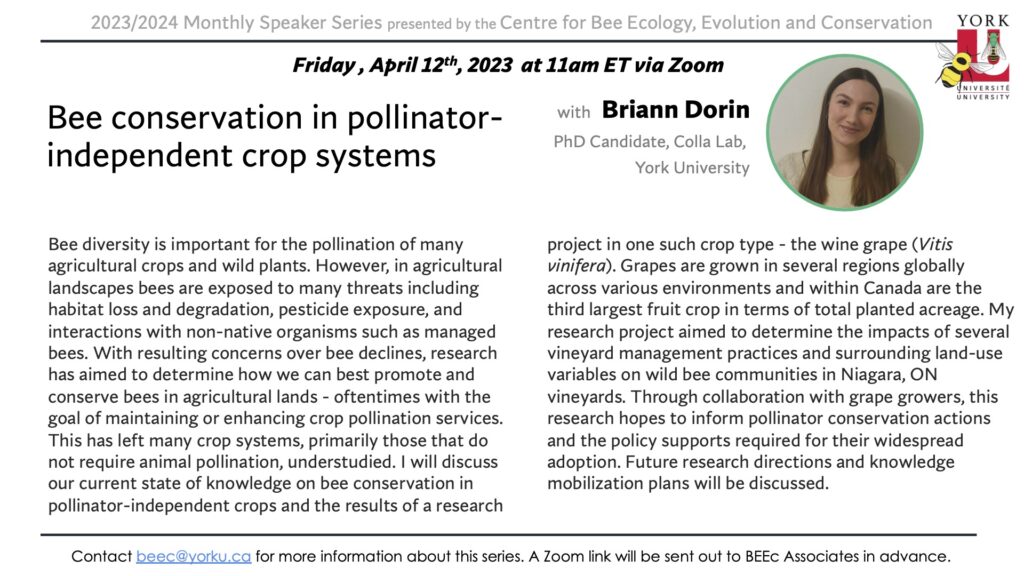
2022-2023 Speaker Series Events
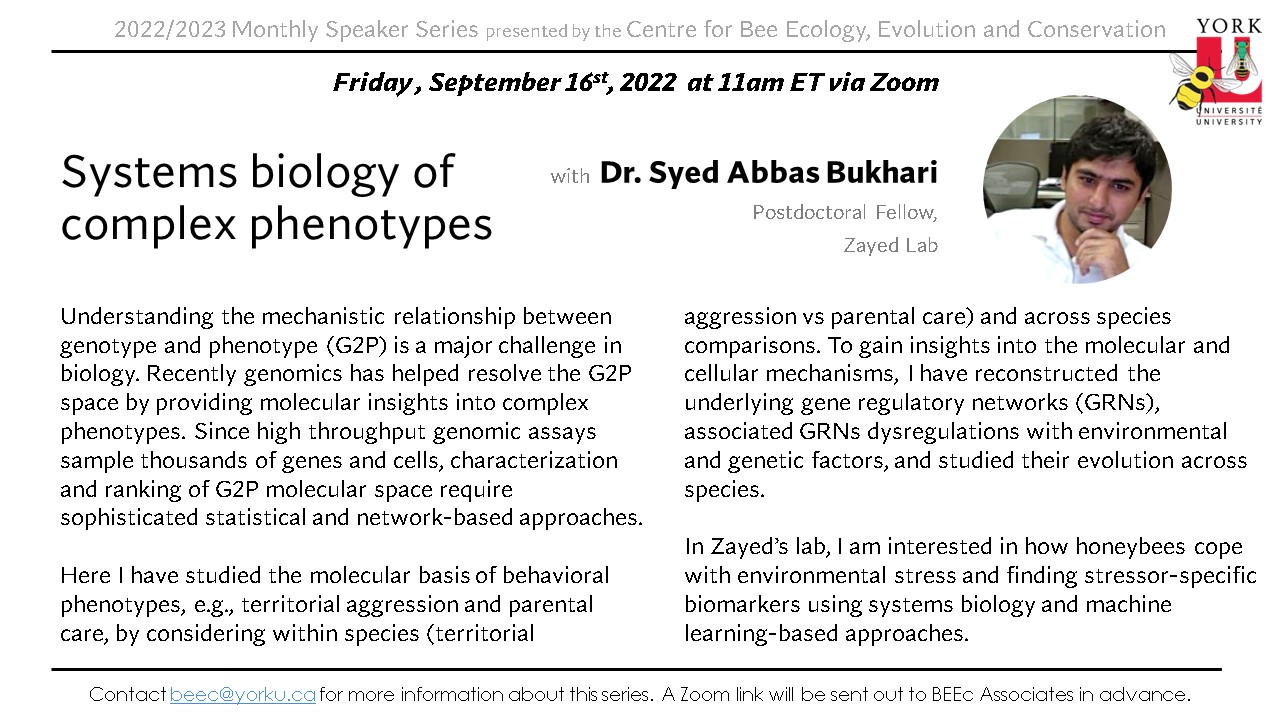
September 16, 2022: Systems biology of complex phenotypes, with Dr. Syed Abbas Bukhari (No Recording Available)
October 21, 2022: Evolution of sociality and parental care in Ceratina bees, with Dr. Michael Mikát
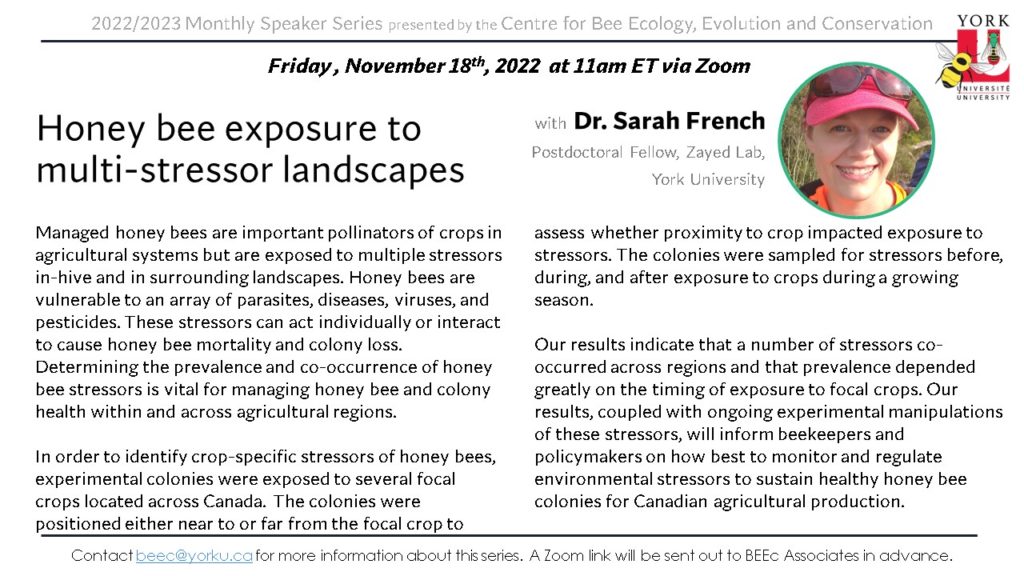
November 18, 2022: Honey bee exposure to multi-stressor landscapes, with Dr. Sarah French (No Recording Available)
December 16, 2022: Metagenomics and metatranscriptomics of small carpenter bees (Ceratina calcarata), with Dr. Katherine Chau
January 13, 2023: The Evolution of Bee Brood Parasitism, with Dr. Trevor Sless
February 17, 2023: Effects of dune stabilization on bees and aculeate wasps in the southern Canadian prairies, with Dr. Tom Onuferko
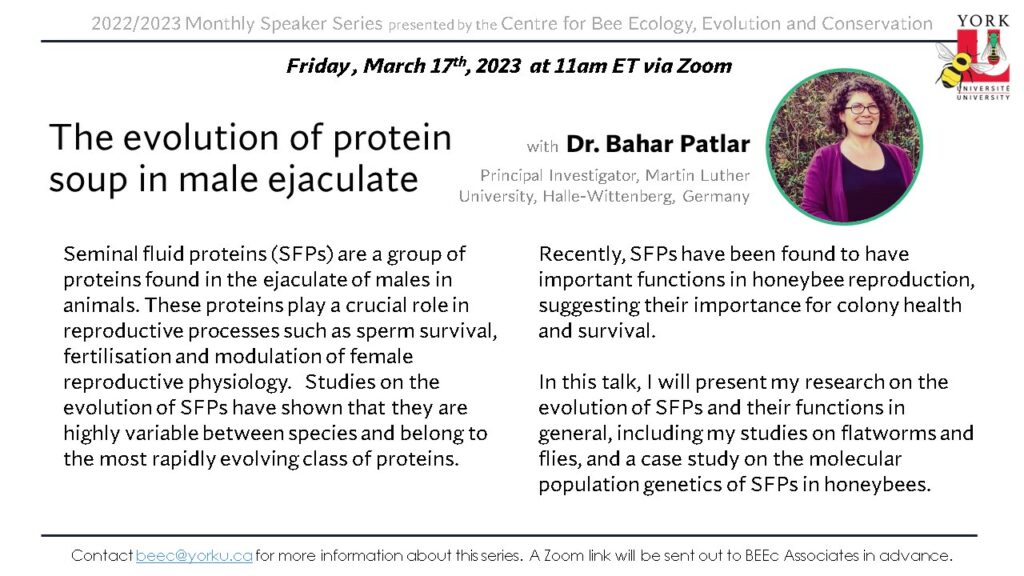
March 17, 2023: The evolution of protein soup in male ejaculate, with Dr. Bahar Patlar. (Note: recording will not be made public until results discussed are published).
April 14, 2023: Solutions for Farmers and Food for Bees : From knowledge on bee nutrition to actions promoting bee conservation, with Dr. Mathilde Tissier
2021-2022 Speaker Series Events
The talks below were those where the speakers gave us permission to record and share their presentations. We thank the other speakers who shared their knowledge with us as well.
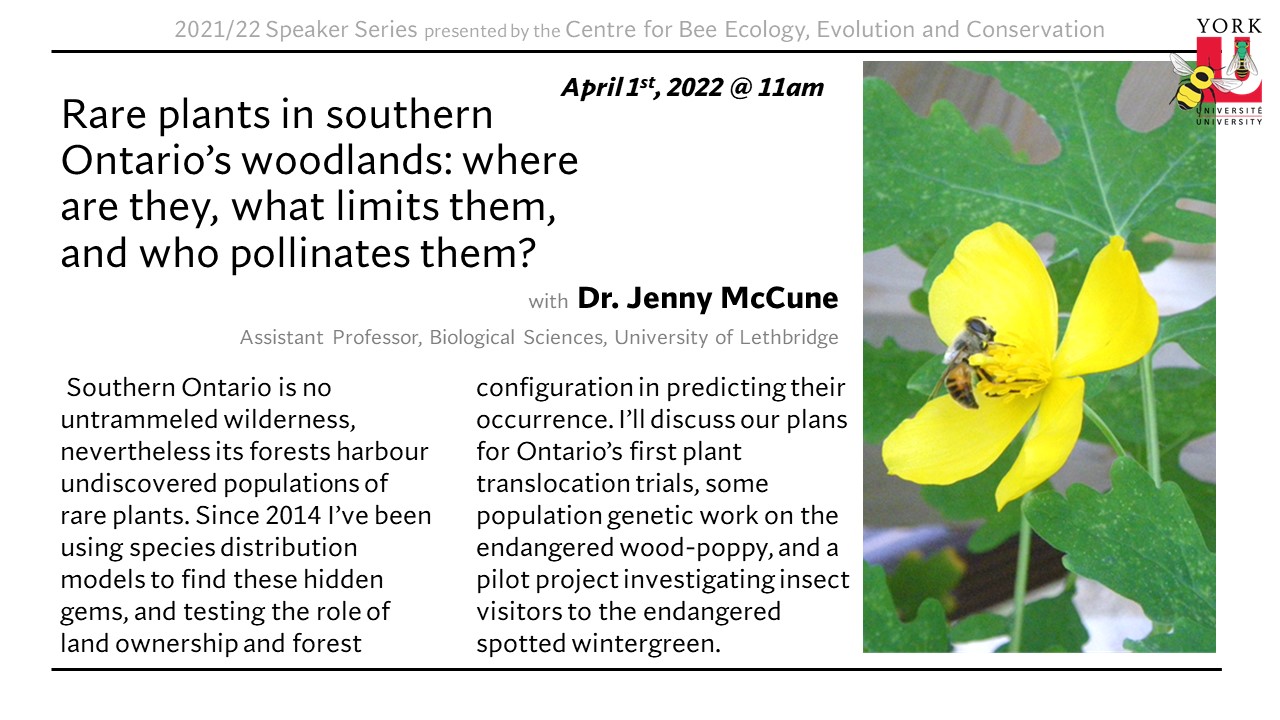
April 1, 2022: Rare Plants in Southern Ontario's Woodlands: Where Are They, What Limits Them and Who Pollinates Them?
with Dr. Jenny McCune, Assistant Professor, University of Lethbridge - view the poster
March 4, 2022: The Role of Heterogeneity in supporting Wild Bee Biodiversity in Canadian Agroecosystems
with Dr. Jess Vickruck, Research Scientist, Agriculture and Agri-Food Canada - view the poster
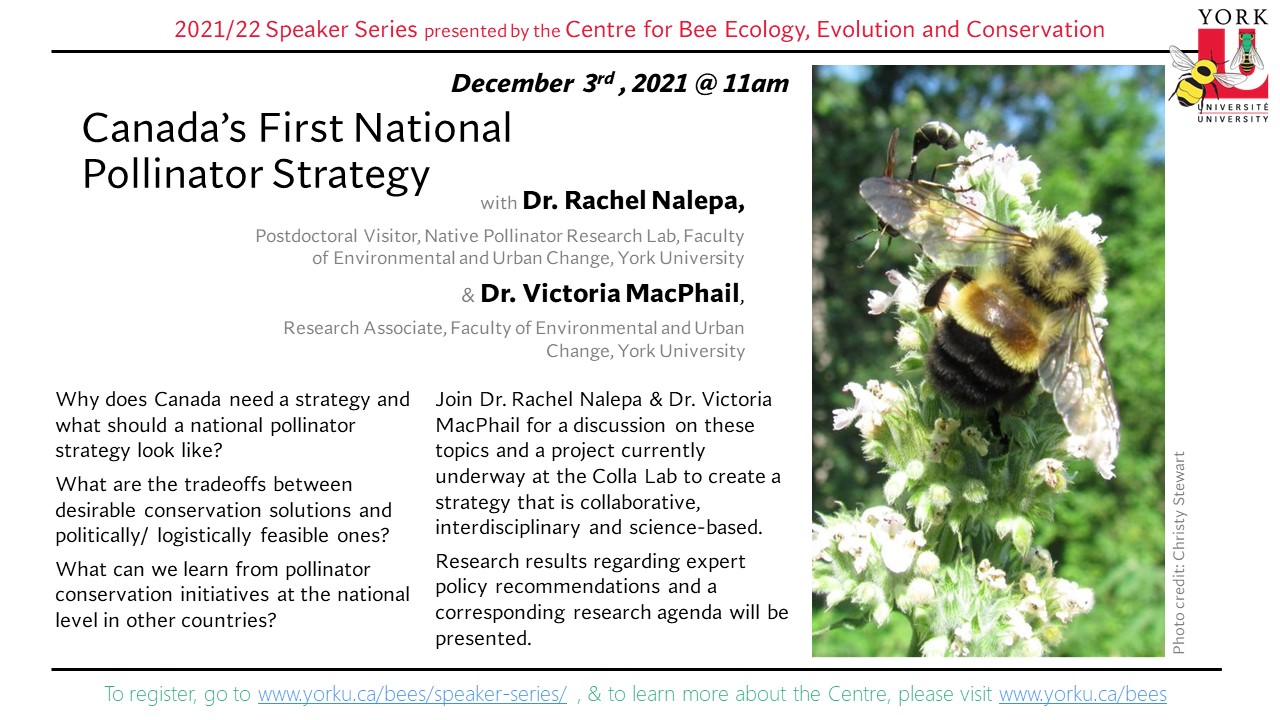
Dec 3, 2021: Recommendations for Canada's First National Pollinator Strategy
with Dr. Rachel Napela, York University - view the poster
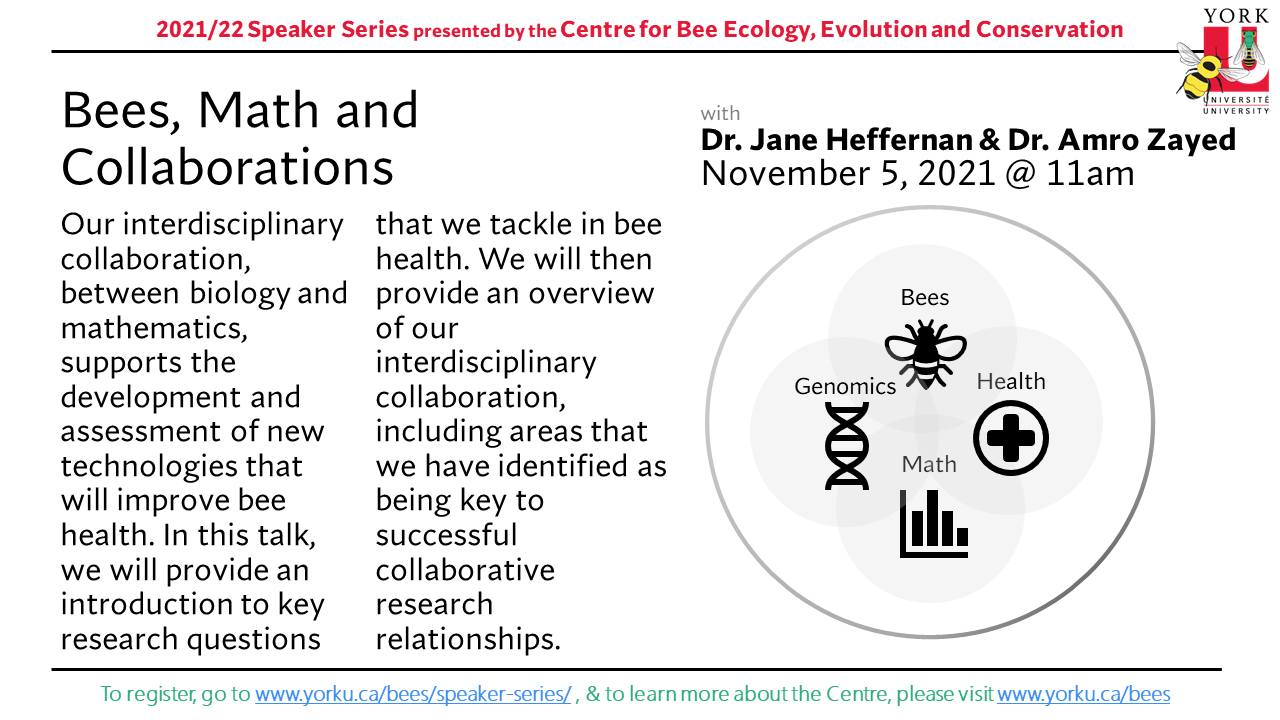
Nov 5, 2021: Bees, Math, & Collaborations
with Drs. Jane Heffernan and Amro Zayed, York University - view the poster
Oct 1, 2021: Early Insecticide Controversies and Beekeeper Advocacy in the Great Lakes Region
with Dr. Jennifer Bonnell, York University - view the poster
Summer 2021 - Beyond the Buzz: Examining Bees Through an Interdisciplinary Lens
Bees, People, Science & Others
- July 9, 2021 with Kathleen Law, Pollinator Partnership Canada, and Dr. Clement Kent, York University - view the poster
Bees, Land & Food Justice
- June 4, 2021 with Dr. Sheila Colla, York University, Adrianne Lickers Xavier, McMaster University, Dr. Sarah Rotz, York University - view the poster
2020-2021 Speaker Series Events

With Dr. Nadia Tsvetkov, Post-doctoral Fellow, University of British Columbia

Featuring Spencer K. Monckton, a PhD candidate from the Packer lab, York University
With Victoria MacPhail, a PhD candidate from the Native Pollinator Research Lab, York University