
Skip to main content Skip to local navigation
Home » Distinguished Fellowship in Learning and Teaching Excellence

Distinguished Fellowship in Learning and Teaching Excellence

The Faculty of Health’s strategic plan and priorities for teaching excellence and innovative pedagogies are reflected in the Distinguished Fellowship in Learning and Teaching Excellence (FLTE) program.

The goals of this initiative are to provide an environment for cultivating innovation and excellence in teaching and learning in health-related disciplines; further the application of innovative pedagogies in teaching practice; and recognize exceptional educators.

FLTEs bring expertise and contribute to the Faculty of Health’s teaching and learning community. They act as ambassadors for teaching excellence and scholarship, helping to strengthen the Faculty’s ability to deliver high-quality learning experiences that meet the needs of today’s learners.

Guided by the Faculty’s priorities, FLTEs develop resources and identify new approaches that strengthen teaching excellence and the scholarship of teaching and learning. Areas of focus include experiential education, technology-enhanced learning and decolonization, equity, diversity and inclusion (DEDI). They work with faculty, staff and students to promote engaged teaching.

The FLTE program began in 2023. Each year, one FLTE is selected for a term of up to three years and may be renewed in accordance with Faculty guidelines. Meet the current fellows and learn more about their projects below.

Dr. Sandra Peniston, Associate Professor, Teaching Stream, School of Nursing

Project: Global Citizenship: Experiential, Decolonial, and Transformative Teaching and Learning for a Healthy and Just World

This project advances global citizenship education across the Faculty of Health through experiential, interdisciplinary, and equity-focused teaching. Grounded in participatory and decolonial approaches, it supports educators in preparing graduates to address complex health, social, and environmental challenges with cultural humility, social accountability, and a commitment to a healthy and just world.

  • Develop a pan-Faculty global citizenship course and adaptable teaching modules for integration across programs.
  • Create an open-access toolkit with participatory, decolonial, experiential, and technology-enhanced teaching resources to support curriculum innovation.
  • Establish sustainable faculty development resources and communities of practice to strengthen interdisciplinary collaboration and globally networked learning.
  • Implement a digital badge or concentration recognizing student achievement in interdisciplinary, SDG-aligned global citizenship learning.
  • Produce scholarly publications, conference presentations, and knowledge mobilization resources that advance global citizenship, health equity, and socially accountable education.

The phases of the project are:

  • Phase 1 (Year 1): Design and Co-Creation:
    •  Conduct a literature review, needs assessment, and curriculum mapping to identify opportunities for global citizenship education across the Faculty.
    • Establish School Champions and/or Community of Practice.
    • Co-design the pan-Faculty course, modular teaching resources, Health-focused SDG Teaching Toolkit, and Digital Global Citizenship Badge framework.
  • Phase 2 (Year 2): Pilot Implementation and Refinement:
    • Pilot curriculum resources and experiential learning activities across Schools.
    • Advance institutional approvals for the pan-Faculty course and Digital Badge.
    • Deliver faculty development workshops.
    • Refine resources through stakeholder feedback.
    • Conduct formative evaluation to inform iterative improvements.
  • Phase 3 (Year 3): Evaluation and Sustainability:
    • Evaluate educational outcomes and Faculty-wide impact.
    • Pilot the pan-Faculty course.
    • Finalize teaching resources and the SDG Toolkit.
    • Institutionalize the Digital Badge.
    • Disseminate scholarly outputs.
    • Implement a sustainability plan to support long-term curriculum integration and global citizenship education.
Photo of Prof Larkin Lamarche. Caption provided: Photo with “Big Lonely Doug” on the Traditional territories of the Pacheedaht, Cayuse, Umatilla, and Walla Walla. “Doug” is a symbol of on-going colonial violence, ecotourism tension, and the fight for preservation and a big reminder of the interconnectedness of all kin.
Larkin

Dr. Larkin Lamarche (they/them), Associate Professor, Teaching Stream, School of Kinesiology & Health Science

Project: Land as Pedagogies: Cultivating Capacity for Team Teaching with Land
The centrality and fundamental significance of Land in any de/uncolonization effort cannot be understated. This project will engage with aspiring/inspiring land-learners to design ways to increase sustainable energy devoted to Land-based pedagogies and cultivate sites of Land-based education.

  • Co-produce resources to support health-based instructors’ wonder and critical use of Land-based pedagogies in their courses
  • Expand experiential education opportunities for Faculty of Health students to include Land-based ‘placements’
  • Cultivate a Faculty of Health Earthwork community of practice
  • Foster awareness, appreciation, understanding, and innovation in relation to Land-based pedagogies in the Faculty of Health

Below are the interconnected activities of the project.

  • Conduct an environmental scan (university-wide) to identify current ways instructors teach with Land, and understand successes, hesitations, and challenges of Land-based pedagogies from student and instructor perspectives.
  • Informed by the environmental scan, a cluster of resources will be co-developed (with students and instructors):
    • A workshop series focused on Land as Pedagogies.
    • An open access Field Guide for health-based educators, containing Land-based learning pages spanning a breadth of health topics.
  • Launch Stumped, a collegial consultation process for any course instructor wanting to engage with Land-based pedagogies; as part of the consultation, a group of aspiring/inspiring land-learners will devote focused capacity-building energy to develop and pilot Land-based learning activities to be integrated into courses in the Faculty of Health (learning to be included in the Field Guide, mentioned above).
  • A storying of successes, hesitations, and challenges of our journey to cultivate sites of Land-based education will be capture throughout the project.
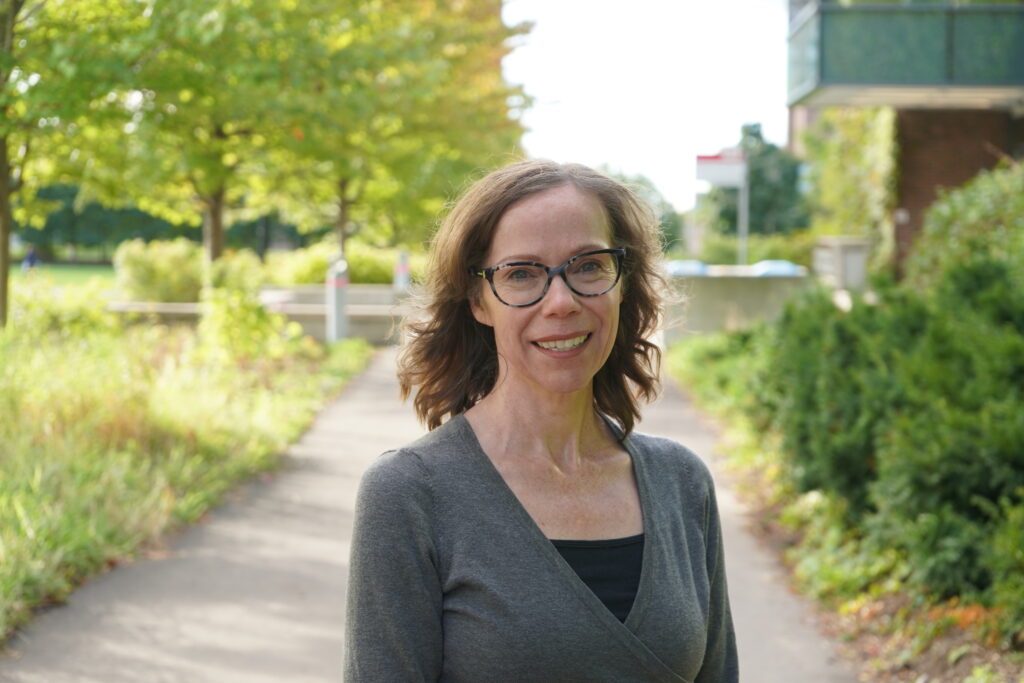
Photo of Professor Lynda van Dreumel

Dr. Lynda van Dreumel (she/her), Associate Professor, Teaching Stream, School of Health Policy & Management

Project: Building Student Capacity and Future Readiness Through ePortfolios in
the Faculty of Health

ePortfolios play an important role in higher education by providing students with a digital space to connect their learning experiences and achievements.  This project engages students and faculty members in the co-creation of a framework for the development and implementation of ePortfolios in courses and curricula within the Faculty of Health.

  • Provide students with guided curricular opportunities for deeper learning, self-reflection and professional identity formation, and a platform to showcase knowledge and skills as they pursue their next academic or career goal.
  • Co-creation of a Faculty of Health ePortfolio Framework and Implementation Roadmap for any/all courses or units to guide the inclusion of ePortfolios in their programs.
  • Development of a set of resources available for students and faculty to build skillsets and capacity for ePortfolio implementation.
  • Completion of a Proof of Concept project with at least one program adopting and implementing the use of ePortfolios into the curriculum.

Three phases of the project are:

  • Phase 1: A current state and needs analysis will be completed by engaging students, faculty members, university staff, and community partners to understand:
  • Phase 2: A Framework for ePortfolio Adoption and a Roadmap for ePortfolio Implementation will be completed and will address:
    • High impact practices related to ePortfolio adoption and implementation
    • Course and curricular considerations and decision-making criteria when implementing ePortfolios
    • Strategies for connecting ePortfolio activities to Course Learning Outcomes, Program Learning Outcomes, and Undergraduate Degree Level Expectations
    • Strategies for leveraging the results of ongoing ePortfolio implementation in Program Evaluation and Cyclical Program Reviews
    • Digital platform options available and considerations for selection
    • Implementation resources and strategies available as open- source digital learning objects
  • Phase 3: At least one program in the Faculty of Health will participate in a Proof of Concept for implementation of ePortfolios in a course, a series of courses, or across their curriculum. 

Results will be disseminated at York and in the broader SoTL community.


Photo of Professor Julie Conder

Dr. Julie Conder (she/her), Associate Professor, Teaching Stream, Department of Psychology

Project: Increasing Equity for First-Generation Students in the Faculty of Health (FirstGen: SkillsHub)

This teaching-learning project aims to meet the identified needs of first-generation students through the creation and evaluation of learning and assessment tools.

Project Outcomes:

  • Increase equity for first-generation and intersectionally marginalized students, by increasing access to resources and community building opportunities
  • Expand experiential education activities for FoH students through funded positions that produce eLearning module materials
  • Build and support use of technology-enhanced learning and innovative assessments for first-generation students
  • Decolonize aspects of curriculum via evidence-based alternate assessment strategies.