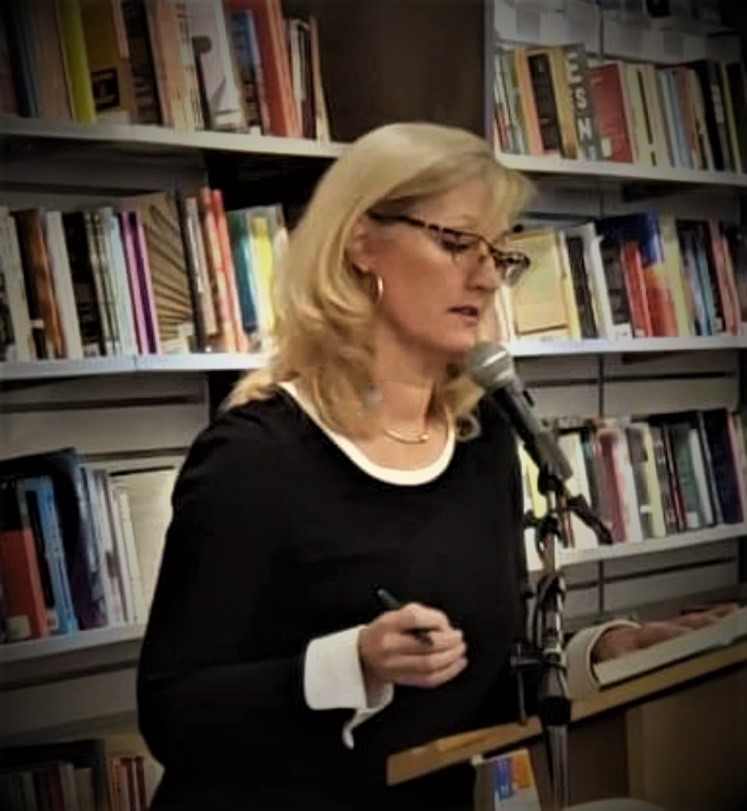

Joan Steigerwald is Associate Professor in the Science and Technology
Studies Program, Division of Humanities, and the Graduate Programs in
Humanities and Social and Political Thought. Her research focuses upon
the relationships between science, philosophy and aesthetics in the
Enlightenment and Romantic periods, particularly in the German lands.
She is currently exploring new approaches to the study of living
organisms that developed at the end of the eighteenth century through
new experimental practices, instruments of judgment and forms of
figurative representation. More generally, her research interests lie in
the cultural contexts of science, the history of the life sciences and
of environmental thought, figural representations of nature, and the
epistemology of experiment and technology.
She teaches the undergraduate courses Science and Humanities and Nature in Narrative, and the graduate courses Ends of Enlightenment, Essays on the Philosophy of Freedom, and Representing Nature.
She is a member of the Canadian Society for the History and Philosophy of Science, the American History of Science Society, the International Society for the History, Philosophy and Social Studies of Biology, and the North American Society for Studies in Romanticism.
REPRESENTATIVE PUBLICATIONS:
2007
"Figuring Nature: Ritter's Galvanic Inscriptions", European Romantic
Review, 18: 2, 255-63.
2006 Guest Editor. "Kantian Teleology and the Biological Sciences", Special Issue of Studies in History and Philosophy of Biological and Biomedical Sciences. 37: 4.
2006
"Kant's Concept of Purpose and the Reflecting Power of Judgment", Studies in History and Philosophy of Biological and Biomedical Sciences. 37: 4, 712-34. 2006
"Figuring Nature, Figuring the (Fe)male: The Frontispiece to Humboldt's Ideas Towards a Geography of Plants, in Figuring it Out: Science, Gender, and Visual Culture, ed. by Anne B. Shteir and Bernard Lightman. London: University Press of New England, 54-82.
2005
“The History of Romanticism, Religion and Nature”, in Encyclopedia of Religion and Nature, ed. by Bron Tyler and Jeffrey Kaplan. London: Continuum International, II: 1419-22.
2003
"The Dynamics of Reason and its Elusive Object in Kant, Fichte and Schelling", Memorial Edition of Studies in the History and Philosophy of Science in honor of founding editor Gerd Buchdahl, 34:1, 111-34.
2002
"Epistemologies of Rupture: The Problem of Nature in Schelling's Philosophy", Studies in Romanticism, 41:4, 545-84.
2002
"Goethe's Morphology: Urphänomene and Aesthetic Appraisal", Journal of the History of Biology, 35: 291-328.
2002
"Instruments of Judgment: Inscribing Organic Processes in Late Eighteenth-Century Germany", Studies in History and Philosophy of Biological and Biomedical Sciences, 33: 79-131.
2000
"The Cultural Enframing of Nature: Environmental Histories in the German Romantic Period", Environment and History, 6: 451-96.
WORK IN PROGRESS:
Epistemologies of Rupture: The Problem of the Organism in German Idealism, Romanticism and Science ((SSHRC Grant).
This book project is highly interdisciplinary, drawing upon scholarship in German idealism, the history of science, and Romantic aesthetic theory in an examination of philosophies of nature at the turn of the 19th century. In the years around 1800 in interest in nature was not solely the province of science. For Kant and Schelling the development of detailed natural philosophies was central to their philosophical projects. The extraordinary sophistication and import of German philosophy at this time meant that its influence was felt in almost all areas of inquiry. Scientists as well as early Romantic critics and writers were familiar with the works of Kant, Fichte and Schelling, often studying them in detail. Scientists also formed close personal and working relationships with Romantic theorists, and these theorists in turn closely followed scientific studies. Thus at the turn of the 19th century, especially in and around Jena, an interest in nature was pursued by a variety of individuals drawing simultaneously upon philosophy, science and aesthetics. The appearance of new journals experimenting with disciplinary boundaries and of new learned societies and nexuses of scholars fed this cross fertilization of ideas and approaches. The interdisciplinary character of the philosophies of nature developed in this period demands an interdisciplinary approach to the study of its works.
Although interdisciplinary, combining scholarship in philosophy, history of science and Romanticism, the project remains based in the discipline of history and philosophy of science. It reassesses the meaning and significance of German natural philosophy during the Romantic period, especially those aspects concerned with living organisms. The book will argue that natural philosophy at this time offered important insights not only into the relationships between the study of living and nonliving systems and of self-organizing systems, but also into both experimental and philosophical reasoning and the limits of human knowledge. These conclusions are important not only for our historical understandings of the period and of how present conceptions of nature were shaped by past conceptions. German natural philosophy around 1800 also offers important insights into the purposiveness of organisms, and raises fundamental questions about the nature and limits of knowledge of the natural world that are similar to the reassessments of science currently taking place within philosophy and the history of science.
Back |