
Overview
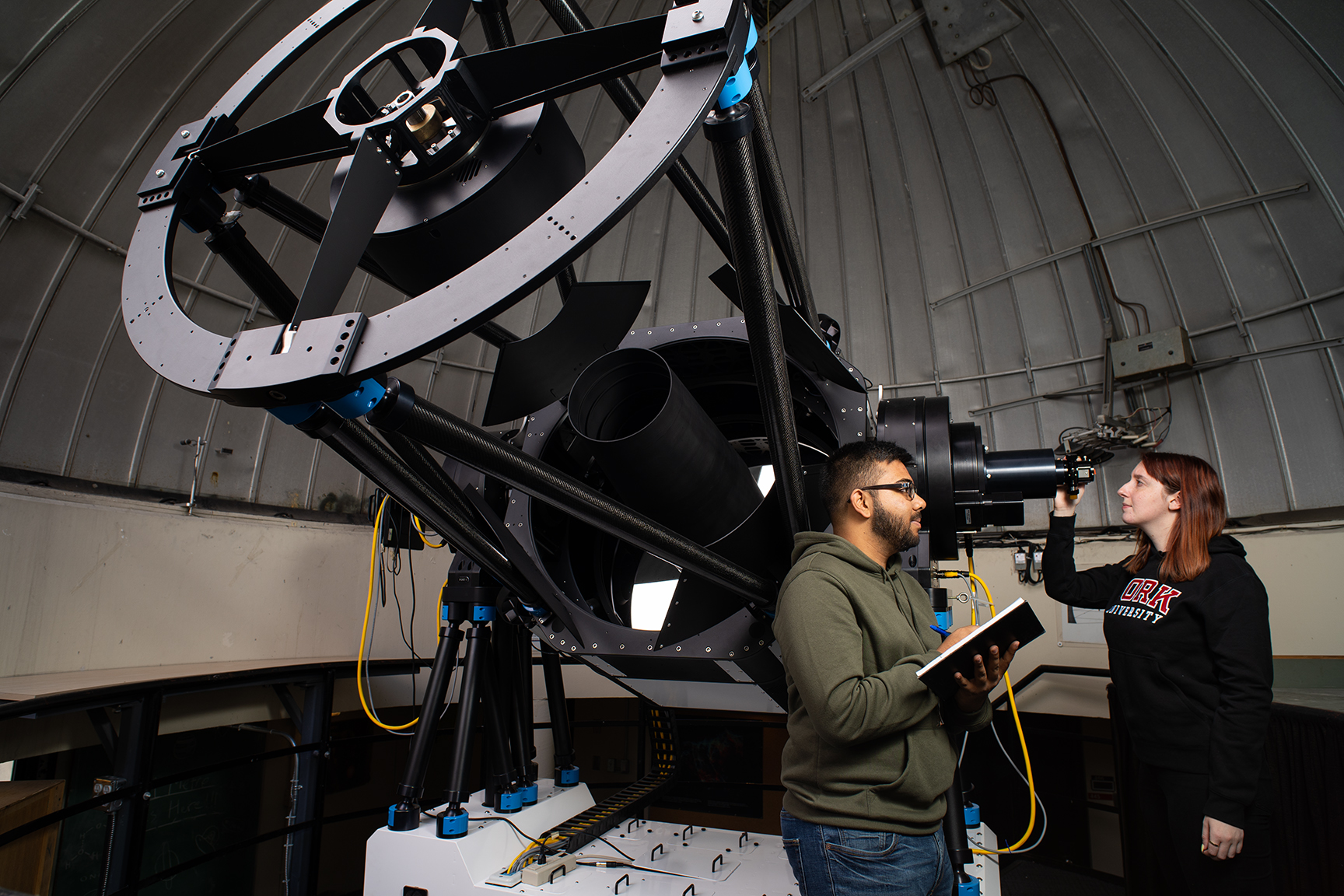
At York, a broad mix of experimental and theoretical physics and astronomy is taught in a research-intensive environment. You will have the option of pursuing studies in three different streams distinguished by course requirements: Physics, Applied Physics, and Astronomy and Astrophysics. Regardless of the stream, you will gain a thorough understanding of fundamental concepts in physics, such as classical mechanics, relativity, modern optics, electromagnetism, quantum mechanics and statistical mechanics.
In the Physics stream, you have the most flexibility in choosing the direction of studies in third and fourth year. In the Applied Physics stream, you get additional training specified in more technological areas, such as electronics. In the Astronomy and Astrophysics stream, you will add courses in subjects ranging from planets to the universe as a whole, all of which include training in astrophysics.
All streams develop practical skills in mathematics and computing by promoting applications to problems in physics or astronomy. You will learn to think critically and to analyze and solve complex problems, talents which are in high demand in both the private and public sectors. You may also have the chance to participate in research projects led by our professors, join our EXPLORE course, or apply for the Natural Science and Engineering Research Council of Canada's (NSERC) summer program.
Example First-Year Courses
Below are some courses you may take in your first year. Please note that this is only an example, your actual course schedule may be different.
- Physics I
- Physics II
- Chemical Structure
- Chemical Dynamics
- Applied Calculus I
- Applied Calculus II
- Applied Linear Algebra
- Introduction to Computing for the Physical Sciences
- Environment, Technology and Sustainable Society I (or other approved Non-Science courses)
Careers
A degree from the Faculty of Science opens the door to many different pathways and opportunities. York Science offers an ideal learning environment to achieve your highest potential. Our programs are known for academic excellence, with professors who are committed to your success.
The Co-op and Career Centre at York offers support services to students looking to engage in experiential learning and career preparation, including co-op and internship workshops, resume help, interview prep, and much more.
Career Paths
Astronomy Majors:
- Research or research support at government laboratories, National Research Council Observatories
- Applied Computing
- Mathematical and Computer Modelling
- Digital Imaging (e.g., in remote sensing, oceanography, geophysics, biophysics, medicine)
- Virtual Reality and Data Visualization
- Medical Physics – hospitals, biotechnology industries
- Finance or Consulting (applied statistical analysis)
- Postgraduate Studies/Academic Career
- Education – elementary, high school, college, university
Physics Majors:
- Research or research support at government laboratories
- Industrial Physicist – telecommunications (fibre optics), biotech industries, opto-electronics (lasers), aerospace
- Mathematical and Computer Modelling
- Virtual Reality and Data Visualization
- Advanced Engineering fields (e.g., biomedical, aerospace, nanotechnology)
- Medical Physics – hospitals, biotechnology industries
- Finance or Consulting (applied statistical analysis)
- Postgraduate Studies/Academic Career
- Education – elementary, high school, college, university