
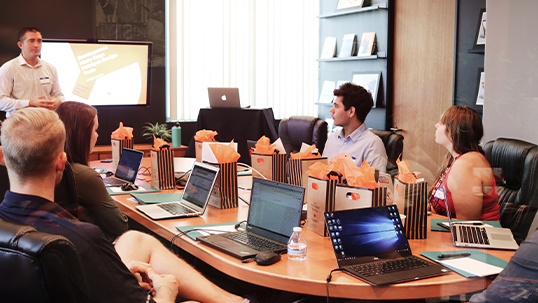
These opportunities allow students to apply theory to real-world situations and connect course material with experiences that occur through interactions with community and industry partners. Typically integrated into the classroom experience, students work together in groups to complete a project, scenario, situation, or problem presented by an industry partner.
Community and/or industry partners are often invited into the classroom to present pre-defined problems, questions, or issues to be explored and analyzed by students.
Reflection remains a key element in courses with community based projects. Students will be asked to link the project experience with their understanding of theory from the course and reflect on their learning.
Benefits

Interact and network with community and/or industry partners

Work on industry specific projects, problems, or scenarios

Grow understanding of theory and practical knowledge

Apply course-based theory to real world experiences

Practice reflection strategies to strengthen the learning process

Build collaborative and problem-solving skills by working with diverse perspectives
Community Based Projects Search
Applied Marketing Management
ADMS 3220 3.00
Students analyze marketing problems and develop solutions to real-world situations. Course components include: situation analysis, segmentation, targeting, positioning, marketing strategies, evaluation and control.

Applied Public Policy Analysis
PPAS 4200 6.00
An applied analysis of specific areas of public policy chosen to reflect current public debates. Students apply their knowledge of policy analysis in the context of case studies and/or real world projects with community partners.


Foreign Language and Digital Media: Developing Skills for Online, Spanish-English Publications
SP 4990 3.00
In this capstone course, students engage in high-impact Community Focused Experiential Education. Activities focus on writing, researching, editing and publishing works for an online university undergraduate magazine.

International Refugee Protection Regime II
PPAS 4112 3.00
The current state of the international refugee protection regime will be examined to reveal the underlying forces and dynamics at the root of the critical problems and the probable solutions facing those seeking international protection. The second course in the series analyzes specific international asylum and refugee issues from an interdisciplinary perspective. Students will conduct independent research on international asylum and refugee issues and will have an Experiential Education opportunity with an organization working with refugees.

Marketing Live Client Learning
ADMS 4211 3.00
Work on real-life projects with companies and non-for-profit organizations, and participate in national case competitions through the Marketing Live Client Learning course.

Organizational Writing Practicum
PRWR 4003 6.00
This practicum offers students the opportunity to experience the expectations of the business world by applying the principles of effective organizational communication to create their own branded identity as a Professional Writing Consultancy that develops relationships with clients in the York University Community. Working in dedicated project teams, students perform client needs assessments, develop proposals, create project plans, produce, edit and publish materials, and manage deliverables in both print and digital media.

Program Evaluation I
PPAS 4310 3.00
Provides students with the fundamental methodological tools necessary to evaluate the effectiveness of government and NGO programs. Students will learn to develop research designs for formative evaluations, summative evaluations and needs studies. Students will have an opportunity to put research designs into practice for program evaluations in partnership with public and not-for-profit sector organizations. Both courses must be taken in the same year.

Program Evaluation II
PPAS 4320 3.00
Provides students with the fundamental methodological tools necessary to evaluate the effectiveness of government and NGO programs. Students will learn to develop research designs for formative evaluations, summative evaluations and needs studies. Students will have an opportunity to put research designs into practice for program evaluations in partnership with public and not-for-profit sector organizations. Both courses must be taken in the same year.


Research Seminar in Economics
ECON 4089 3.00
This course assists students in developing strong analytical, quantitative, and communication skills through independent research and by working in collaboration with a partner organization. It familiarizes students with some of the major issues and research approaches in economics through discussions and presentations of various topics.

Interested in adding your course to our database?
Please email eelaps@yorku.ca with your course code and description.